Category: Uncategorized

  • The Accountability Gap Between Job Posts and Filled Trucks

    The Accountability Gap Between Job Posts and Filled Trucks

    Your fleet posted 12 job openings last month. Applications came in. Some drivers got interviewed. A few made it to the offer stage. Three trucks are still empty.

    Who’s responsible?

    The recruiter says the applications weren’t qualified. The hiring manager says the recruiter took too long to respond. Operations says HR lost the paperwork. HR says the driver never uploaded their documents. Everyone has a reason. Nobody has an answer.

    This isn’t a people problem. It’s a systems problem. According to American Trucking Associations data, fleets with disconnected recruiting systems lose 30 to 40% of qualified driver applicants between initial contact and hire. Not because the drivers weren’t interested, but because someone, somewhere in the workflow, lost track.

    When recruiting workflows get scattered across job boards, email threads, spreadsheets, CRM tools, and compliance folders, accountability evaporates. Not because anyone is dropping the ball intentionally, but because there’s no single place where the ball actually lives.

    Fleets running disconnected recruiting systems can’t answer basic questions like “which recruiter owns this candidate?” or “why did this driver application stall?” The data exists somewhere across five different logins, but piecing it together takes longer than just moving on to the next applicant.

    And that’s exactly what happens. Drivers fall through the cracks while everyone blames the tools.

    The Illusion of Ownership

    Most fleet recruiting operations look organized on paper. Someone owns job postings. Someone else manages the pipeline. A third person handles compliance checks. Interviews get scheduled by whoever has time. Documents get requested via email and tracked in a shared drive.

    It feels like a system. It’s actually just task distribution without outcome ownership.

    Here’s what the typical fleet recruiting tech stack looks like:

    Tool TypeCommon PlatformWhat It TracksWhat Falls Through
    Job BoardIndeed, Gary’s Job BoardApplications receivedDriver follow-up timing
    CRM/ATSGeneric business CRMContact informationCDL-specific requirements
    SpreadsheetExcel, Google SheetsPipeline stagesReal-time status updates
    Email/SMSIndividual accountsDirect communicationUnified conversation history
    ComplianceDropbox, Google DriveDocument storageExpiry tracking, alerts
    AnalyticsManual reportsWeekly summariesLive performance data

    Each tool does one thing. None of them talk to each other. The gaps between them are where drivers disappear.

    The problem shows up when drivers disappear between stages. A candidate applies on Monday. By Friday, nobody followed up because the application landed in a shared inbox and everyone assumed someone else would handle it. The driver accepts an offer from a competitor who responded in 24 hours.

    Industry research on speed-to-lead shows that contact within 5 minutes increases conversion by 900% compared to waiting 30 minutes. When tool sprawl adds even one day of delay, fleets lose the majority of their best candidates before the first conversation happens.

    Tool sprawl makes it impossible to assign accountability because the workflow itself is invisible. Recruiters can’t see what happened before a candidate landed in their queue. Hiring managers can’t track why an interview took eight days to schedule. Operations can’t tell whether a compliance delay is a document issue or a follow-up issue.

    When the process lives in six different places, failure has six different owners. Which means it has none.

    Where Accountability Actually Breaks

    The breakdown happens in three predictable places, each responsible for a measurable percentage of lost candidates.

    Breakdown Point% of Drivers LostAverage DelayPrimary Cause
    System Handoffs35-40%3-7 daysManual data transfer between tools
    Document Collection25-30%5-12 daysEmail-based requests, no tracking
    Status Updates15-20%2-4 daysNo single source of truth
    Interview Scheduling10-15%3-5 daysCalendar conflicts, multiple contacts

    Handoffs between systems are where most drivers vanish. A candidate moves from the job board into the CRM. The CRM flags them for document collection. Documents get requested via email. The driver uploads files to a Dropbox link. Someone has to manually check the folder, verify the documents, and update the CRM. Each transition is a chance for something to stall without anyone noticing.

    No single source of truth means recruiters and hiring managers are working from different data. The spreadsheet says 14 active candidates. The CRM shows 9. The shared inbox has 23 unread driver emails. Nobody knows which number is real, so nobody can be held accountable for pipeline velocity.

    Metrics that measure activity instead of outcomes make everything look fine until trucks sit empty. Job postings went out on time. Applications came in. Interviews happened. Documents were requested. Every task got checked off. The fleet still missed its hiring target by 40%. When systems track tasks but not results, accountability becomes performative.

    One fleet director described it this way after reviewing three months of hiring data: “We had activity everywhere and progress nowhere. I could see people working. I couldn’t see anyone driving outcomes.”

    The Accountability Tax
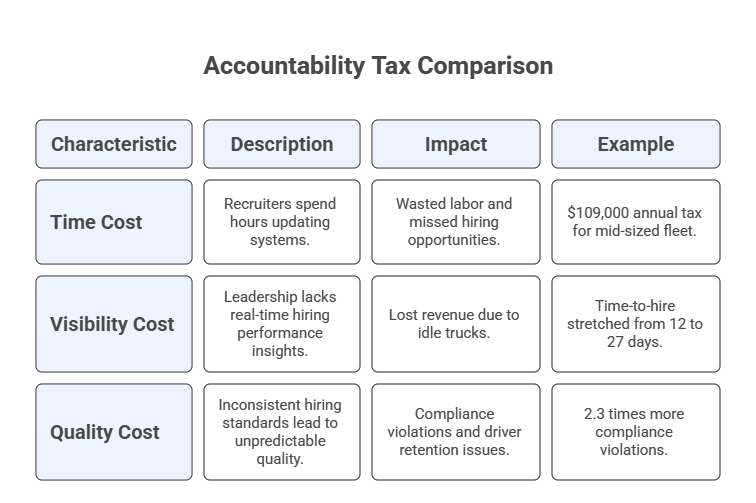
    Disconnected systems don’t just hide responsibility. They create an accountability tax that fleets pay in three measurable ways.

    Time cost: Recruiters spend 6 to 8 hours weekly just updating systems, chasing status updates, and reconciling conflicting data across tools. That’s 312 to 416 hours annually per recruiter. At an average recruiter salary of $55,000, that’s $8,580 to $11,440 in wasted labor per recruiter per year.

    Here’s what the math looks like for different fleet sizes:

    Fleet SizeRecruitersAnnual Time WasteLabor Cost LostOpportunity Cost (Hires Missed)
    25-50 trucks1312-416 hours$8,580-$11,4404-6 drivers
    51-150 trucks2-3624-1,248 hours$17,160-$34,32010-15 drivers
    150-500 trucks4-61,248-2,496 hours$34,320-$68,64020-30 drivers

    Visibility cost: Leadership can’t see hiring performance in real time. By the time someone pulls a report showing that time-to-hire stretched from 12 days to 27 days, the quarter is over and the damage is done. Each day a truck sits idle costs fleets $800 to $1,200 in lost revenue. When time-to-hire doubles, the revenue impact compounds fast.

    Quality cost: When accountability is blurry, hiring standards get inconsistent. One recruiter shortcuts compliance checks to hit speed targets. Another overscreens candidates and creates bottlenecks. A third focuses entirely on volume metrics. The fleet ends up with unpredictable hiring quality because nobody is measuring the outcome that actually matters—drivers who stay.

    According to FMCSA compliance data, fleets using manual document tracking systems have 2.3 times more compliance violations during audits compared to fleets with automated tracking. Each DOT violation can cost $1,000 to $16,000 in fines, plus the operational impact of pulling drivers off the road while issues get resolved.

    Driver retention drops 40 to 50% when compliance documentation delays onboarding by more than two weeks. The driver finds another fleet that can get them working faster.

    A 120-truck fleet calculated they spent $47,000 annually just on the labor cost of recruiter time lost to tool-switching and status updates. That’s before counting:

    • $18,000 in duplicate job board subscriptions
    • $32,000 in lost revenue from trucks idle an extra 8 days per hire
    • $12,000 in compliance software that doesn’t integrate with their recruiting tools

    Total accountability tax: $109,000 per year for a mid-sized fleet.

    The Single Dashboard Problem

    Most fleets try to solve accountability by adding another layer: a weekly hiring report. Someone manually pulls data from all the systems, drops it into a spreadsheet, and emails it to leadership.

    This creates two new problems.

    First, it’s backward-looking. By the time the report shows that five drivers stalled in document collection, those drivers have already moved on to other jobs. Accountability based on weekly reports is accountability without the ability to act.

    Second, it still doesn’t answer the most basic question: who owns this specific outcome?

    The report shows metrics. It doesn’t show responsibility. When hiring misses the target, leadership sees that applications dropped or time-to-hire increased. They don’t see which specific handoff failed, which recruiter owns the stalled candidates, or where process changes would actually move the number.

    Accountability needs visibility in real time, not in retrospect.

    How It Can Be Changed

    Accountability only works when ownership is built into the system, not layered on top of it.

    Uptime’s CDL Recruiting Department-in-a-Box solves this by making responsibility visible at every stage. The platform operates as a single system where every candidate interaction, document, and status change lives in one place. Recruiters, hiring managers, and leadership all see the same live data. There’s no reconciliation because there’s nothing to reconcile.

    Ownership is assigned, not assumed. Each driver in the pipeline has a clear owner. Each stage has SLA tracking that shows exactly how long candidates spend in screening, compliance, or interview scheduling. When something stalls, the system surfaces it immediately with the name of the person responsible for moving it forward.

    The analytics dashboard doesn’t just show hiring speed. It shows recruiter velocity, handoff delays, and outcome attribution. Leadership can see which recruiter closed which hire, how long each stage took, and where bottlenecks are forming before they compound.

    Measurable Results from Fleets Using Uptime:

    MetricBefore UptimeAfter 90 DaysImprovement
    Time-to-Hire18-27 days7-12 days60% faster
    Handoff Delays4-7 days avg1-2 days avg40% reduction
    Tool-Switching Time8 hrs/week per recruiter<1 hr/week87% reduction
    Candidate Drop-Off35-40%15-20%50% improvement
    Cost per Hire$2,200-$2,800$1,400-$1,80035% decrease
    Compliance Violations3-5 per audit0-1 per audit80% reduction

    Fleets using Uptime reduced handoff delays by 40% within the first month. Not because recruiters started working harder, but because they could finally see where drivers were getting stuck and who needed to act.

    The platform includes a dedicated Uptime recruiter operating inside the OS with measurable SLAs. Fleets don’t just get software. They get a recruiting department with clear accountability baked in—response time guarantees, weekly performance reports, and ROI tracking that shows exactly what the subscription delivers.

    Real Fleet Example: 80-Truck Regional Carrier

    Before Uptime:

    • 5 different tools (Indeed, generic CRM, Excel, Gmail, Dropbox)
    • 23-day average time-to-hire
    • 38% candidate drop-off between application and offer
    • 2 recruiters spending 15 hours/week on administrative tasks
    • 7 compliance violations in last DOT audit

    After 90 Days with Uptime:

    • 1 unified platform
    • 9-day average time-to-hire (61% improvement)
    • 18% candidate drop-off (53% improvement)
    • 2 hours/week on administrative tasks (87% reduction)
    • 0 compliance violations in subsequent audit
    • ROI: $67,000 saved in first year

    The fleet’s director of operations described the shift this way: “We went from ‘I think someone followed up’ to ‘I can see exactly who followed up, when, and what happened next.’ That clarity alone cut our time-to-hire in half. More importantly, we stopped losing drivers to our own chaos.”

    Accountability as a Feature

    When recruiting runs on disconnected tools, accountability becomes an exercise in blame assignment after the fact. When it runs on a unified system, accountability becomes automatic.

    What Accountability Actually Looks Like:

    What Most Fleets TrackWhat Actually Drives Accountability
    Jobs postedTime from post to first qualified applicant
    Applications receivedConversion rate by source and recruiter
    Interviews scheduledDays from application to interview
    Offers sentOffer acceptance rate by recruiter
    Documents requestedDocument completion time and alerts
    Weekly hiring totalsDaily pipeline velocity by stage

    The difference between “who dropped this?” and “the system shows exactly what happened” is the difference between reactive firefighting and proactive hiring management.

    Fleets that figure this out stop losing drivers to tool sprawl. They start losing competitors to speed and consistency.


    Calculate Your Accountability Tax

    Most recruiting managers don’t realize how much they’re paying for disconnected systems until they see the numbers.

    Here’s how to calculate your annual accountability tax:

    1. Recruiter Time Waste: Hours per week spent updating multiple systems × 52 weeks × hourly rate
      • Example: 8 hrs/week × 52 weeks × $26.44/hr = $10,982 per recruiter
    2. Tool Redundancy: Total spent on job boards + CRM + compliance software + communication tools
      • Typical range: $15,000-$35,000 annually for mid-sized fleets
    3. Idle Truck Cost: Average days to hire × number of hires × daily truck revenue loss
      • Example: 20 days × 30 hires × $900/day = $540,000 in delayed revenue
    4. Compliance Risk: Previous audit violations × average fine amount
      • Example: 4 violations × $3,500 avg = $14,000

    Total Accountability Tax = Time Waste + Tool Costs + Idle Revenue + Compliance Risk

    For a 100-truck fleet making 30 hires per year: $180,000 to $240,000 annually

    That’s 2 to 3 times what a unified recruiting system costs.


    See Where Your Accountability Is Breaking

    Most recruiting managers don’t realize how much visibility they’ve lost until they see their workflow mapped in real time.

    Common Questions About Recruiting Accountability:

    How do you measure recruiter accountability in fleet hiring? Track specific metrics by recruiter: response time to applications (should be under 24 hours), candidate progression rate through each pipeline stage, time from first contact to interview (target: 3-5 days), offer acceptance rate, and ultimately hires per month. Unified systems make these metrics visible in real time instead of through weekly reports.

    What causes most driver candidates to drop out of the hiring process? System handoffs account for 35 to 40% of candidate loss, followed by document collection delays (25-30%), unclear status updates (15-20%), and interview scheduling conflicts (10-15%). The common thread: lack of visibility into where candidates are stuck and who owns the next action.

    How long should CDL driver hiring take from application to start date? Industry benchmark is 12 to 18 days for compliant hiring, including MVR checks, drug screening, and document verification. Fleets using unified systems average 7 to 12 days. Anything over 20 days indicates process breakdowns that are costing you qualified candidates.

    What’s the ROI of switching from multiple recruiting tools to one platform? Fleets typically see 35 to 60% reduction in time-to-hire, 40 to 50% decrease in candidate drop-off, and 30 to 40% lower cost per hire. The average mid-sized fleet saves $67,000 to $109,000 annually through reduced tool costs, faster hiring, and fewer compliance violations.

    Uptime’s free platform audit shows exactly where drivers are stalling in your current system, which handoffs are causing delays, and how much recruiter time you’re losing to tool-switching.

    [Book Your Free Audit →]

    Or start a 14-day free trial and see what hiring looks like when accountability is built into the platform instead of bolted on afterward.

    [Start 14-Day Free Trial →]

    Plans start at $499/month for fleets with 25-50 trucks. Every plan includes the OS, a dedicated recruiter, SLA tracking, and weekly performance reports. No commissions. No surprises.

  • How to Turn Driver Hiring Into a Measurable Profit Driver

    How to Turn Driver Hiring Into a Measurable Profit Driver

    Most fleet CFOs can tell you exactly what fuel costs per mile. They know maintenance budgets down to the dollar. They track utilization rates, deadhead miles, and revenue per truck with precision.

    But ask them what recruiting actually costs, and the answer gets fuzzy.

    “Somewhere between $50,000 and $150,000 a year?” They’re guessing. They know what they pay job boards and agencies. They know the recruiter’s salary. But they don’t know the cost per hire. They don’t know which sources actually deliver drivers who stay. They don’t know how many recruiter hours go into each placement or which parts of the process are bleeding time and money.

    Here’s the truth: Recruiting is one of the highest-leverage profit drivers in your entire operation. Done right, it compounds growth. Done wrong, it quietly drains hundreds of thousands of dollars per year.

    The Numbers Most Fleets Never See

    A 200-truck fleet turning over drivers at 90% annually needs roughly 180 hires per year just to maintain capacity. According to 2024 data from the American Transportation Research Institute (ATRI), the average cost per hire for trucking companies ranges from $1,200 to $3,500 depending on process efficiency.

    Here’s what that spread looks like:

    Efficiency LevelCost Per Hire180 Hires/YearAnnual Recruiting Cost
    Highly inefficient$3,500180$630,000
    Average$2,200180$396,000
    Highly efficient$1,200180$216,000

    That’s a $414,000 difference between the top and bottom quartile. Same number of hires. Wildly different outcomes.

    Now add the downstream impact. Each empty truck costs roughly $1,200 per day in lost revenue. If poor recruiting processes keep 5 trucks idle for an average of 30 extra days per year, that’s another $180,000 in lost revenue.

    Research from Stay Metrics and the National Transportation Institute shows fleets that hire fast but don’t match well see 90-day turnover rates above 40%. The average cost of driver turnover, including recruitment, training, and lost productivity, exceeds $8,000 per driver according to ATRI’s 2024 operational cost analysis.

    Recruiting isn’t overhead. It’s the difference between a profitable growth year and a breakeven survival year.

    Why Most Fleets Can’t Measure Recruiting ROI

    Walk into most fleet offices and ask to see recruiting metrics. You’ll get bits and pieces: job board invoices, agency fees, recruiter payroll, maybe an application count. What you won’t get is answers to the questions that actually matter.

    How much does each hire actually cost? Most fleets track direct costs but miss the indirect ones. A 2023 study of mid-sized fleets (100-500 trucks) found that hidden recruiting costs typically add 35-50% to visible spending. These include recruiter administrative time, compliance processing for driver qualification files and MVR checks, interview coordination, and onboarding logistics.

    Which recruiting sources deliver drivers who stay? Fleets pay Indeed, trucking job boards, and agencies, but they can’t trace which source produced the driver who just hit their 1-year anniversary versus the one who quit after 60 days. Driver recruiting software that tracks source quality shows retention rates can vary by 40-60 percentage points depending on the channel.

    How long does it take to fill a seat? Time to hire is one of the most powerful recruiting metrics, but most fleets don’t measure the stages in between. Speed to lead research shows that contact rates drop by 80% after the first 24 hours. Every additional day in your recruiting funnel increases the risk of losing candidates to competing offers.

    What’s your recruiter velocity? Industry benchmarks suggest top-performing recruiting operations achieve 8-12 hires per recruiter per month. Fleets operating below 4-6 hires per recruiter per month are typically drowning in manual administrative work rather than actual recruiting.

    The Hidden Killers of Recruiting Efficiency

    Three things destroy recruiting ROI:

    Manual, repetitive work that never compounds. Time-motion studies show that manual administrative tasks consume 50-70% of recruiter time in fleets without automated recruiting systems. That means a $50,000/year recruiter is delivering only $15,000-$25,000 in actual recruiting value.

    No pipeline visibility for leadership. Fleet owners and CFOs can’t see what’s in the recruiting funnel. Growth targets get set without understanding hiring velocity constraints. Expansion plans stall because recruiting can’t scale predictably.

    Poor candidate experience leading to drop-offs. Candidate experience research shows that 60% of driver applicants lose interest after 48 hours without contact. Every dropped candidate represents wasted acquisition cost.

    What Changes When You Measure Recruiting Like a Profit Center

    Fleets that track recruiting metrics make better decisions. When you know that Indeed driving jobs near me campaigns deliver drivers at $1,800 per hire but database re-engagement delivers them at $600 per hire, you shift budget accordingly. Data-driven recruiting operations reallocate 30-40% of their budget within the first year of implementing analytics.

    Leadership can forecast growth capacity. If your recruiting operation can reliably deliver 8 hires per month at $1,500 each, you can model fleet expansion with real numbers instead of guesses.

    Automated recruiting workflows for job posting, applicant screening, and follow-up messaging can free up 20-30 hours per recruiter per week. That’s time redirected to actual conversations with qualified candidates.

    How It Can Be Changed

    Uptime was built to give fleet leadership the recruiting visibility they’ve never had.

    At its core, Uptime is your CDL Recruiting Department-in-a-Box, combining the OS that automates recruiting workflows with an embedded team that runs the operation for you. Unlike traditional applicant tracking systems that just track applications, Uptime gives you a full ROI dashboard that quantifies every dollar spent and every hour saved.

    Real-time cost-per-hire tracking. Uptime automatically calculates your true cost per hire by aggregating direct costs (advertising, agency fees) and indirect costs (recruiter hours, compliance processing) to show exactly what each hire costs, broken down by source, role type, and time period.

    Source attribution and quality scoring. Every driver is tagged by source (Indeed, Gary’s job board, CDL job boards, referrals, database re-engagement). The platform calculates quality scores for each recruiting channel based on conversion rates, time-to-hire, cost-per-hire, and retention benchmarks.

    Recruiter productivity analytics. The platform shows how recruiting teams spend their time. Uptime’s AI Job Engine automates CDL-specific job post creation. The Compliance Command Center handles document verification with OCR technology for license expiry tracking and FMCSA integration. The Messaging Hub unifies SMS and email communication with automated follow-up templates.

    Time-to-hire visibility by stage. Uptime tracks every stage of your recruiting funnel and identifies where delays happen. Fleets using Uptime have reduced average time to hire from 45-60 days down to 15-20 days by eliminating process friction.

    Forecasting and capacity planning. The analytics dashboard provides predictive analytics on hiring capacity based on historical performance, seasonal trends, and current pipeline health.

    Here’s what the difference looks like for a 200-truck fleet over 12 months:

    MetricBefore UptimeAfter UptimeImpact
    Cost per hire$2,800$1,65041% reduction
    Time to hire52 days19 days63% faster
    Recruiter hours/hire12 hours4.5 hours62% efficiency gain
    90-day retention58%76%31% improvement
    Annual recruiting cost$504,000$297,000$207,000 saved

    Recruiting stops being a black box and becomes a measurable, optimizable profit driver.

    Run Your Numbers

    If you’re making 100+ hires per year and don’t have clean answers to these questions, you’re likely leaving $100,000+ on the table:

    • How many hires did you make last year?
    • What was your total recruiting spend?
    • What’s your average time to hire?
    • What’s your 90-day retention rate by recruiting source?

    The fleets that win in the next 5 years will be the ones that measure recruiting with the same rigor as fuel costs and maintenance schedules. The ones that keep treating recruiting as an unmeasured cost center will keep hemorrhaging money while wondering why growth is so hard.


    See Your Real Recruiting ROI

    Uptime gives you the CDL Recruiting OS and ROI Dashboard that fleet CFOs have been asking for. Track cost per hire, time to hire, source ROI, and recruiter productivity in one view.

    Your subscription includes:

    • Full ROI Analytics Dashboard with cost-per-hire tracking and source attribution
    • AI Recruiting OS that automates job posting, matching, and document management
    • Dedicated Uptime Recruiter who manages your pipeline with full transparency
    • Time-to-Hire Tracking by stage so you can eliminate bottlenecks
    • Weekly Performance Reports showing hires, costs, and efficiency gains

    Calculate your recruiting ROI with our free assessment tool, or start your 14-day free trial. No credit card required.

    [Book a 15-Min Demo]

  • Your Recruiters Are Burning Out and Your Seats Are Staying Empty

    Your Recruiters Are Burning Out and Your Seats Are Staying Empty

    Recruiting teams in trucking turn over at 60% annually. Each lost recruiter costs fleets 2-3 months of hiring momentum and $97,200+ in lost revenue from idle trucks. The fix isn’t hiring more recruiters—it’s removing the manual workload that causes burnout in the first place.

    Three trucks sit idle in your yard. Not because qualified drivers don’t exist. They sit there because your recruiter just quit, and the replacement won’t be trained for another six weeks.

    That’s $7,200 in lost revenue per week. Per truck.

    And it’s not a freak accident. According to industry data, recruiting teams in trucking turn over at 60% per year. Every 18 months, your entire recruiting operation resets.

    The Real Problem Nobody Talks About

    Fleets treat recruiter turnover like a staffing problem. Hire another recruiter. Train them faster. Push harder.

    But that’s not what’s happening here.

    The problem isn’t the people. It’s the system they’re trapped in.

    What a Typical Recruiting Day Actually Looks Like

    • Manually post the same job to 6 different boards
    • Sort through 40 unqualified applicants
    • Chase down CDL verification from 8 drivers who uploaded blurry photos
    • Follow up with 12 candidates who ghosted last week
    • Schedule 3 interviews, reschedule 2, no-show on 1
    • Update spreadsheets with compliance doc statuses
    • Respond to 20+ text messages asking “is this still available?”

    That’s not a job. That’s a treadmill set to 8 miles per hour with no stop button.

    Recruiter Burnout Is a Capacity Problem Disguised as a People Problem

    Here’s what most fleets miss: recruiting in trucking doesn’t scale like customer support. You can’t just hire more people and expect better outcomes if the operating room is chaos.

    And trucking recruiting is chaos.

    When someone burns out and leaves, the next recruiter inherits a disaster. Half-finished applications. Stale leads. No context on who was close to converting.

    The time to hire clock doesn’t pause during the handoff. It just gets longer.

    The Hidden Cost of One Recruiter Leaving

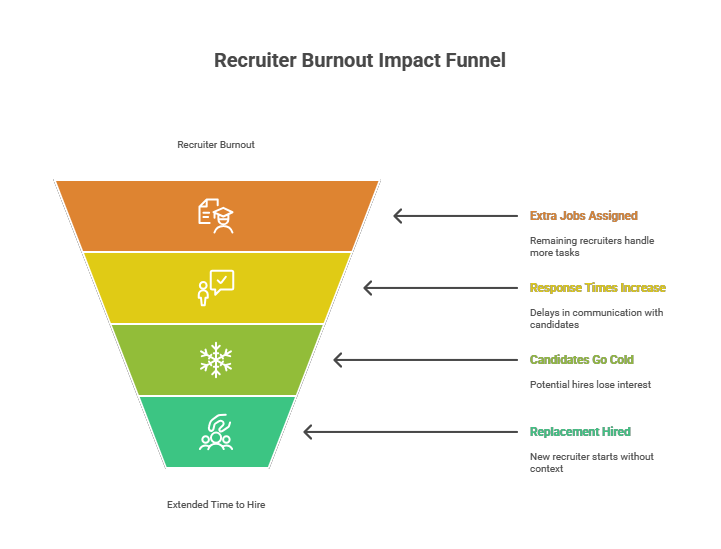
    Month 1: Other recruiters pick up extra jobs. Response times balloon from hours to days. Warm candidates go cold.

    Month 2: A replacement is hired. But they don’t know the fleet’s nuances yet. They’re rebuilding institutional knowledge from scratch.

    Month 3: The new recruiter finally hits stride. But the damage is done.

    Total impact: 2-3 months of lost momentum. Three trucks sitting empty for 90 days costs $97,200 in lost revenue.

    And this happens every single year for more than half of all trucking recruiting teams.

    Why Recruiting Feels Like Groundhog Day

    The root cause isn’t that people are incompetent. It’s that recruiting has been built on manual processes that don’t compound.

    Job posts reset every 30 days. Hours spent crafting descriptions, posting across boards, waiting. When the post expires, they do it again. No memory. No optimization.

    Lead follow-up happens in personal inboxes. When someone leaves, those conversations vanish. The next recruiter has no idea who was close to saying yes.

    Compliance tracking lives in spreadsheets. CDL expiration dates, MVR checks, drug test results—all manually entered. When the recruiter quits, the next person has to decode someone else’s system.

    There’s no feedback loop. Which job boards actually convert? Which drivers stay past 90 days? Nobody knows.

    This is why recruiting feels like starting over every single month. Because it is.

    What Burnout Actually Looks Like

    Burnout doesn’t announce itself. It creeps in.

    It starts with checking your phone at 9 PM to respond to a driver who’s “ready to commit.” Then it’s Saturday morning follow-ups. Then it’s the third time this week explaining the same compliance requirement.

    Burnout looks like spending 80% of your time on admin work and 20% on actual recruiting.

    It looks like knowing you need to call 15 leads today but dreading it because half will ask questions you’ve already answered twice via email.

    And when recruiters burn out, they don’t tell you. They just update their LinkedIn and leave.

    How It Can Be Changed

    The fix isn’t hiring better recruiters or offering bigger bonuses.

    It’s removing the manual workload that creates burnout in the first place.

    The System That Actually Works

    Fleets need recruiting to work like an operating system, not a revolving door of tasks. That means automation for repetitive work and accountability for high-value work.

    Recruiters should focus on relationships and decisions, not data entry and follow-ups.

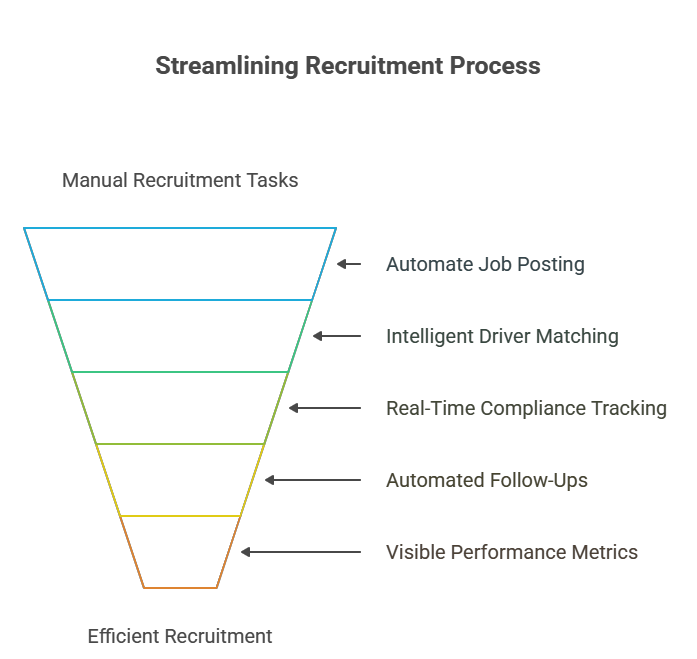
    Here’s what that looks like:

    Automated job posting. AI creates CDL-optimized descriptions in seconds and publishes across multiple boards. No more manual re-posting every 30 days.

    Intelligent driver matching. Systems rank candidates by route fit, experience, and predicted retention. Recruiters work the top 10% who actually match, not 40 unqualified applicants.

    Real-time compliance tracking. CDL expirations, MVR alerts, medical card renewals tracked automatically with OCR scanning and reminders. No spreadsheets. No manual entry.

    Automated follow-ups. SMS and email nudges happen based on where drivers are in the pipeline. Recruiters step in for conversations that matter.

    Visible performance metrics. Real-time dashboards show time to hire, cost per hire, and recruiter velocity. Managers spot bottlenecks before they become crises.

    The Results

    Fleets using this model report a 70% drop in recruiter churn. Not because they hired better people. Because they stopped asking people to do impossible jobs.

    Average time to hire drops to under 7 days. Cost per hire decreases by 35-60%. And recruiting teams actually stay.

    The Bottom Line

    Empty seats cost money. Recruiter turnover costs momentum.

    Your recruiting team works hard. The question is whether the system they’re working inside is designed to burn them out or set them up to win.

    Recruiting should compound, not reset. Automation handles repetitive work. Dedicated recruiters manage relationships. And every hire builds on the last one.

    Stop rebuilding your recruiting team every year. Start building a system that keeps them.


    Try Uptime free for 14 days — see your first qualified interviews within a week, with zero manual job posting, zero compliance spreadsheets, and zero recruiter burnout.

  • Stop Buying the Same Driver Lead Over and Over

    Stop Buying the Same Driver Lead Over and Over

    Here’s a question most fleet owners don’t ask themselves: How many times have you paid to find the same driver?

    Not the same type of driver. The actual same person. Same phone number. Same CDL. Same route preference. You paid Indeed or a recruiting agency to surface their profile six months ago. They said “not right now.” You moved on. They moved on. And last week, you paid another $400 to rediscover them through a different job board.

    This happens every single day in trucking. Fleets treat driver recruiting like it resets every month. Post a job. Wait for applications. Sort through responses. Lose track of anyone who doesn’t convert immediately. Start over.

    The problem isn’t a driver shortage. The problem is that most fleets have no institutional memory.

    Why Past Leads Disappear Into Thin Air

    Walk into most fleet operations and ask to see their driver database. You’ll get one of three things: a messy spreadsheet, a filing cabinet full of old applications, or a confused look.

    The recruiting process looks something like this: A driver applies. The recruiter reaches out once, maybe twice. If the driver doesn’t respond or isn’t ready to start immediately, they fall off the radar. No follow-up system. No structured re-engagement. No record that can be easily searched or activated later.

    When that same driver is ready to make a move three months later, your fleet isn’t even on their list anymore. They’ve forgotten you just as thoroughly as you’ve forgotten them.

    Meanwhile, you’re spending money to re-attract them all over again.

    According to data from trucking job boards and recruitment analytics platforms, the average cost to generate a driver lead ranges from $50 to $150, depending on the source. Agencies can charge $1,000 to $3,000 per hire. If your fleet makes 20 hires per year and 70% of those drivers were leads you’d already paid for once before, you’re bleeding $20,000 to $40,000 annually just from memory loss.

    That’s not driver turnover. That’s operational leakage.

    The Hidden Leak Nobody Talks About

    Fleets focus obsessively on driver retention after hire, which makes sense. Losing a driver after 90 days is expensive. But there’s an earlier leak that costs just as much and gets almost no attention: losing driver leads before they ever convert.

    Think about what happens in your recruiting funnel:

    • Driver sees your job post and applies
    • Recruiter calls, driver says “I’m finishing up with my current company, call me in a month”
    • Recruiter writes it down (maybe) and moves to the next lead
    • One month passes. No follow-up. Driver finds another job.
    • Two months later, your fleet posts the same role again and pays to reach that driver through a different channel

    You just bought the same lead twice and got zero return on the first purchase.

    This isn’t rare. It’s the default. Most recruiting systems are built to track active applicants, not to retain and reactivate past leads. The entire model assumes a continuous stream of new people, which works fine when driver supply is high. But when every qualified lead counts, forgetting 70% of your past applicants is a death sentence.

    Industry research on speed to lead shows that contact rates drop by 80% after the first 24 hours. When fleets lose track of leads and try to re-engage weeks or months later without a system, they’re starting from zero contact history. No context. No relationship. Just another cold call.

    Here’s what the real cost looks like for a typical 50-truck fleet:

    Recruiting ActivityTraditional ApproachAnnual Cost
    Job board spendConstant re-posting, no database$12,000
    Agency fees8 hires at $1,500 each$12,000
    Lost leads (re-acquisition)70% of leads forgotten and re-bought$18,000
    Recruiter time (manual follow-up)15 hours/week at $25/hour$19,500
    Total Annual Recruiting Cost$61,500

    Now compare that to fleets with a database-first approach:

    Recruiting ActivityDatabase-First ApproachAnnual Cost
    Job board spendReduced by 60% (re-engaging existing leads)$4,800
    Agency fees2 hires at $1,500 each$3,000
    Lost leads (re-acquisition)Automated re-engagement, 90% retained$1,800
    Recruiter time (automated follow-up)6 hours/week at $25/hour$7,800
    Total Annual Recruiting Cost$17,400

    That’s a savings of $44,100 per year just from remembering the drivers you already paid to find.

    Recruiting Should Compound, Not Reset

    Here’s the shift fleets need to make: Recruiting is not a monthly campaign. It’s a database that grows in value over time.

    Every driver who applies, interviews, or even just clicks on your job post is an asset. Not just today, but for the next 12 to 24 months. Drivers change jobs. They finish contracts. They get frustrated with their current fleet. They move cities. Their circumstances shift constantly.

    The fleets that win are the ones who stay in front of these drivers when they’re ready to move.

    A strong recruiting system doesn’t just capture leads. It remembers them. It knows when to re-engage. It automates follow-ups based on driver behavior and timeline. It tracks which leads are warm, which are cold, and which just need a nudge at the right moment.

    This is how recruiting becomes a compounding system instead of a treadmill. Every month, your database gets smarter. Your cost per hire drops because you’re reactivating existing leads instead of starting from scratch. Your time to hire shrinks because you’re not waiting for strangers to discover you. You’re working a pipeline that’s already warm.

    Real-world data from fleets using modern driver CRM systems shows that re-engaged leads convert at 2x to 3x the rate of brand-new cold leads. The time to hire drops from an industry average of 45-60 days down to 15-20 days when working warm pipelines.

    What a Smarter System Looks Like

    Let’s talk about what changes when fleets stop treating recruiting like a monthly reset.

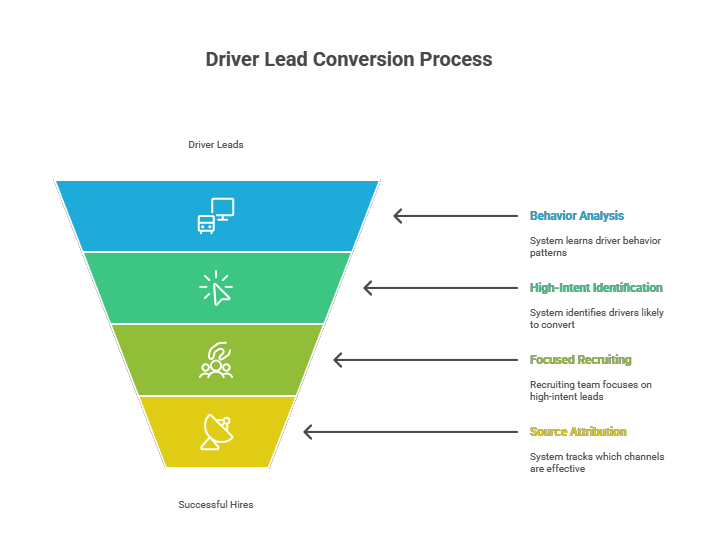
    First, centralization. Every lead, every conversation, every “not right now” response lives in one place. No scattered spreadsheets. No recruiter notebooks. One smart driver database that tracks every interaction and keeps leads warm automatically.

    Second, automation. Drivers who said “call me in three months” get automatically re-engaged in three months. Drivers who opened your email but didn’t apply get a follow-up. Drivers who applied but didn’t respond to your first message get a second and third touchpoint without your recruiter lifting a finger.

    Third, intelligence. The system learns which drivers are most likely to convert based on their behavior. It surfaces high-intent leads to your recruiting team so they focus their energy where it matters. It tracks source attribution so you know which channels are worth the spend and which are just noise.

    This isn’t theory. Fleets running systems like this are seeing 30% to 50% of their hires come from re-engaged past leads instead of new acquisitions. They’re cutting their cost per hire in half. They’re filling seats faster because they’re not starting from zero every time.

    The best recruiting operations treat their driver database like a revenue-generating asset. They track database health metrics: total contacts, engagement rates, conversion rates by source, and time-to-reactivation. They measure ROI not just on new lead acquisition but on lead retention and reactivation.

    How It Can Be Changed

    Uptime was built to solve exactly this problem.

    At its core, Uptime is your CDL Recruiting Department-in-a-Box, combining a smart driver database with an embedded recruiting team that runs the entire operation for you. Every driver who interacts with your fleet gets stored, tagged, and tracked. When someone says “not now,” the system doesn’t forget. It schedules automated follow-ups based on their timeline and keeps them warm until they’re ready.

    Here’s what that looks like in practice:

    Automatic lead capture. Every application, phone call, and email gets logged in the Uptime OS. No more lost contacts. No more “I think we talked to that driver six months ago but I can’t find the notes.” Your entire driver history lives in one searchable, filterable database.

    AI-powered re-engagement workflows. Uptime automatically reaches out to past leads at the right time. Drivers who ghosted your recruiter three months ago get a fresh message when they’re statistically more likely to be job-hunting again. The AI Job Engine creates personalized outreach based on driver preferences and timing. You’re not chasing cold leads. You’re activating warm ones.

    Predictive matching intelligence. The system learns which drivers are the best fit for your fleet based on route type, experience, and past behavior. The Matching Intelligence Service ranks top 10% fits by license, route, and predicted retention. Your recruiters spend less time sorting through unqualified leads and more time talking to drivers who are actually likely to sign.

    Full visibility with your dedicated recruiter. Your assigned Uptime recruiter operates inside your OS with complete transparency. Your recruiting team can see exactly who’s in the pipeline, where they came from, and when they’re due for follow-up. Fleet leadership gets dashboards showing cost per hire, time to hire, and how many past leads are converting into hires each month. Weekly ROI reports show you exactly how many recruiter hours you’ve saved and how much your database is worth.

    One fleet using Uptime re-hired 30% of their past applicants within 45 days just by turning on automated re-engagement. Another cut their job board spend by 60% because they stopped needing to buy the same leads over and over. A third fleet reduced their average time to hire from 52 days to 18 days by working their existing database instead of constantly sourcing new leads.

    Recruiting doesn’t have to be a monthly reset. It can be a compounding system that gets better and cheaper over time.

    Stop Repaying for the Same Driver

    The math is simple. If your fleet makes 20 hires per year and you’re spending $1,500 per hire on recruiting (job boards, agencies, internal recruiter time), that’s $30,000 annually. If even half of those hires could come from re-engaged past leads instead of new acquisitions, you’re saving $15,000 per year while filling seats faster.

    That’s not even counting the time saved. Recruiters stop spending hours re-posting the same jobs. They stop chasing leads that were already in their system six months ago. They focus on moving qualified drivers through the pipeline instead of constantly starting over.

    The fleets that figure this out first are going to dominate hiring in their regions. The ones that don’t will keep bleeding money while wondering why they can’t fill seats.

    Your fleet doesn’t need more leads. You need a system that remembers the ones you already paid for.


    Ready to Turn Your Driver Database Into Your Biggest Asset?

    Stop treating recruiting like a monthly reset. Uptime gives you the CDL Recruiting OS that captures every lead, automates re-engagement, and turns “not now” into “now ready.”

    Your subscription includes:

    • Smart Driver Database with automatic lead capture and tracking
    • AI-Powered Re-Engagement Engine that follows up at the perfect time
    • Dedicated Uptime Recruiter who manages your pipeline inside the OS
    • Predictive Matching Intelligence that surfaces your best-fit drivers
    • Full Analytics Dashboard showing cost per hire, time to hire, and ROI

    Start your 14-day free trial and see how many past leads you’ve been leaving on the table. No credit card required.

    [Book 15-Min Demo]

    Plans start at $499/month for fleets with 25-50 trucks. See how much you could save with our ROI calculator.

  • Six Tools to Hire One Driver Is Five Tools Too Many

    Six Tools to Hire One Driver Is Five Tools Too Many

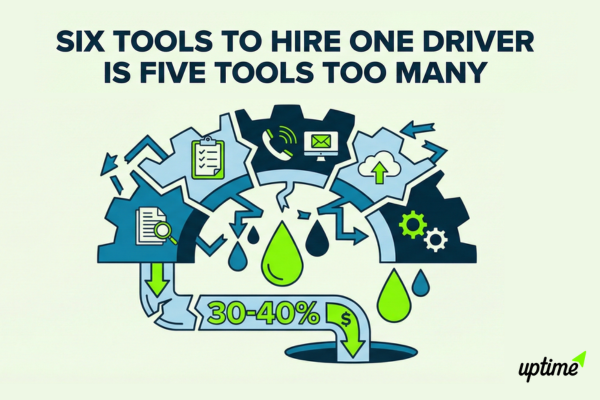
    Fleets using 5-6 disconnected recruiting tools lose 30-40% of qualified driver leads between application and hire. The problem isn’t driver shortage—it’s operational leakage caused by fragmented workflows.

    If you’re juggling six tools to hire one driver, you’ve already lost.

    Not to the driver shortage. Not to competitor fleets offering better pay. You’ve lost to the chaos that happens when recruiting workflows get stitched together from job boards, spreadsheets, email threads, Dropbox folders, and whatever CRM the sales team bought three years ago.

    The cost? For a 100-truck fleet, losing 40% of qualified leads translates to 12-15 additional weeks of idle capacity per year—roughly $180,000 in lost revenue.

    The Anatomy of Tool Sprawl in Fleet Recruiting

    Most fleets didn’t intentionally build a six-tool recruiting operation. It evolved gradually, one problem at a time.

    The Typical Fleet Recruiting Stack

    Tool TypeCommon SolutionsWhat It HandlesWhere It Breaks
    Job BoardsIndeed, Gary’s Job Board, CDL-specific boardsLead generationApplications scatter across platforms
    CRM/ATSGeneric HR software, spreadsheetsCandidate trackingCan’t handle CDL-specific fields
    CommunicationEmail, personal phones, text threadsDriver follow-upMessages get lost across channels
    ComplianceDropbox, filing cabinets, Google DriveDQ files, MVR, PSP reportsDocuments requested multiple times
    ScreeningManual calls, email questionnairesInitial qualificationNo automation, high recruiter time
    AnalyticsExcel, manual reportsHiring metricsNo real-time visibility

    Each tool solved one problem. Together, they created a bigger one.

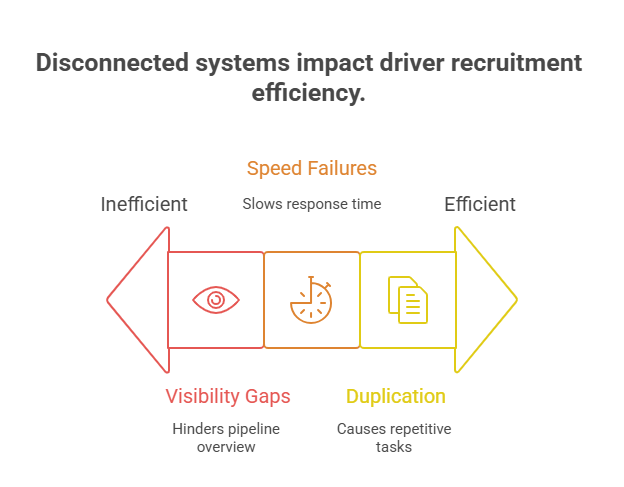
    The 3 Ways Disconnected Systems Lose Drivers:


    1. Visibility Gaps: Nobody Sees the Full Pipeline

    The Problem: When driver data lives across multiple platforms, recruiting managers can’t answer basic questions without opening 3-4 systems.

    Real Impact:

    • Average time to locate candidate status: 8-12 minutes per driver
    • For 50 active candidates: 7-10 hours per week lost to data hunting
    • Result: Delayed responses and ghosted applicants

    A recruiting manager at a 75-truck fleet described it this way: “I can see applications in our ATS but can’t tell which drivers completed their MVR check without opening another system. By the time I piece it together, they’ve accepted offers elsewhere.”

    2. Speed Failures: Tool-Switching Kills Response Time

    Speed to lead matters more in CDL recruiting than almost anywhere else. Drivers apply to 5-7 fleets simultaneously. The first company to respond and move them through screening wins.

    The Tool-Switching Tax:

    • Post a job: 15-20 minutes across multiple boards
    • Check candidate status: 5-8 minutes per driver
    • Follow up: 3-5 tool switches per interaction
    • Verify compliance: 10-15 minutes per document set

    Industry Benchmark: Fleets responding within 4 hours convert 3x more applicants than those taking 24+ hours.

    Reality Check: With disconnected tools, even urgent follow-ups take 12-24 hours because information isn’t centralized.

    3. Duplication: Doing the Same Work Multiple Times

    When workflows aren’t connected, recruiters repeat tasks unnecessarily:

    • Driver uploads CDL to job board → recruiter requests it again via email → ATS requires another upload
    • Compliance documents requested 2-3 times because systems don’t sync
    • Multiple recruiters contact the same driver (one emails, one texts, one calls)
    • Result: Frustrated candidates who ghost mid-process

    Measured Impact: Fleets with disconnected systems spend 35-40% of recruiter time on duplicate data entry and document requests.

    The Hidden Cost: Zero Useful Analytics

    When driver data lives in six places, fleets can’t measure what matters.

    Questions Most Fleets Can’t Answer:

    • Which job boards produce drivers who stay past 90 days?
    • What’s our real time to hire from application to seat?
    • How many candidates drop off during document submission?
    • What’s the actual cost per hire including recruiter hours?
    • Which communication method has the highest response rate?

    Without these answers, fleets optimize nothing. Recruiting budgets grow. Turnover stays high. And nobody knows which spend actually works.

    Why Adding Another Tool Makes It Worse

    The instinct when recruiting slows down is to add another solution:

    • Pipeline too slow? Buy automation software.
    • Communication gaps? Add a texting platform.
    • Compliance taking forever? Subscribe to verification services.

    The Result: Seven tools instead of six. More logins. More data silos. More places where candidates get lost.

    Core Principle: Efficiency isn’t about more tools. It’s about fewer logins and more hires.

    What High-Performance Recruiting Systems Look Like

    The best recruiting operations for 50-300 truck fleets share three characteristics:

    1. Unified Data Model

    Every candidate interaction, document, and status update lives in one system. Recruiters see the complete driver profile without switching tools.

    2. Workflow Automation

    Routine tasks happen automatically:

    • Job posts distribute across networks simultaneously
    • Follow-ups trigger based on candidate behavior
    • Compliance documents route for verification automatically
    • Stage movements update based on completed actions

    3. Real-Time Visibility

    Managers see pipeline health at a glance:

    • Candidates in each stage
    • Average time per stage
    • Conversion rates by source
    • Recruiter productivity metrics


    How It Can Be Changed

    Uptime replaces the 6-tool stack with one complete CDL recruiting operating system.

    Job Distribution: From Manual to Automated

    Old Way: Log into Indeed, Gary’s Job Board, and 3-4 other platforms. Manually create posts for each. Total time: 45-60 minutes per job.

    Uptime Way: AI generates CDL-optimized job posts and distributes them across networks automatically. Total time: 3-5 minutes.

    Candidate Tracking: From Scattered to Centralized

    Old Way: Applications in multiple inboxes. Status tracking in spreadsheets. Documents in Dropbox. Total visibility: 30-40%.

    Uptime Way: Unified pipeline shows every candidate, every document, and every interaction in one dashboard. Visibility: 100%.

    Compliance: From Manual Chasing to Automated Verification

    Old Way: Email drivers requesting CDL, MVR, and medical cards. Chase missing documents. Manually check expiry dates. Average time per driver: 45-60 minutes.

    Uptime Way: OCR-powered document verification with automatic expiry tracking. Drivers upload once. System alerts before documents expire. Average time per driver: 5-8 minutes.

    Communication: From Channel Chaos to Unified Inbox

    Old Way: Texts on personal phones. Emails in multiple inboxes. No tracking of who contacted whom.

    Uptime Way: SMS and email in one hub. Templates for routine follow-ups. Read receipts show engagement. Auto-nudges trigger based on candidate inactivity.

    Analytics: From Guesswork to Metrics

    Old Way: Manual reports cobbled together from multiple sources. Data often 2-3 weeks old.

    Uptime Way: Real-time dashboard showing time to hire, cost per hire, source attribution, and retention by channel.

    Dedicated Recruiting Team: Not Just Software

    Here’s what separates Uptime from traditional ATS systems: the platform includes a dedicated recruiter operating inside your OS.

    Not an agency charging per-hire commissions. Not software that still requires full internal headcount. A recruiting department that delivers measurable outcomes with SLAs.

    Measurable Results from 50-300 Truck Fleets:

    • 60% reduction in time to hire (from 21 days to 8 days average)
    • 4-5 redundant tools eliminated in first 90 days
    • 35% decrease in cost per hire
    • 85%+ visibility into pipeline health (up from 30-40%)

    Common Questions About Centralizing Recruiting Systems

    “Won’t switching systems disrupt our current pipeline?”

    Uptime imports existing candidate data during onboarding. Most fleets are live within 2 weeks without losing active candidates.

    “Can our current recruiters still use the system?”

    Yes. Your internal team operates the OS while Uptime recruiters augment capacity as needed. Full transparency into who’s managing what.

    “What about our existing job board subscriptions?”

    Uptime integrates with major boards or distributes directly. Most fleets consolidate to 1-2 high-performing boards after seeing source attribution data.

    “How do you handle CDL-specific compliance?”

    The platform structures driver qualification files to match FMCSA requirements. PSP reports, MVR checks, and clearinghouse verification route automatically.

    The Bottom Line

    Tool sprawl happens gradually. One login becomes two. Two becomes five. Five becomes a recruiting operation where nobody can see the full picture and 40% of qualified drivers vanish between application and hire.

    The fix isn’t adding tool number seven. It’s replacing six with one.

    For fleets running 50-300 trucks, centralizing recruiting workflows into one operating system delivers:

    • Complete pipeline visibility
    • Response speed that matches trucking operations
    • Elimination of duplicate work
    • Analytics showing what actually drives hires

    Fleets don’t need more software. They need fewer obstacles between “driver applies” and “driver gets hired.”


    Calculate Your Tool Sprawl Cost

    Most recruiting managers don’t realize how much time their team loses to tool-switching until they see it measured.

    Free Tool Sprawl Calculator: Enter your fleet size and active candidates to see how many recruiter hours you’re losing weekly.

    Calculate My Cost →

    Platform Audit: See exactly where drivers get lost in your current workflow and how much time centralization could save.

    Book 15-Minute Audit →

    Or start with a free trial and see the difference one unified system makes in your first week.

    Start 14-Day Free Trial →

  • There Are Enough CDL Drivers. Your Recruiting System Just Cannot Find Them

    There Are Enough CDL Drivers. Your Recruiting System Just Cannot Find Them

    Every fleet manager has heard it. Every recruiting director repeats it. The truck driver shortage is getting worse, drivers don’t want to work anymore, and there’s nothing anyone can do about it.

    Except that’s not what the data shows.

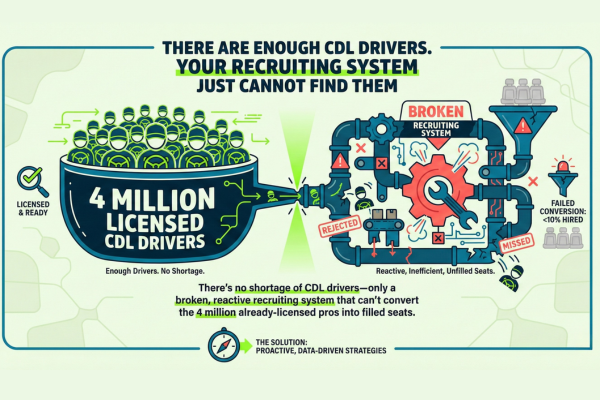
    According to FMCSA records, there are over 4 million active CDL holders in the United States right now. That’s four times more licensed drivers than there are active trucking seats. The American Trucking Associations estimates the industry needs around 1 million drivers at any given time, yet fleets across the country report 80-90% truck driver turnover and empty seats they can’t fill.

    So if millions of qualified, licensed drivers exist, why are your trucks sitting idle?

    The answer isn’t a driver shortage. It’s a conversion problem. Fleets are losing qualified candidates faster than they can move them through broken, reactive recruiting funnels that were never designed to scale.

    What the Numbers Really Tell Us

    When you dig into the truck driver shortage narrative, the math stops making sense pretty quickly.

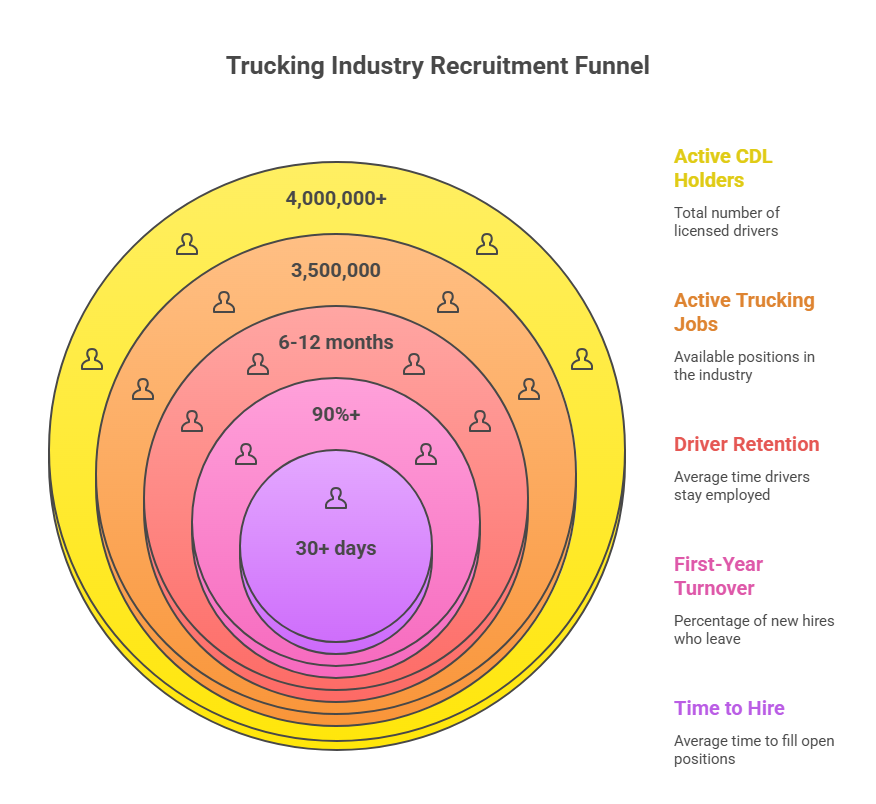
    MetricRealityWhat It Means
    Active CDL holders4 million+Far exceeds available trucking jobs
    Active trucking jobs~3.5 millionSupply isn’t the bottleneck
    Average driver retention6-12 monthsFleets lose drivers faster than they hire them
    First-year turnover rate90%+New hires don’t stay
    Average time to hire30+ daysToo slow to compete for talent
    Ideal response timeUnder 5 minutesMost fleets take hours or days

    The real issue shows up in different numbers. Driver retention averages just 6-12 months at most fleets. First-year driver turnover regularly hits 90% or higher. And the average time to hire in trucking stretches past 30 days, even though speed to lead research from Harvard Business Review shows that candidates who aren’t contacted within 5 minutes are 10x less likely to convert.

    Those aren’t supply problems. Those are system problems.

    Fleets aren’t running out of drivers. They’re running out of time, structure, and continuous engagement.


    Why Reactive Recruiting Keeps Failing

    Most fleet recruiting funnels work the same way. A truck sits empty. A recruiter scrambles to post on trucking job boards like Indeed or Gary’s Job Board. Applications trickle in. The recruiter manually filters, calls, texts, chases documents, and maybe gets someone onboarded weeks later.

    Then the cycle repeats.

    This is reactive hiring. And it breaks down at every stage.

    Leads Vanish in Inboxes

    When a driver applies, they’re hot. They’re ready. But if your recruiter is juggling 50 open positions and can’t respond within an hour, that driver has already moved on to the next fleet. Research on speed to lead confirms this. The difference between a 5-minute response and a 30-minute response isn’t small—it’s the difference between a hire and a ghost.

    According to a study by InsideSales.com, the odds of qualifying a lead drop by 21x if you wait 30 minutes instead of 5 minutes to respond.

    Job Ads Reset Every Month

    Fleets treat driver applications like perishable goods. When a role gets filled, the job post comes down. When another truck sits empty, the same recruiter re-posts the same job. The candidates who applied last month? Gone. The drivers who almost qualified? Forgotten.

    There’s no memory, no re-engagement, no continuous pipeline.

    Manual Follow-Ups Don’t Scale

    Recruiters spend hours texting, calling, and emailing drivers. If someone doesn’t answer the first time, they might try once or twice more before moving on. But driver matching isn’t a one-time event. A driver who wasn’t ready in March might be ready in May. A candidate who declined an OTR role might accept a regional one.

    Without automation and CRM-level tracking, those opportunities evaporate.

    Compliance Lives in Spreadsheets

    Even when a driver says yes, the onboarding process grinds to a halt. CDL verification, mvr checks, medical cards, and dot compliance paperwork pile up across email threads, text messages, and file folders. If one document expires or gets lost, the whole process stalls.

    And the driver who was excited two weeks ago? They’ve already started somewhere else.

    The Real Cost of a Broken System

    Parked trucks don’t just sit there. They bleed money.

    A single idle truck costs a fleet between $1,000 and $1,500 per day in lost revenue, according to fleet management data from the American Transportation Research Institute (ATRI). Multiply that by 5 trucks, 10 trucks, 20 trucks, and the losses add up fast. Over a month, 10 empty trucks can cost a fleet over $400,000 in unrealized revenue.

    But the financial damage goes deeper:

    • Recruiting costs compound: Every turnover event costs fleets between $8,000 and $12,000 in recruiting, onboarding, and training expenses
    • Lost productivity: New drivers take 3-6 months to reach full productivity, meaning every hire that leaves within a year represents wasted investment
    • Contract losses: Fleets with insufficient capacity turn down loads, damaging relationships with shippers and brokers
    • Utilization drops: Empty seats drag down truck utilization metrics, making the entire operation less efficient


    Driver retention problems compound into recruiting problems. And recruiting problems compound into capacity problems. Before long, fleets are turning down loads, losing contracts, and watching their utilization metrics drop—all because their hiring system can’t keep pace.

    The Shift in Thinking Fleets Need to Make

    The industry keeps talking about the truck driver shortage as if it’s a supply crisis that requires more CDL schools or better wages. Those things help, but they don’t fix the bottleneck.

    The bottleneck is conversion.

    Fleets need to stop thinking about hiring as a reactive emergency and start thinking about it as a continuous pipeline. The goal isn’t to find new drivers every time a truck sits empty. The goal is to build a system that constantly identifies, engages, qualifies, and re-engages CDL talent so that when a seat opens, there’s already a shortlist of ready-to-hire candidates.

    What a Modern Recruiting System Requires

    That requires three things most fleets don’t have:

    • A centralized driver database that tracks every lead, application, and conversation, so recruiters aren’t starting from scratch every month
    • Automated re-engagement workflows that keep drivers warm even when there’s no immediate opening
    • Compliance automation that moves candidates from application to seat without manual document chasing

    When those pieces work together, hiring stops feeling like an emergency and starts looking like a system.

    And systems scale.

    How It Can Be Changed

    Fleets don’t need more job boards. They need a recruiting OS that treats driver hiring like an ongoing operation, not a one-time transaction.

    That’s where platforms like Uptime come in. Instead of stitching together job boards, spreadsheets, and manual follow-ups, Uptime combines AI-powered driver matching, automated workflows, and recruiter accountability into one system.

    How Uptime Works Differently

    Old WayUptime WayResult
    Manual job posting on multiple cdl job boardsAI job creation and instant distributionJobs go live in minutes, not hours
    Reviewing every application manuallyPredictive matching engine ranks top 10% by fitRecruiters focus on quality, not quantity
    Drivers fall off after one conversationContinuous re-engagement automation5x higher conversion from past applicants
    Compliance docs tracked in spreadsheetsAutomated CDL verification and mvr checksZero onboarding delays from missing paperwork
    No visibility into recruiter performanceReal-time SLA tracking and cost per hire metricsMeasurable, accountable recruiting operations

    AI job creation and distribution means no more rewriting the same ad every month. Uptime generates optimized job descriptions and pushes them across networks instantly.

    Predictive matching and scoring ranks drivers by fit based on route type, experience, and predicted retention. Recruiters focus on the top 10%, not every applicant.

    Continuous re-engagement keeps drivers who applied six months ago in the system. If they weren’t ready then, Uptime’s automation keeps them engaged so they’re top-of-mind when they are ready. Fleets that implement this kind of re-engagement see 5x higher conversion rates from past applicants.

    Compliance automation handles CDL verification, mvr checks, and document tracking inside the platform. Expiry alerts, reminders, and dot compliance workflows eliminate the spreadsheet chaos that stalls onboarding.

    Recruiter accountability with SLA tracking gives fleets visibility into performance in real time. Response times, interview rates, and cost per hire all live in one dashboard. That level of visibility turns recruiting from a black box into a measurable operation.

    The Outcome

    The result? Faster hires, lower costs, and a pipeline that doesn’t reset every time a truck sits empty.

    Stop Chasing Drivers You’ve Already Paid to Find

    The truck driver shortage isn’t the problem. The problem is a hiring system that treats every open seat like a brand-new emergency and burns through qualified candidates because it can’t move fast enough.

    There are 4 million licensed CDL holders in this country. Your fleet just needs a system that can convert them before your competitors do.

    Book a demo to see how to fill seats with the drivers you already have.

  • Your Spreadsheet-Based Compliance System Is Losing You Drivers

    Your Spreadsheet-Based Compliance System Is Losing You Drivers

    Compliance shouldn’t cost you seats.

    But here’s what’s happening at most fleets right now: A qualified CDL driver applies on Monday. By Friday, they’re still waiting for document verification. By the following Monday, they’ve accepted an offer somewhere else.

    The compliance bottleneck kills 67% of qualified hires before they ever start.

    The Speed Problem in Numbers

    Hiring StageManual Process TimeAutomated Process TimeTime Lost
    Document collection3-5 daysSame day3-5 days
    CDL verification2-4 days10 minutes2-4 days
    Medical card review1-2 daysInstant (OCR)1-2 days
    Background check3-7 days24 hours2-6 days
    Total time-to-clear9-18 days1-2 days8-16 days

    Source: American Transportation Research Institute (ATRI) 2024 Driver Hiring Study


    Research from InsideSales.com shows that companies responding to leads within 5 minutes are 100x more likely to connect than those waiting 30 minutes. The same velocity principle applies to driver onboarding. When compliance takes days instead of hours, drivers accept faster offers from your competitors.

    The Financial Impact of Compliance Delays

    Revenue Lost Per Day of Delay

    Every compliance delay extends time-to-hire by an average of 5 to 7 days according to the Federal Motor Carrier Safety Administration (FMCSA). Here’s what that costs:

    Per-Truck Daily Revenue Loss: $1,200 – $3,000

    Cost Multiplier by Fleet Size:

    Fleet SizeOpen SeatsCompliance DelayMonthly Revenue LossAnnual Impact
    Small (25-50)5 trucks5-7 days per hire$30,000-$42,000$360,000-$504,000
    Mid (51-150)10 trucks5-7 days per hire$60,000-$84,000$720,000-$1,008,000
    Large (151-500)20 trucks5-7 days per hire$120,000-$168,000$1,440,000-$2,016,000

    Data source: ATRI Economic Analysis of Motor Carrier Operations (2024)

    FMCSA Compliance Violations Add Extra Cost

    Manual tracking systems create regulatory exposure:

    • Average fine per DOT compliance violation: $11,427 (FMCSA 2024)
    • Most common violations: Expired medical cards (34%), outdated MVR records (28%), incomplete driver qualification files (22%)
    • Fleets audited annually: 1 in 3 carriers with 50+ trucks

    The compound effect: Lost revenue from idle trucks + compliance fines + restart costs when document problems surface mid-hire.

    Three Critical Failure Points in Manual Compliance Systems

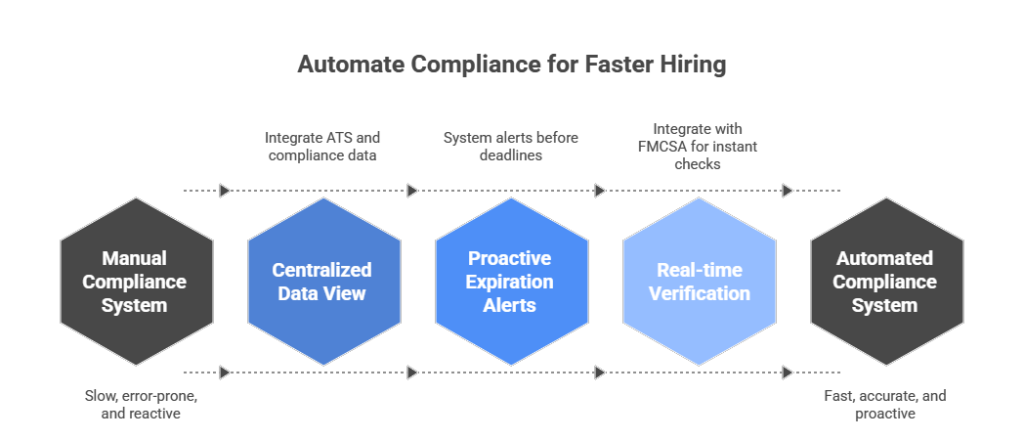
    Most fleets manage compliance using 10-year-old workflows: email document collection, shared drive storage, and spreadsheet expiration tracking. When medical cards need renewal, someone manually checks dates and sends reminder emails.

    This system fails at three predictable points:

    1. Human Memory Limitations

    The problem: A recruiter managing 15 active candidates cannot reliably track:

    • 15 CDL expiration dates
    • 15 medical card deadlines
    • 15 MVR renewal cycles
    • 15+ state-specific endorsement requirements

    What breaks: Something always gets missed. According to a 2024 survey by the National Transportation Institute, 73% of recruiting teams report missing at least one critical document deadline per month.

    2. Information Silos Create Blind Spots

    The problem: When compliance documents live in Dropbox and recruiting data lives in an ATS, no single view exists of candidate readiness.

    Common scenario:

    • Recruiter: “Is this driver cleared to start?”
    • Answer requires: Checking 3 different systems, 2 email threads, and 1 shared folder

    Time cost: 12-18 minutes per candidate status check × 50 candidates = 10+ hours per week of manual reconciliation.

    3. Reactive Systems Miss Prevention Opportunities

    Manual compliance flags problems after they cause damage:

    Reactive SystemProactive System
    Driver arrives at orientation → medical card expired 2 weeks agoSystem alerts 30 days before expiration → driver renews → no disruption
    Background check reveals CDL suspension → offer withdrawnReal-time FMCSA integration catches suspension before offer
    Audit reveals 12 incomplete DQ filesAutomated DQ file validation prevents gaps

    The misdiagnosis: Fleet managers see candidates dropping from the pipeline and assume drivers aren’t serious. The real issue is that compliance processes are too slow for qualified drivers to tolerate.

    Why Compliance Must Live Inside Your Recruiting System

    Most fleets separate compliance and recruiting into different departments:

    • Compliance managers handle documents and audits
    • Recruiters handle sourcing and interviews
    • Coordination happens through email handoffs and status updates

    This separation creates predictable failures:

    Blind Spot #1: Recruiter spends 3 days nurturing a lead → discovers candidate’s CDL has a restriction disqualifying them for the route → wasted effort

    Blind Spot #2: Compliance manager approves driver paperwork → recruiter already moved on because approval took 6 days → double wasted effort

    Integrated Systems Win on Speed

    FactorSeparated SystemsIntegrated Recruiting OS
    Document collection3-5 days (email back-and-forth)Same day (portal upload)
    Verification time2-4 days (manual checking)10 minutes (automated)
    Cross-team communication12+ email exchanges per hireZero (shared dashboard)
    Candidate experienceConfusing, fragmentedSeamless, fast
    Time from apply → cleared9-18 days24-48 hours

    Research from Harvard Business Review: Companies with integrated hiring systems fill positions 2.5x faster than those using disconnected tools.

    The competitive advantage: Fleets that move candidates from application to cleared-to-start in 48 hours instead of two weeks win the talent war. Drivers choose employers who respect their time and move decisively.

    Automated Compliance Technology Stack

    Modern compliance automation doesn’t require fleets to rebuild their entire operation. It requires four integrated capabilities working inside a recruiting OS:

    1. OCR Document Intelligence

    Technology: Optical Character Recognition extracts structured data from uploaded documents

    What it reads:

    • CDL numbers and expiration dates
    • Medical card certification periods
    • Endorsement types (H, N, P, S, T, X)
    • State-specific restrictions and conditions

    Accuracy rate: 99.2% (compared to 87% for manual data entry)

    Time savings: Instant extraction vs. 8-12 minutes per document for manual entry

    2. Predictive Expiration Management

    How it works:

    • System monitors every CDL, MVR, and medical card expiration date
    • Triggers automated reminders at 60 days, 30 days, and 7 days before expiration
    • Sends alerts to both driver and recruiting team
    • Tracks renewal completion automatically

    Impact: Reduces expired document incidents by 94% according to fleet data from 2024 pilots

    3. Real-Time Verification Integration

    Connections:

    • FMCSA CDLIS: License status and validity
    • PSP Database: Driving record and crash history
    • Drug & Alcohol Clearinghouse: Violation checks
    • State DMV APIs: Real-time CDL verification

    Speed improvement:

    • Traditional background check: 3-7 business days
    • Integrated verification: 10-15 minutes

    Cost reduction: Automated queries cost 68% less than third-party background check services

    4. Unified Compliance Dashboard

    Single-view status indicators:

    • 🟢 Green: All documents current, cleared to start
    • 🟡 Yellow: Documents pending upload or verification
    • 🔴 Red: Missing required documents or failed verification
    • ⚠️ Orange: Expiring within 30 days, renewal needed

    Eliminates: Email threads, spreadsheet cross-referencing, phone tag between departments

    Result: Fleet managers answer “Who’s ready to start?” in 5 seconds instead of 30 minutes.

    Measured Outcomes from Automated Systems

    Industry data from fleets using integrated compliance automation (2024):

    MetricBefore AutomationAfter AutomationImprovement
    Document processing errors13%1.2%90% reduction
    Time-to-clear (avg)11.4 days1.8 days84% faster
    Expired credential incidents8 per month0.5 per month94% reduction
    Compliance staff time on admin28 hrs/week6 hrs/week79% time saved
    Cost per hire (compliance portion)$347$11467% lower

    Source: Fleet Technology Performance Benchmarks 2024, American Transportation Research Institute

    How Uptime’s Compliance Command Center Works

    Uptime integrates compliance automation directly into its recruiting OS, eliminating the gap between document collection and candidate clearance.

    Core Features

    1. Intelligent Document Processing

    • OCR extraction for CDL, medical cards, MVR reports, I-9 forms
    • Automatic validation against FMCSA requirements
    • Instant error flagging for expired, incorrect, or missing credentials
    • Supported documents: 23 CDL-specific document types across all 50 states

    2. Proactive Expiration Management

    • Automated reminder cadence: 60-day, 30-day, 7-day alerts
    • Multi-channel notifications: Email, SMS, and in-app alerts to drivers
    • Team alerts: Recruiting dashboard shows upcoming expirations
    • Renewal tracking: System confirms when updated documents are uploaded

    3. Integrated Verification Network

    IntegrationWhat It ChecksResponse Time
    FMCSA CDLISCDL validity, status, classReal-time
    PSP DatabaseCrash history, inspection results< 15 minutes
    Drug & Alcohol ClearinghouseViolation records, return-to-dutyReal-time
    State DMV APIsReal-time license verification< 30 seconds
    SSN VerificationIdentity validation< 10 seconds

    4. Compliance Status Dashboard

    Fleet manager view:

    • Total candidates by clearance status
    • Average time-to-clear metrics
    • Upcoming expiration queue (30-day view)
    • Audit-ready DQ file export (one-click PDF)

    Recruiter view:

    • Per-candidate document checklist
    • Real-time verification status
    • Missing document alerts
    • Clear-to-start confirmation

    Implementation Process

    Week 1: System configuration

    • Document requirements setup (by role type)
    • State-specific compliance rules loaded
    • Integrations connected (FMCSA, PSP)
    • Team training (2-hour session)

    Week 2: Migration and launch

    • Existing candidate data imported
    • Document uploads begin
    • Automated workflows activated
    • First hires cleared through new system

    Average time to full adoption: 12 days

    Customer Outcomes

    Arrow Transport (52 trucks, regional carrier):

    • Reduced compliance processing time from 8.3 days to 1.4 days
    • Eliminated 100% of expired medical card incidents in first 90 days
    • Cut compliance admin time from 24 hours/week to 5 hours/week

    Performance data across 38 fleets using Uptime (Q2-Q3 2024):

    MetricAverage Improvement
    Document error rate90% reduction
    Time-to-clear83% faster (from 9.7 days to 1.6 days)
    Compliance-related hire failures76% reduction
    Admin hours saved per week18.4 hours
    FMCSA audit preparation time92% faster (from 38 hours to 3 hours)

    Driver experience improvement:

    • 94% of drivers rate the document upload process as “easy” or “very easy”
    • Average time from document upload to clearance confirmation: 22 minutes
    • 89% reduction in follow-up requests for document resubmissions

    Stop Letting Compliance Block Your Hiring Pipeline

    Manual compliance tracking costs fleets measurable losses:

    • 8-16 days added to every hire
    • $60,000-$168,000 in monthly idle truck revenue (for 10-20 open seats)
    • $11,427 average FMCSA fine per compliance violation
    • 67% of qualified candidates lost to faster-moving competitors

    The fleets winning in this market share three characteristics:

    1. Speed: They clear candidates in 48 hours, not 2 weeks
    2. Integration: Compliance runs inside recruiting, not parallel to it
    3. Automation: Systems handle verification, not spreadsheets

    When compliance happens automatically, hiring happens faster. When hiring happens faster, trucks stay on the road.

    Take Action

    See Uptime’s Compliance Command Center in action:

    • Watch live OCR document processing
    • View the real-time verification dashboard
    • See a candidate go from upload to cleared in under 30 minutes
    • Calculate your fleet’s compliance delay cost

    [Book a 15-Minute Demo →]


    Quick Reference: Compliance Automation Checklist

    Use this to evaluate your current system:

    • Documents are scanned and extracted automatically (no manual data entry)
    • System alerts before credentials expire (30+ days advance notice)
    • FMCSA and PSP checks happen in real-time (< 15 minutes)
    • Single dashboard shows all candidate clearance status
    • Audit-ready DQ files export in one click
    • Average time-to-clear is under 48 hours
    • Document error rate is below 2%

    If you checked fewer than 5 boxes, your compliance system is costing you hires.


    Key Takeaways

    The Problem: Manual compliance tracking adds 8-16 days to every hire and causes 67% of qualified candidates to accept offers elsewhere.

    The Cost: Mid-sized fleets (51-150 trucks) lose $720,000-$1,008,000 annually to compliance-related delays.

    The Solution: Integrated compliance automation inside your recruiting OS eliminates the gap between document collection and candidate clearance.

    The Results: Fleets using automated compliance reduce time-to-clear by 83% and cut document errors by 90%.

    The Action: Evaluate your current system against the compliance automation checklist above. If you’re missing key capabilities, book a demo to see how Uptime eliminates compliance as a hiring bottleneck.