Category: Fleet Playbooks

  • AI Isn’t Here to Replace CDL Drivers, It’s Here to Get Them Hired Faster

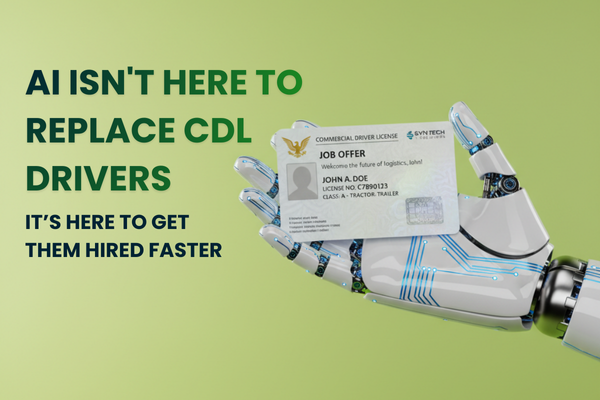
    AI Isn’t Here to Replace CDL Drivers, It’s Here to Get Them Hired Faster

    The word “AI” makes most truck drivers tense up.

    And for good reason.

    You’ve heard the headlines. Autonomous trucks are coming. Self-driving technology will eliminate CDL jobs. Silicon Valley investors are pouring billions into replacing you.

    So when someone says “AI-powered driver matching,” the instinct is to shut down.

    More tech that threatens your livelihood. More automation that treats you like you’re obsolete.

    Here’s the truth: AI in recruiting works completely differently than AI in driving.

    One tries to replace you. The other tries to get you hired faster, in jobs that actually fit, without the weeks of wasted time filling out duplicate applications.

    The resistance is understandable. But avoiding tech in job searching means staying stuck in a system that was broken before smartphones even existed.

    You’re filling out the same form on 10 different websites while drivers using modern platforms are getting matched in minutes.

    AI isn’t here to replace you. It’s here to get you hired faster.

    Why Drivers Distrust Automation in Trucking

    The skepticism about AI in trucking didn’t appear out of nowhere. It came from years of media coverage and industry hype about technology that explicitly aims to eliminate the driver.

    The Headlines That Created Distrust

    “Self-driving trucks will be on highways by 2020”

    “Autonomous vehicles could replace 3.5 million truck drivers”

    “Tech companies race to automate trucking industry”

    “Driverless trucks complete cross-country delivery”

    These stories dominate trucking news. They paint a picture where technology sees you as the problem to solve, not the professional to support.

    The message is clear: automation wants your job.

    When that’s your frame of reference, hearing about “AI matching” or “smart algorithms” in driver recruiting triggers the same alarm bells.

    It sounds like another way technology is being used against you instead of for you.

    The Real Difference Between Driving AI and Recruiting AI

    Autonomous Driving AIRecruiting AI
    Goal: Replace the driverGoal: Find the driver a better job
    Impact: Eliminates positionsImpact: Fills positions faster
    Who benefits: Fleet owners reducing labor costsWho benefits: Drivers finding better fits
    Timeline: Still years awayTimeline: Working right now
    Driver role: EliminatedDriver role: Empowered with better tools

    These are fundamentally different technologies with opposite objectives.

    One tries to make you obsolete. The other tries to make your job search faster, easier, and more successful.

    Understanding this difference matters for your career.

    What AI Actually Does in Driver Recruiting

    AI in recruiting isn’t some mysterious black box making decisions about your future.

    It’s just software that handles the tedious matching work humans are terrible at doing at scale.

    The Manual Matching Problem

    Traditional recruiting works like this:

    A recruiter posts a job for “CDL A drivers, OTR, hazmat preferred, home every 2 weeks.” They get 200 applications. Now they have to manually:

    • Review each CDL to verify class and endorsements
    • Check if the driver actually wants OTR or applied by mistake
    • Confirm home time expectations match
    • Verify experience levels
    • Screen out unqualified applicants
    • Prioritize the best matches

    This takes days. Sometimes weeks.

    Good candidates move on before anyone even reads their application.

    What AI Matching Actually Does

    AI automates the screening that doesn’t require human judgment.

    License verification

    The system reads your CDL class and endorsements instantly. It matches you only to jobs you’re legally qualified for.

    No more wasting time applying to positions that require a Class A when you have a Class B.

    Route preference filtering

    You specify you want regional Southeast routes. The AI only shows you opportunities in that geography.

    You’re not scrolling through OTR listings in the Pacific Northwest that you’d never accept.

    Home time matching

    You need to be home every weekend. The system filters out jobs with 3-weeks-out schedules.

    You see only positions that fit your life.

    Pay range alignment

    You won’t accept anything under $0.55 per mile. The AI doesn’t show you jobs offering $0.45.

    You’re not tempted by offers that don’t meet your requirements.

    Experience level matching

    You have 8 years of clean driving. The system prioritizes opportunities looking for experienced drivers instead of entry-level positions where you’d be underpaid for your skills.

    What AI Doesn’t Do

    Make final hiring decisions

    Fleets still review your complete profile. They still interview you. They still make the hiring choice.

    AI just handles the initial sorting that would otherwise take days of manual work.

    Replace human recruiters

    You still talk to real people. You still ask questions. You still negotiate terms.

    AI just eliminates the part where your application sits unread for two weeks.

    Hide information from you

    You see why you match with certain opportunities. The criteria are transparent.

    You’re not wondering why you got matched with a particular fleet or why you didn’t.

    Lock you into anything

    You control which fleets can contact you. You approve who gets access to your profile.

    AI suggests matches, but you make every decision about which conversations to pursue.

    The Speed Difference

    TaskManual RecruitingAI-Powered Matching
    Screen 200 applications8-12 hours2-3 seconds
    Match driver preferences to routes30-45 minutes per driverInstant
    Identify endorsement requirementsManual document reviewAutomatic verification
    Filter by home time needsRead each applicationReal-time filtering
    Update when new jobs openEmail blast to everyoneNotify only qualified matches


    This speed doesn’t benefit fleets at your expense.

    It benefits you by getting relevant opportunities in front of you within minutes instead of weeks.

    The Cost of Avoiding Modern Hiring Tools

    Staying with old-school job hunting methods isn’t noble.

    It’s just slower and more frustrating.

    What You Lose By Avoiding AI Matching

    Time wasted on bad-fit applications

    You spend 20 minutes applying to a job. Three days later, the recruiter calls and says, “We actually need someone with a tanker endorsement.”

    You don’t have one. That information could have been filtered automatically before you invested any time.

    Opportunities missed while you’re applying manually

    The perfect job gets posted. Five drivers using AI platforms get matched and contacted within an hour.

    By the time you manually find the listing, fill out the application, and wait for a response, the position is filled.

    Mental energy spent tracking applications

    You applied to 12 fleets. You’re manually tracking which ones you’ve heard from, which are still pending, which documents each one needs.

    AI platforms handle this automatically, freeing your brain for things that actually matter.

    Lower match quality

    You’re applying to anything that looks decent. Half don’t really fit. You end up in jobs that aren’t quite right and start looking again in 6 months.

    Better matching on the front end means longer tenures in jobs you actually want.

    The Real Numbers

    MetricTraditional Job SearchAI-Powered Platform
    Time per application15-20 minutes5 minutes one-time profile
    Applications to get 5 real opportunities20-305-8
    Time from application to first contact5-14 days1-2 days
    Match accuracy40-60%85-95%
    Total weekly time investment5+ hours30-60 minutes

    Avoiding AI doesn’t protect you from anything.

    It just makes your job search slower and less effective.

    How AI Matching Actually Works for Drivers

    Modern driver platforms use AI the same way you’d use a really good personal assistant.

    It handles the grunt work so you can focus on making good decisions.

    The Driver Experience

    You build one profile

    CDL class. Endorsements. Years of experience. Route preferences. Home time needs. Pay expectations. Equipment preferences.

    Fill it out once. The AI uses this to filter everything else automatically.

    You get matched instantly

    A fleet posts a new position. Within seconds, the AI checks if you qualify:

    • Do you have the right CDL class? Yes.
    • Do you have the required endorsements? Yes.
    • Does the route type match your preference? Yes.
    • Does the home time work for you? Yes.
    • Does the pay meet your minimum? Yes.

    You see only relevant opportunities

    The AI shows you this match because every criterion aligns.

    You’re not scrolling through 200 listings where 180 don’t fit. You’re reviewing 5-10 that actually work.

    Fleets request access to contact you

    Instead of you applying blindly, fleets see your profile and ask permission to reach out.

    The AI has already confirmed you’re a match. Now they’re competing for your attention.

    You control everything

    Don’t like a fleet that requested access? Decline. Want to know why you matched with a particular opportunity? The criteria are visible. Need to update your preferences? Change your profile and your matches adjust automatically.

    Let Technology Finally Work for You

    You’ve spent years watching technology get used against drivers.

    Autonomous truck headlines. ELD mandates that felt punitive. Systems that track every minute but don’t make your job easier.

    AI in recruiting is different.

    It doesn’t want your job. It wants to get you a better job, faster, with less wasted time and frustration.

    The choice isn’t between using AI or staying human. The choice is between modern tools that respect your time or old systems that waste it.

    How Uptime Uses AI to Get You Hired Faster

    Uptime built its matching engine specifically to solve the broken CDL hiring process without replacing human decision-making.

    Smart matching by license, route, and home time

    • Input your CDL class and endorsements once
    • Specify your preferred lanes and route types
    • Set your home time requirements
    • Define your pay expectations
    • AI filters every opportunity through these criteria automatically

    One profile works everywhere

    • No more filling out the same form on 10 different fleet websites
    • Update your profile once and changes flow through to all matches
    • Upload documents once and share them only with fleets you approve

    Verified fleets only

    • AI matches you only with carriers that have been vetted
    • No fake listings from lead generation companies
    • Real fleets, real jobs, real transparency

    Smart Inbox puts you in control

    • Fleets request access, you approve or decline
    • AI has already confirmed you’re a mutual match before the request
    • Direct messaging eliminates phone tag
    • Clear status tracking for every conversation

    Speed that actually benefits you

    • 5x faster than traditional application processes
    • Get matched within minutes of a relevant job posting
    • Skip the weeks of waiting for manual recruiter review

    Drivers using AI-powered platforms aren’t selling out. They’re just working smarter. They’re getting matched in minutes instead of days. They’re seeing only jobs that fit instead of scrolling through hundreds that don’t.

    The technology is already here. It’s already working. The only question is whether you’re using it.

    Create your free profile on Uptime. Fill it out once. Let the AI handle the matching work humans were never good at doing at scale. Review opportunities that actually fit your CDL class, your routes, and your lifestyle.

    No blind applications. No wasted time on bad fits. No weeks of waiting. Just fast, accurate matches with verified fleets that need what you bring.

    AI isn’t here to replace you. It’s here to get you hired faster.

    Get matched with verified fleets in minutes →
  • How Predictive Recruiting Cuts Time-to-Hire by 70%

    How Predictive Recruiting Cuts Time-to-Hire by 70%

    Your dispatch team doesn’t wait until a truck is parked to find the next load. They forecast capacity weeks out. They book loads based on projected availability. They plan routes around driver schedules and equipment positioning.

    So why does recruiting work the opposite way?

    Most fleets only post jobs when trucks are already sitting empty. A driver quits Monday. Recruiting scrambles to post on Indeed by Wednesday. Applications trickle in over the next two weeks. Meanwhile, that truck costs $1,200 per day in lost revenue, and the freight broker you’ve been working with for three years just found a more reliable carrier.

    Reactive hiring isn’t just inefficient. It’s a compounding revenue leak.

    The Real Cost of Crisis Mode Recruiting

    Here’s what reactive hiring costs a 200-truck fleet:

    A driver gives notice. Operations flags the open seat. Recruiting starts from scratch: write a job post, upload to trucking job boards, wait for applications, screen candidates, schedule interviews. According to the American Transportation Research Institute’s 2024 operational cost analysis, the entire cycle averages 45-60 days for most carriers.

    During those 60 days, that truck sits. Or worse, it gets leased at break-even margins just to keep moving.

    The math is brutal:

    Recruiting ApproachAvg Time to FillCost Per Empty DayCost Per HireAnnual Impact (180 hires)
    Reactive (crisis mode)60 days$1,200$72,000$12,960,000 lost
    Predictive (ready pipeline)12 days$1,200$14,400$2,592,000 lost
    Difference48 days saved$10,368,000 recovered

    For a 200-truck fleet, the difference between reactive and predictive recruiting can swing revenue by over $10 million annually. Even a 50-truck fleet making 45 hires per year can recover $2.5 million in revenue just by cutting time-to-fill from 60 days to 12 days.

    Why Reactive Recruiting Kills Predictable Growth

    Crisis mode recruiting makes your entire business unpredictable.

    You can’t forecast capacity. Sales can’t commit to new contracts without knowing if you’ll have drivers to cover them. Finance can’t build accurate revenue projections. Every growth decision becomes a gamble on whether recruiting can keep up.

    You pay premium rates for urgency. Rush job board ads. Agency fees for immediate placements. Sign-on bonuses that escalate when you’re desperate. Reactive hiring means negotiating from weakness.

    Driver quality drops under pressure. Research from Stay Metrics shows fleets with inconsistent, reactive hiring practices see 90-day turnover rates 30-40% higher than fleets with proactive pipeline management. Rushed screening means hiring the same seats over and over.

    Your best candidates go elsewhere. Speed to lead research shows contact rates drop 80% after 24 hours. Qualified CDL drivers with clean records get multiple offers. When your process is reactive and slow, your best candidates accept offers from competitors who moved faster.

    The Shift: From Job Posting to Pipeline Building

    Stop thinking about recruiting as a series of job posts. Start thinking about it as an always-on pipeline.

    Your fleet doesn’t operate in discrete hiring cycles. Drivers leave continuously. Seasonality creates predictable waves. The smartest fleets treat recruiting like dispatch: as an ongoing operational process requiring forecasting, planning, and proactive management.

    Predictive recruiting means building relationships with qualified drivers before you need them. You know what your pipeline looks like 30, 60, 90 days out. You engage candidates early and keep them warm so they’re ready when you have capacity.

    What Predictive Recruiting Looks Like in Practice

    Fleets running predictive recruiting operate completely differently.

    They forecast hiring needs based on data. Turnover has patterns. Certain routes lose drivers faster. Certain seasons see higher attrition. Predictive systems analyze historical turnover data, seasonal trends, and growth targets to forecast hiring needs for the next quarter.

    They maintain active pipelines of pre-qualified candidates. Instead of waiting until trucks are parked, they constantly source and engage drivers through database re-engagement, referral programs, and targeted outreach.

    They match drivers to upcoming capacity. If forecasts show you’ll need 3 regional drivers next month, recruiting starts building those relationships now. When capacity opens, candidates are warm and ready.

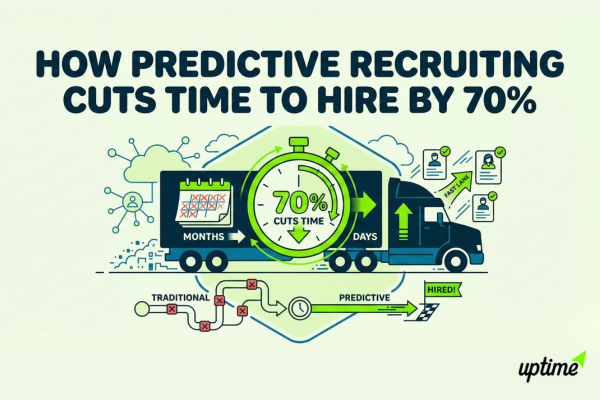
    They reduce time-to-fill by 70-80%. Working an active pipeline instead of starting from scratch increases hiring velocity dramatically. Average time-to-fill drops from 45-60 days down to 10-15 days.

    Here’s the process comparison:

    StageReactive ApproachPredictive Approach
    Triggering EventDriver quitsForecast shows need in 30 days
    SourcingPost job ad, waitEngage pre-qualified pipeline
    ScreeningScreen applicationsCandidates already screened
    InterviewSchedule from scratchFast-track warm candidates
    Time to Start45-60 days10-15 days

    Fleets running predictive recruiting report 60-70% reductions in last-minute job board spend.

    How It Can Be Changed

    Uptime was built specifically to shift fleets from reactive to predictive recruiting.

    At its core, Uptime is your CDL Recruiting Department-in-a-Box, combining an AI-powered operating system with an embedded recruiting team that runs proactive pipeline management. Instead of posting jobs when trucks are parked, Uptime maintains a live, ready-to-hire pipeline.

    Predictive matching based on fleet needs. Uptime’s Matching Intelligence Service analyzes your fleet’s driver profiles, route types, and capacity needs. The AI learns which attributes (license type, experience, location, route preference) match your operation and ranks candidates on predicted fit and retention likelihood.

    When forecasts show you’ll need 2 regional reefer drivers in 30 days, Uptime surfaces best-match candidates before you’re in crisis mode.

    Always-on pipeline nurturing. The platform maintains relationships with every driver who’s engaged with your fleet. Past applicants who said “not now” get automatic re-engagement at optimal times. Drivers matching upcoming needs get personalized outreach. The system keeps candidates warm so when capacity opens, they’re ready.

    Your dedicated Uptime recruiter manages the pipeline proactively. Unlike traditional recruiting where teams react to openings, your assigned Uptime recruiter works 30-60 days ahead, building relationships, pre-screening candidates, and staging offers before trucks are empty.

    Real-time capacity forecasting. The analytics dashboard shows pipeline health: qualified candidates at each stage, predicted time-to-fill for upcoming needs, and gap analysis showing where sourcing needs to intensify.

    Fleets using Uptime’s predictive approach report dramatic shifts:

    • 65% reduction in last-minute job board spend
    • 70% faster time-to-fill (52 days to 15 days average)
    • 35% improvement in 90-day retention
    • Zero crisis-mode recruiting cycles

    One 300-truck fleet went from 8 emergency agency placements per month (at $2,500 each) to zero, cutting $240,000 per year in premium placement fees.

    Recruiting stops being reactive firefighting and becomes proactive capacity management.

    Stop Hiring in Crisis. Start Building Capacity.

    Your dispatch team doesn’t scramble for freight at the last minute. Your maintenance team doesn’t wait for breakdowns to order parts. Why should recruiting operate in permanent crisis mode?

    Fleets that shift from reactive to predictive recruiting see immediate impact. They fill seats 4x faster. They spend 40-60% less on recruiting. They build the driver capacity needed to accept growth opportunities instead of turning them down.


    Keep Your Lanes Full. Build Your Pipeline Now.

    Uptime gives you the predictive recruiting OS that turns hiring from reactive scrambling into proactive capacity management.

    Your subscription includes:

    • Predictive Matching Intelligence that forecasts needs and surfaces best-fit candidates
    • Always-On Pipeline Nurturing that keeps qualified drivers warm
    • Dedicated Uptime Recruiter managing your pipeline 30-60 days ahead
    • Capacity Forecasting Dashboard showing pipeline health and hiring needs
    • AI Job Engine for targeted sourcing based on route type and driver profile

    Stop reacting to empty trucks. Start forecasting driver capacity like you forecast freight.

    [Book a 15-Min Pipeline Demo]

  • Every Parked Truck Is a Revenue Leak Your Recruiting System Created

    Every Parked Truck Is a Revenue Leak Your Recruiting System Created

    A truck sitting in the yard doesn’t look expensive. No fuel burning. No maintenance happening. Just metal and rubber taking up space.

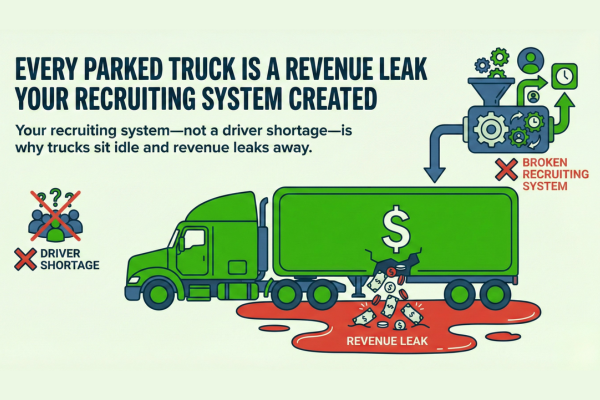
    But that truck costs between $1,200 and $3,000 every single day it sits empty.

    Not because the driver shortage is real. Not because qualified CDL holders don’t exist. But because the recruiting system most fleets use was never built to move at trucking speed.

    The Math Fleet Owners Don’t Want to See

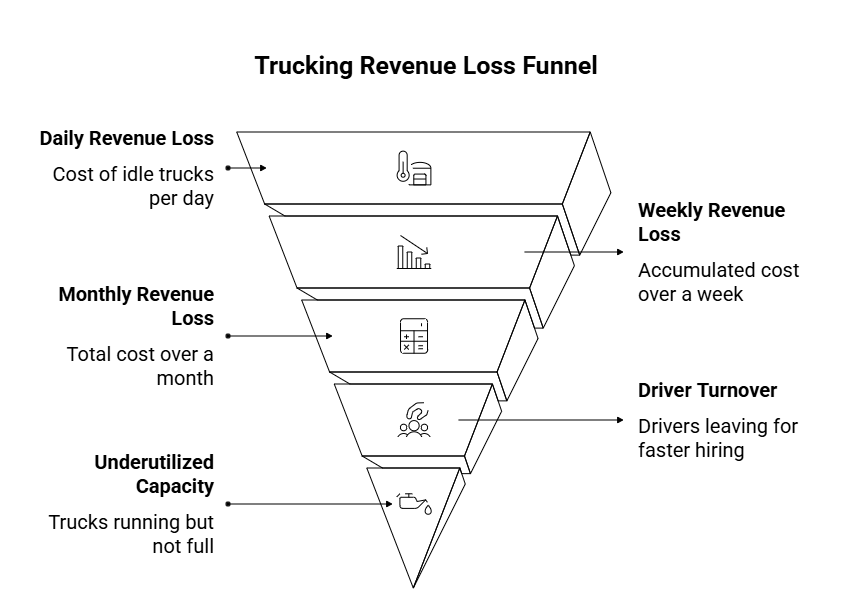
    Ten idle trucks for one week equals $30,000 in lost revenue. That’s assuming $1,200 per truck per day on the conservative end. Scale that to a month and fleets are bleeding six figures while their recruiting team is still screening applications from three weeks ago.

    The American Trucking Associations reported driver turnover rates at large truckload carriers hit 87% in recent quarters. But here’s what that stat doesn’t capture: most of those drivers didn’t leave the industry. They moved to another fleet that hired them faster.

    The numbers get worse when factoring in deadhead miles and empty capacity. A truck that’s parked can’t generate revenue. A truck that’s running but underutilized because routes are being adjusted to cover driver gaps is only marginally better.

    Idle ScenarioDaily CostWeekly CostMonthly Cost
    5 trucks idle$6,000-$15,000$42,000-$105,000$180,000-$450,000
    10 trucks idle$12,000-$30,000$84,000-$210,000$360,000-$900,000
    20 trucks idle$24,000-$60,000$168,000-$420,000$720,000-$1,800,000


    Fleets treat idle time as an HR problem when it’s actually an operations breakdown.

    The issue isn’t that drivers aren’t applying. Most recruiting systems have leads sitting in spreadsheets, email threads, and half-filled application forms. The bottleneck is what happens between “driver applies” and “driver gets hired.”

    Where Traditional Recruiting Systems Break Down

    Most fleets are using tools built for corporate hiring. Applicant tracking systems designed for office jobs where time to hire is measured in weeks, not days. Where compliance means checking a background report, not verifying CDL endorsements, PSP reports, MVR checks, and drug test clearances through the FMCSA clearinghouse.

    Industry data shows the average time to hire for CDL drivers ranges from 21 to 45 days. But driver candidates are actively applying to multiple fleets simultaneously. Research on speed to lead in high-velocity hiring shows that companies responding within 5 minutes are 9 times more likely to convert a candidate than those responding after 30 minutes.

    The typical flow looks like this:

    • Job gets posted on multiple trucking job boards manually
    • Applications trickle in through different channels
    • Recruiter manually screens each one for CDL class, endorsements, and experience
    • Follow-ups happen when someone remembers
    • Compliance documents get requested via email (driver qualification file, DOT physical, clearinghouse query)
    • Half the candidates ghost before the process finishes
    • The cycle restarts next month

    Speed to lead matters more in trucking than almost any other industry. A driver applying for a CDL position is often applying to five other fleets at the same time. The first company to respond, screen, and make an offer wins. The fleet that takes three days to follow up loses that driver to a competitor who moved in three hours.

    This isn’t a talent problem. It’s a systems problem.

    Why Recruiting Feels Like Starting Over Every Month

    Fleets spend thousands on job boards, recruiting agencies, and internal HR staff, yet truck utilization stays flat. The hiring funnel resets every 30 days because nothing compounds.

    What happens to drivers who applied last month but weren’t ready? Most systems have no re-engagement workflow. Those leads disappear. Job posts expire and get rewritten from scratch. Compliance tracking lives in a folder somewhere. Nobody owns follow-up. There’s no analytics showing which sources actually produce drivers who stay past the critical 90-day turnover window.

    The result is operational leakage. Revenue walks out the door not because drivers don’t exist, but because the system can’t retain, screen, and onboard them fast enough to match trucking capacity needs.

    And every day that system stays broken, another truck sits idle.

    The Real Cost Isn’t the Truck

    Fleet owners look at parked trucks and see asset underutilization. Accountants see depreciation and opportunity cost. But the operational impact runs deeper.

    When trucks sit empty:

    • Routes get reassigned and schedules compress
    • Remaining drivers take on more miles and burn out faster (accelerating driver turnover)
    • Customer relationships strain when loads get delayed
    • Competitors capture market share that’s hard to win back

    A fleet running at 85% capacity because of driver turnover and slow hiring isn’t just losing revenue on the empty seats. It’s losing competitive positioning. Clients don’t care that the issue is recruiting bottlenecks. They care that their freight isn’t moving.

    One operations director at a 76-truck fleet put it plainly: “We weren’t losing money because drivers didn’t exist. We were losing money because our system took 3 weeks to do what should take 3 days.”

    How Recruiting Pipelines Create Compounding Gains

    The difference between a reactive hiring process and a structured recruiting pipeline is the same as the difference between scrambling for loads and having predictable freight.

    A pipeline doesn’t reset. It builds. Drivers who weren’t ready last month stay warm through automated re-engagement. Compliance documents get tracked automatically with expiry alerts for CDL renewals, DOT physicals, and MVR updates. Follow-ups happen whether someone remembers or not. Analytics show which channels bring in drivers with the best retention rates and lowest cost per hire.

    Most fleets measure cost per hire. The better metric is time to seat.

    Cutting time to hire from 21 days to 7 days doesn’t just fill trucks faster. It captures drivers before competitors do. It reduces the number of candidates who ghost mid-process. It lets fleets run predictable hiring cycles instead of constantly chasing new leads.

    Fleets optimizing for hiring speed report 40-60% reductions in idle truck days and 30-50% improvements in driver application to hire ratios.

    How It Can Be Changed

    The shift isn’t about hiring more recruiters or posting on more job boards. It’s about replacing disconnected tools with a system built specifically for CDL recruiting at trucking speed.

    Uptime isn’t a job board. It’s not another applicant tracking system built for corporate HR. It’s a complete CDL Recruiting Department-in-a-Box that combines an operating system with an embedded recruiting team.

    The platform handles the grunt work. AI-powered job creation and distribution across trucking networks. Predictive driver matching that ranks candidates by route fit, experience, and retention likelihood. Automated compliance tracking with OCR for license expiries and driver qualification file management tied directly to FMCSA and PSP data.

    But the system doesn’t just track applicants. A dedicated Uptime recruiter operates inside the OS, managing sourcing, screening, and follow-ups with measurable SLAs. Fleets get weekly ROI reports showing time to hire, cost per hire, and recruiter velocity. Everything lives in one dashboard instead of scattered across emails and spreadsheets.

    Traditional ATSUptime Recruiting OS
    Manual job postingAI job creation + auto-distribution
    Generic candidate screeningPredictive CDL matching by route/experience
    Spreadsheet compliance trackingOCR + automated DQ file management
    Recruiter works in emailRecruiter works inside your OS with SLAs
    No re-engagement workflowAutomated driver pipeline nurturing
    Generic time-to-hire metricsTrucking-specific analytics (idle days, cost per seat)

    The result is hiring speed that matches trucking operations. Fleets using Uptime cut time to hire by 60% and reduce idle truck days by filling seats in under a week instead of three.

    It’s not about finding more drivers. It’s about keeping the ones already in the system and moving them to hire fast enough to matter.

    Idle Time Is a Choice

    Every parked truck represents a decision. Not a conscious one. But a decision made by default when recruiting systems can’t keep pace with driver turnover and capacity needs.

    The driver shortage narrative lets fleets off the hook. It frames the problem as external and unsolvable. But most fleets already have enough inbound interest. They just don’t have the infrastructure to convert it into hires before those drivers accept offers elsewhere.

    Recruiting at trucking speed means treating driver pipeline like freight pipeline. Predictable, measurable, and optimized for throughput. When the system works, trucks don’t sit. Revenue doesn’t leak. And fleets stop paying twice for the same driver seat.


    Calculate What Idle Time Is Actually Costing You

    Most fleet owners underestimate the revenue impact of empty trucks because the cost is spread across missed loads, route adjustments, and capacity constraints.

    Uptime’s ROI calculator shows the real number. Enter your truck count and average idle days, and see exactly how much revenue faster hiring could recover each month.

    Calculate My Idle Truck Cost →

    Or book a 15-minute demo to see how Uptime’s recruiting department fills seats in days instead of weeks.

    Book a Demo →