Author: datagrid

  • AI Isn’t Here to Replace CDL Drivers, It’s Here to Get Them Hired Faster

    AI Isn’t Here to Replace CDL Drivers, It’s Here to Get Them Hired Faster

    The word “AI” makes most truck drivers tense up.

    And for good reason.

    You’ve heard the headlines. Autonomous trucks are coming. Self-driving technology will eliminate CDL jobs. Silicon Valley investors are pouring billions into replacing you.

    So when someone says “AI-powered driver matching,” the instinct is to shut down.

    More tech that threatens your livelihood. More automation that treats you like you’re obsolete.

    Here’s the truth: AI in recruiting works completely differently than AI in driving.

    One tries to replace you. The other tries to get you hired faster, in jobs that actually fit, without the weeks of wasted time filling out duplicate applications.

    The resistance is understandable. But avoiding tech in job searching means staying stuck in a system that was broken before smartphones even existed.

    You’re filling out the same form on 10 different websites while drivers using modern platforms are getting matched in minutes.

    AI isn’t here to replace you. It’s here to get you hired faster.

    Why Drivers Distrust Automation in Trucking

    The skepticism about AI in trucking didn’t appear out of nowhere. It came from years of media coverage and industry hype about technology that explicitly aims to eliminate the driver.

    The Headlines That Created Distrust

    “Self-driving trucks will be on highways by 2020”

    “Autonomous vehicles could replace 3.5 million truck drivers”

    “Tech companies race to automate trucking industry”

    “Driverless trucks complete cross-country delivery”

    These stories dominate trucking news. They paint a picture where technology sees you as the problem to solve, not the professional to support.

    The message is clear: automation wants your job.

    When that’s your frame of reference, hearing about “AI matching” or “smart algorithms” in driver recruiting triggers the same alarm bells.

    It sounds like another way technology is being used against you instead of for you.

    The Real Difference Between Driving AI and Recruiting AI

    Autonomous Driving AIRecruiting AI
    Goal: Replace the driverGoal: Find the driver a better job
    Impact: Eliminates positionsImpact: Fills positions faster
    Who benefits: Fleet owners reducing labor costsWho benefits: Drivers finding better fits
    Timeline: Still years awayTimeline: Working right now
    Driver role: EliminatedDriver role: Empowered with better tools

    These are fundamentally different technologies with opposite objectives.

    One tries to make you obsolete. The other tries to make your job search faster, easier, and more successful.

    Understanding this difference matters for your career.

    What AI Actually Does in Driver Recruiting

    AI in recruiting isn’t some mysterious black box making decisions about your future.

    It’s just software that handles the tedious matching work humans are terrible at doing at scale.

    The Manual Matching Problem

    Traditional recruiting works like this:

    A recruiter posts a job for “CDL A drivers, OTR, hazmat preferred, home every 2 weeks.” They get 200 applications. Now they have to manually:

    • Review each CDL to verify class and endorsements
    • Check if the driver actually wants OTR or applied by mistake
    • Confirm home time expectations match
    • Verify experience levels
    • Screen out unqualified applicants
    • Prioritize the best matches

    This takes days. Sometimes weeks.

    Good candidates move on before anyone even reads their application.

    What AI Matching Actually Does

    AI automates the screening that doesn’t require human judgment.

    License verification

    The system reads your CDL class and endorsements instantly. It matches you only to jobs you’re legally qualified for.

    No more wasting time applying to positions that require a Class A when you have a Class B.

    Route preference filtering

    You specify you want regional Southeast routes. The AI only shows you opportunities in that geography.

    You’re not scrolling through OTR listings in the Pacific Northwest that you’d never accept.

    Home time matching

    You need to be home every weekend. The system filters out jobs with 3-weeks-out schedules.

    You see only positions that fit your life.

    Pay range alignment

    You won’t accept anything under $0.55 per mile. The AI doesn’t show you jobs offering $0.45.

    You’re not tempted by offers that don’t meet your requirements.

    Experience level matching

    You have 8 years of clean driving. The system prioritizes opportunities looking for experienced drivers instead of entry-level positions where you’d be underpaid for your skills.

    What AI Doesn’t Do

    Make final hiring decisions

    Fleets still review your complete profile. They still interview you. They still make the hiring choice.

    AI just handles the initial sorting that would otherwise take days of manual work.

    Replace human recruiters

    You still talk to real people. You still ask questions. You still negotiate terms.

    AI just eliminates the part where your application sits unread for two weeks.

    Hide information from you

    You see why you match with certain opportunities. The criteria are transparent.

    You’re not wondering why you got matched with a particular fleet or why you didn’t.

    Lock you into anything

    You control which fleets can contact you. You approve who gets access to your profile.

    AI suggests matches, but you make every decision about which conversations to pursue.

    The Speed Difference

    TaskManual RecruitingAI-Powered Matching
    Screen 200 applications8-12 hours2-3 seconds
    Match driver preferences to routes30-45 minutes per driverInstant
    Identify endorsement requirementsManual document reviewAutomatic verification
    Filter by home time needsRead each applicationReal-time filtering
    Update when new jobs openEmail blast to everyoneNotify only qualified matches


    This speed doesn’t benefit fleets at your expense.

    It benefits you by getting relevant opportunities in front of you within minutes instead of weeks.

    The Cost of Avoiding Modern Hiring Tools

    Staying with old-school job hunting methods isn’t noble.

    It’s just slower and more frustrating.

    What You Lose By Avoiding AI Matching

    Time wasted on bad-fit applications

    You spend 20 minutes applying to a job. Three days later, the recruiter calls and says, “We actually need someone with a tanker endorsement.”

    You don’t have one. That information could have been filtered automatically before you invested any time.

    Opportunities missed while you’re applying manually

    The perfect job gets posted. Five drivers using AI platforms get matched and contacted within an hour.

    By the time you manually find the listing, fill out the application, and wait for a response, the position is filled.

    Mental energy spent tracking applications

    You applied to 12 fleets. You’re manually tracking which ones you’ve heard from, which are still pending, which documents each one needs.

    AI platforms handle this automatically, freeing your brain for things that actually matter.

    Lower match quality

    You’re applying to anything that looks decent. Half don’t really fit. You end up in jobs that aren’t quite right and start looking again in 6 months.

    Better matching on the front end means longer tenures in jobs you actually want.

    The Real Numbers

    MetricTraditional Job SearchAI-Powered Platform
    Time per application15-20 minutes5 minutes one-time profile
    Applications to get 5 real opportunities20-305-8
    Time from application to first contact5-14 days1-2 days
    Match accuracy40-60%85-95%
    Total weekly time investment5+ hours30-60 minutes

    Avoiding AI doesn’t protect you from anything.

    It just makes your job search slower and less effective.

    How AI Matching Actually Works for Drivers

    Modern driver platforms use AI the same way you’d use a really good personal assistant.

    It handles the grunt work so you can focus on making good decisions.

    The Driver Experience

    You build one profile

    CDL class. Endorsements. Years of experience. Route preferences. Home time needs. Pay expectations. Equipment preferences.

    Fill it out once. The AI uses this to filter everything else automatically.

    You get matched instantly

    A fleet posts a new position. Within seconds, the AI checks if you qualify:

    • Do you have the right CDL class? Yes.
    • Do you have the required endorsements? Yes.
    • Does the route type match your preference? Yes.
    • Does the home time work for you? Yes.
    • Does the pay meet your minimum? Yes.

    You see only relevant opportunities

    The AI shows you this match because every criterion aligns.

    You’re not scrolling through 200 listings where 180 don’t fit. You’re reviewing 5-10 that actually work.

    Fleets request access to contact you

    Instead of you applying blindly, fleets see your profile and ask permission to reach out.

    The AI has already confirmed you’re a match. Now they’re competing for your attention.

    You control everything

    Don’t like a fleet that requested access? Decline. Want to know why you matched with a particular opportunity? The criteria are visible. Need to update your preferences? Change your profile and your matches adjust automatically.

    Let Technology Finally Work for You

    You’ve spent years watching technology get used against drivers.

    Autonomous truck headlines. ELD mandates that felt punitive. Systems that track every minute but don’t make your job easier.

    AI in recruiting is different.

    It doesn’t want your job. It wants to get you a better job, faster, with less wasted time and frustration.

    The choice isn’t between using AI or staying human. The choice is between modern tools that respect your time or old systems that waste it.

    How Uptime Uses AI to Get You Hired Faster

    Uptime built its matching engine specifically to solve the broken CDL hiring process without replacing human decision-making.

    Smart matching by license, route, and home time

    • Input your CDL class and endorsements once
    • Specify your preferred lanes and route types
    • Set your home time requirements
    • Define your pay expectations
    • AI filters every opportunity through these criteria automatically

    One profile works everywhere

    • No more filling out the same form on 10 different fleet websites
    • Update your profile once and changes flow through to all matches
    • Upload documents once and share them only with fleets you approve

    Verified fleets only

    • AI matches you only with carriers that have been vetted
    • No fake listings from lead generation companies
    • Real fleets, real jobs, real transparency

    Smart Inbox puts you in control

    • Fleets request access, you approve or decline
    • AI has already confirmed you’re a mutual match before the request
    • Direct messaging eliminates phone tag
    • Clear status tracking for every conversation

    Speed that actually benefits you

    • 5x faster than traditional application processes
    • Get matched within minutes of a relevant job posting
    • Skip the weeks of waiting for manual recruiter review

    Drivers using AI-powered platforms aren’t selling out. They’re just working smarter. They’re getting matched in minutes instead of days. They’re seeing only jobs that fit instead of scrolling through hundreds that don’t.

    The technology is already here. It’s already working. The only question is whether you’re using it.

    Create your free profile on Uptime. Fill it out once. Let the AI handle the matching work humans were never good at doing at scale. Review opportunities that actually fit your CDL class, your routes, and your lifestyle.

    No blind applications. No wasted time on bad fits. No weeks of waiting. Just fast, accurate matches with verified fleets that need what you bring.

    AI isn’t here to replace you. It’s here to get you hired faster.

    Get matched with verified fleets in minutes →

  • What Fleets Don’t Tell Drivers About Their Hiring Process

    What Fleets Don’t Tell Drivers About Their Hiring Process

    You applied to a fleet three weeks ago. The job posting said they were urgently hiring. You meet every requirement. Your CDL is current. Your MVR is clean. Your experience matches perfectly.

    You’ve heard nothing.

    Not a rejection email. Not a status update. Not even an automated “we received your application” message.

    Just silence.

    This happens to thousands of qualified drivers every single week. You start thinking maybe your application never went through. Maybe they don’t want you. Maybe you should just apply somewhere else and start the waiting game all over again.

    The truth is simpler and more frustrating.

    Most fleets still use generic HR software that was never built for trucking. Your application is sitting in a system designed for office workers, managed by recruiters drowning in manual processes, with zero visibility into where you actually stand.

    You think you’re being ignored. Really, you’re buried under broken technology.

    Why Fleet Communication Falls Apart After You Apply

    The hiring process breakdown isn’t personal. It’s systemic. Most carriers cobbled together their recruiting systems from generic tools that don’t understand CDL-specific workflows.

    What Actually Happens to Your Application

    Day 1: You submit your application

    You fill out the form. Upload your documents. Hit submit. You get a confirmation screen that says “We’ll be in touch soon.”

    That’s the last clear communication you’ll receive.

    Days 2-5: Your application enters the void

    Your information lands in an applicant tracking system (ATS) designed for corporate hiring. The system wasn’t built to handle CDL class verification, endorsement matching, MVR review workflows, medical card expiration tracking, or DOT compliance checks.

    The recruiter has to manually review everything. They’re handling 200+ applications per week.

    Your file is somewhere in that pile.

    Days 6-10: Manual verification bottlenecks

    The recruiter finally opens your application. They need to verify your CDL class matches the position. They need to check if your endorsements are current. They need to request an MVR. They need to confirm your medical card hasn’t expired.

    Each step requires manual action. Each action takes time. Each delay means you hear nothing.

    Days 11-20: You’re waiting for someone who’s waiting on something else

    Your MVR request is processing at the DMV. Your background check is running. Your employment verification is pending response from a former employer.

    The recruiter moves on to other applications while yours sits in limbo.

    Nobody tells you this is happening. The system doesn’t send updates. You’re just waiting.

    Day 21: You give up and apply somewhere else

    You assume rejection and move on. The recruiter finally gets your background check results back. They try to call you. You don’t recognize the number and don’t answer.

    They move on to the next application.

    Both sides lose.

    The Technology Gap That Creates Radio Silence

    What Drivers NeedWhat Generic HR Systems Provide
    Real-time status updatesNo automated notifications
    CDL-specific verification workflowsGeneric resume parsing
    Transparent timeline expectationsNo visibility into process stages
    Direct recruiter communicationOne-way submission forms
    Mobile-friendly trackingDesktop-only interfaces
    Endorsement-specific matchingKeyword search only

    Generic applicant tracking systems work fine for hiring accountants and marketers.


    They fall apart completely when you need to verify CDL classes, track medical card expirations, and manage DOT compliance checks.

    The tools weren’t built for trucking. Drivers pay the price.

    Why Recruiters Can’t Give You Updates

    You’d think a simple status update would be easy. “We’re reviewing your application.” “We’re waiting on your background check.” “We’ll make a decision by Friday.”

    Most recruiters can’t send those updates even when they want to.

    The Recruiter’s Reality

    They’re drowning in volume

    A single recruiter at a mid-sized fleet handles 50-100 active applications at any given time. That’s 50-100 drivers expecting updates, phone calls, and answers to questions.

    There aren’t enough hours in the day.

    Their systems don’t automate anything

    Every status update has to be sent manually. Every phone call has to be dialed by hand. Every email has to be typed individually.

    The system doesn’t send automated notifications when applications move from “submitted” to “under review” to “background check in progress.”

    They don’t have visibility into their own process

    The background check is with a third-party vendor. The MVR request is at the DMV. The medical card verification is with the compliance department. The drug test results are at the testing facility.

    The recruiter is waiting on other people and other systems.

    They can’t give you an update because they don’t have one.

    High turnover means nobody owns your application

    Recruiting jobs in trucking have notoriously high turnover. The person who received your application might not work there anymore. The next recruiter inherits a backlog of hundreds of files they know nothing about.

    Your application gets lost in the transition.

    What This Looks Like From Your Side

    TimelineWhat You ExperienceWhat’s Actually Happening
    Day 1-3“Maybe they’re just busy”Application in unread queue
    Day 4-7“Did they even get my application?”Recruiter reviewing manually
    Day 8-14“I must not be qualified”Waiting on background check vendor
    Day 15-21“They’re probably not interested”Recruiter trying to reach you, you don’t answer unknown number
    Day 22+“I’m moving on”Your file is marked “no response” and closed

    The irony?

    The fleet might have wanted to hire you. You might have been a perfect fit. But the communication breakdown killed the opportunity before it even started.

    The Cost of Broken Hiring Systems

    When fleets can’t communicate effectively, drivers make rational decisions based on incomplete information. Those decisions cost everyone.

    What Drivers Actually Lose

    Wasted time on dead-end applications

    You spend 15-20 minutes filling out an application. You check your email obsessively for days. You turn down other opportunities while you wait.

    Then you hear nothing and realize you wasted a week.

    Lost income from delayed starts

    You’re between jobs and need to start earning. You applied to 5 fleets. None of them respond within a reasonable timeframe.

    You extend your gap in employment by 2-3 weeks just waiting for communication.

    Mental stress from uncertainty

    The not knowing is worse than rejection. At least rejection gives you closure.

    Radio silence leaves you wondering if you should keep waiting or move on.

    Damaged trust in the fleet

    Even if the fleet eventually reaches out, the poor communication during hiring colors your perception. If they can’t respond to applications, how will they handle dispatch communication? Pay issues? Equipment problems?

    The Industry-Wide Impact

    ProblemEffect on DriversEffect on Fleets
    No status updatesApply to 10+ fleets simultaneouslyWaste time on candidates who’ve moved on
    Manual verification processes2-3 week hiring timelinesTrucks sit empty longer
    Poor mobile experienceCan’t check status on the roadMiss candidates who are currently driving
    Generic HR systemsCan’t filter by endorsementsReview unqualified applications
    One-way communicationNo way to ask questionsMiss opportunities to address concerns

    When hiring systems fail, nobody wins. Drivers waste time. Fleets waste money. Good matches never happen.

    How Hiring Communication Should Actually Work

    The solution isn’t for drivers to be more patient or for recruiters to work harder.

    The solution is technology purpose-built for CDL hiring that keeps everyone informed.

    What Changes With CDL-Specific Platforms

    Real-time status visibility

    You know exactly where your application stands at every moment. “Application received.” “Under review.” “Background check in progress.” “Offer pending approval.”

    No more guessing. No more waiting in the dark.

    Automated notifications

    The system sends you updates when things change. When your background check comes back. When the recruiter reviews your file. When they’re ready to make an offer.

    You’re informed without the recruiter manually sending 200 emails per day.

    Two-way communication built in

    You can message the recruiter directly through the platform. Ask questions. Clarify details. Provide additional information. Get responses in hours, not days.

    Mobile-first design

    Check your application status from your phone. Respond to messages while you’re on a break. Upload additional documents from the road.

    The system works where you are, not just where the recruiter is.

    CDL-specific workflows

    The system understands endorsements, medical card expirations, and MVR requirements. It automates verification steps that normally take days of manual work.

    You get faster decisions because the technology handles the busywork.

    How Uptime Fixes the Communication Breakdown

    Uptime built its platform specifically to solve the radio silence problem that plagues traditional CDL hiring.

    Clear Communication From Match to Start Date

    Smart Inbox shows who’s interested

    Instead of blind applications going into a void, fleets request access to contact you. You see which carriers are interested before you invest time in their process.

    You’re not applying and wondering. They’re expressing interest and you’re responding.

    Direct messaging eliminates phone tag

    Every fleet on Uptime uses the same communication system. You message directly with recruiters. You get notifications when they respond. You can ask questions and get answers in real time.

    No more playing phone tag with unknown numbers.

    Transparent hiring stages

    You know exactly what stage each opportunity is in:

    • Fleet requested access
    • You approved conversation
    • Documents under review
    • Offer being prepared
    • Start date confirmed

    No mystery. No guessing. Just clear status at every step.

    One profile updates everywhere

    When a fleet needs additional documentation, you upload it once and it’s available to every carrier you’re talking to. No duplicate requests. No chasing down the same documents for different companies.

    AI matching prevents mismatches

    You only see opportunities that match your CDL class, endorsements, route preferences, and home time needs. Fleets only see drivers who actually fit their requirements.

    This eliminates the most common reason for communication breakdown: you were never a real match in the first place.

    Traditional Hiring vs. Driver-First Communication

    FactorGeneric HR SystemsUptime Platform
    Application visibilityBlind submission, no trackingRequest-based with full status tracking
    Status updatesManual, inconsistentAutomated at every stage
    Communication channelPhone tag, unknown numbersDirect messaging in platform
    Timeline clarityNo visibilityClear expectations at each step
    Document managementUpload separately for each fleetOne profile, share on approval
    Match qualityApply anywhere, hope it fitsAI-filtered for actual fit
    Mobile accessDesktop-only systemsFull mobile functionality

    This isn’t a minor improvement. It’s a complete redesign of how driver-fleet communication should work.

    Stop Waiting in the Dark

    You’re qualified. You’re experienced. You’re ready to work.

    You shouldn’t have to wonder if anyone even saw your application.

    The communication breakdown in fleet hiring isn’t your fault. But you can control which platforms you use to find your next CDL job.

    Create your free profile on Uptime. Build it once. Let verified fleets request access to contact you. Track every conversation in your Smart Inbox. Know exactly where you stand with every opportunity.

    No more radio silence. No more wondering if they received your application. No more wasting weeks waiting for updates that never come.

    One profile. Clear communication. Real opportunities.

    Apply once, stay informed, and know exactly where you stand from first contact to start date.

    Get started with Uptime and never get lost in the shuffle again →

  • Why Your CDL File Costs You Days of Pay Every Year

    Why Your CDL File Costs You Days of Pay Every Year

    You’re ready to drive. The truck is ready. The load is ready. The fleet wants you to start Monday.

    But you can’t.

    Your medical card expired three weeks ago and you didn’t notice. Or your MVR is from 2023 and the fleet needs one from the last 90 days. Or your hazmat background check is still processing.

    You’re qualified. Your file isn’t.

    The average driver loses 3-5 days of work per year waiting on paperwork issues that could have been caught earlier. That’s not orientation time or training time. That’s pure idle time sitting at home refreshing your email waiting for document approvals.

    At $250 per day in lost earnings, that’s $750 to $1,250 walking out the door.

    Because of missing or expired documents.

    The frustrating part? You did everything right. You showed up qualified, experienced, and ready to work. But the system treats document management like it’s your problem to solve on your own with zero help.

    Why Document Problems Always Come Up at the Worst Time

    CDL document issues don’t spread themselves out evenly throughout the year. They cluster around the moments when you need everything to work perfectly.

    When Things Go Wrong

    Starting a new job

    You’ve accepted an offer. You’ve given notice at your current fleet. You’ve planned your finances around a specific start date.

    Then the new fleet’s compliance department emails you a list of 7 documents they need, and 3 of them are either missing, expired, or in the wrong format.

    Switching to different freight

    You’ve been running dry van for years and now there’s an opportunity in tanker. You have the endorsement. You passed the knowledge test.

    But your tanker endorsement expired 6 months ago and you didn’t catch it.

    DOT compliance does a random audit

    The fleet gets flagged for a compliance check. They need updated MVRs and medical cards for every driver within 48 hours.

    You’re out on a run. You can’t get to a clinic. Now you’re racing against a deadline that could affect your employment status.

    Applying to multiple fleets at once

    Every carrier has slightly different documentation requirements. One wants your MVR from the last 30 days. Another accepts 90 days. A third wants 6 months.

    You’re juggling different timelines and forgetting which documents you’ve already sent to which company.

    The Real Impact of Document Delays

    SituationTime LostIncome Impact
    Expired medical card discovered during onboarding2-3 days$500-$750
    MVR needs updating before start date3-5 days$750-$1,250
    Blurry CDL copy rejected by compliance1-2 days$250-$500
    Hazmat background check expired7-10 days$1,750-$2,500
    Missing employment verification letters2-4 days$500-$1,000

    These aren’t hypothetical scenarios.

    These are the routine document failures that happen to qualified, experienced drivers every single week.

    You didn’t do anything wrong. The system just has no built-in safety net.

    The Root Problem is Fragmented Record Keeping

    The trucking industry operates without a centralized driver file system. Your professional credentials are scattered across multiple places, none of which talk to each other.

    Where Your Critical Documents Actually Live

    Your CDL and endorsements

    • Original: State DMV database
    • Copies: Your wallet, maybe a scan on your phone
    • Fleet access: You provide it manually every time

    Your medical card

    • Original: Examining physician’s office
    • Certified copy: Supposed to be with you at all times
    • Digital backup: Maybe in your photos, maybe lost
    • Expiration tracking: Your responsibility alone

    Your MVR

    • Source: State DMV
    • Freshness requirement: Varies by fleet (30-90 days)
    • Cost: $10-$25 every time you need a new one
    • Processing time: 3-5 business days

    Your employment history

    • Records: Scattered across former employers’ HR systems
    • Verification letters: You have to request them individually
    • Response time: Former employers have no obligation to respond quickly

    Your safety record

    • FMCSA database: Public but not easy to navigate
    • Accident reports: Filed with various state agencies
    • Drug test results: Held by testing facilities and former employers

    Your certifications and training

    • Hazmat endorsement: TSA database and your CDL
    • Specialized training certificates: Filing cabinet at home
    • Safety course completions: Emails from 3 years ago you can’t find

    Nothing syncs. Nothing auto-updates. Nothing sends you reminders.

    You’re managing a complex compliance portfolio with no system, no alerts, and no backup.

    Why Fleets Can’t Fix This Problem For You

    You’d think fleets would solve this since they need compliant drivers. They don’t.

    Fleets Only Care About Compliance at Three Moments

    1. When you’re hired (initial file build)
    2. When DOT does an audit (panic mode)
    3. When you’re leaving (exit documentation)

    Between those moments? Your documents are your problem. Your medical card can expire mid-contract and nobody will notice until something goes wrong.

    Different Fleets Have Different Systems

    One fleet uses paper files in filing cabinets. Another uses a digital system from 2008 that barely works. A third uses a modern compliance platform but doesn’t give drivers access to their own files.

    None of these systems follow you from job to job.

    When you switch fleets, you’re starting from scratch.

    Compliance Departments Are Understaffed

    Most carriers have one compliance person for every 50-100 drivers. They’re drowning in DOT regulations, ELD audits, hours of service violations, and CSA scores.

    Checking if your medical card expires in 45 days? Not on their radar.

    The Industry Standard Puts It On You

    Fleets assume you’re tracking your own stuff. They’ll tell you what they need and when they need it, but keeping everything current and organized between jobs?

    That’s on you.

    What This Means For Your Career

    Document IssueWho Notices FirstWhen They NoticeWhat Happens Next
    Medical card expires next monthNobodyDay it expiresCan’t drive until renewed
    MVR is 6 months oldNew fleet’s complianceDuring onboardingStart date delayed
    Hazmat renewal due in 60 daysNobodyDay it expiresCan’t take hazmat loads
    CDL has wrong addressDOT inspectorRandom inspectionFines and compliance issues
    Missing employment recordsNew fleetBackground check stageHiring process stalled

    The common thread?

    You find out about problems at the worst possible time when fixing them costs you money and delays your work.

    The Hidden Costs Beyond Lost Days

    The obvious cost is lost wages when document issues keep you parked. But there are secondary costs that add up fast.

    What Else You’re Losing

    Rush fees for expedited processing

    Your medical card expired and you need to start a new job Monday. Normal processing is 3-5 business days. Expedited processing costs an extra $50-$100.

    You pay it because you have no choice.

    Multiple MVR purchases

    You’re talking to 4 different fleets. They all want recent MVRs but they all define “recent” differently.

    You end up buying 3 separate MVR reports at $15-$25 each within 60 days.

    Missed job opportunities

    A perfect opportunity comes up. Home daily. Great pay. Matches your endorsements perfectly. They need someone to start in 3 days.

    Your medical card expired last week. By the time you get a new exam, they’ve filled the position.

    Stress and mental load

    You’re managing a mental calendar of expiration dates across 5-7 different documents, each with different renewal processes and lead times.

    You’re constantly worried you’re forgetting something.

    Professional reputation hits

    When you show up to orientation and don’t have the right paperwork, it doesn’t matter that the system is broken.

    You look disorganized.

    That first impression matters when the fleet is deciding who gets the best routes and equipment.

    The Real Annual Cost

    Cost CategoryAnnual Impact
    Lost wages from document delays$750-$1,250
    Rush fees and duplicate document purchases$200-$400
    Missed opportunities from expired credentials$2,000-$5,000
    Compliance violations and fines$100-$500
    Total opportunity cost$3,050-$7,150


    That’s money walking out the door every year because the industry doesn’t have a better system for document management.

    How Driver Compliance Should Actually Work

    The solution isn’t for you to become better at juggling spreadsheets and calendar reminders.

    The solution is a system that treats your professional file like the valuable asset it is.

    What Changes With Centralized Document Management

    One place for everything

    Your CDL. Your medical card. Your MVR. Your employment history. Your certifications.

    All of it lives in one digital file that follows you from opportunity to opportunity.

    Upload each document once. Update it when it changes. Every fleet you connect with pulls from the same source.

    Automatic expiration tracking

    The system knows when your medical card expires. It sends you a reminder 60 days out, then 30 days, then 2 weeks.

    You’re never caught off guard.

    Same thing for your hazmat endorsement, your TWIC card, your TSA approval, and every other time-sensitive credential.

    Instant verification for fleets

    When a carrier wants to check your credentials, they request access. You approve it. They see your complete, up-to-date file in real time.

    No more scanning documents. No more emailing PDFs. No more waiting for compliance to review blurry photos of your CDL.

    Smart alerts for renewals

    90 days before your medical card expires, the system tells you where to get an exam near your current location. It sends you a checklist of what to bring. It follows up after the exam to make sure you uploaded the new card.

    You’re never scrambling at the last minute.

    Traditional Document Management vs. Centralized Systems

    FactorTraditional ApproachModern Platforms
    Document storageScattered across phone, email, filing cabinetOne secure digital location
    Expiration trackingManual calendar remindersAutomatic alerts 60-90 days out
    Sharing with fleetsEmail PDFs repeatedlyOne-time upload, share on approval
    Renewal processRemember dates yourselfStep-by-step guidance with checklists
    File completenessGuess what’s missingDashboard shows gaps instantly
    Cost of lost documentsRe-request from original sourcesPermanent backup always available
    Time to verify credentials2-5 days waiting on complianceInstant fleet verification

    This isn’t about doing the same thing digitally.

    It’s about building a system that works with you instead of against you.

    Your Recruiting Department Should Handle This

    You’ve earned your CDL. You’ve maintained a clean record. You’ve completed your training. You’ve passed your exams.

    You shouldn’t lose days of work because tracking expiration dates is hard.

    The document management problem isn’t your fault. But fixing it is in your control.

    Modern driver platforms are solving this by treating your professional file as part of your complete career toolkit. Not just job matching, but the entire infrastructure you need to stay road-ready.

    How Uptime Keeps Your File Audit-Ready

    Uptime built document management directly into its platform because losing days to paperwork shouldn’t be part of finding better CDL jobs.

    One profile stores everything

    • Upload your CDL, medical card, MVR, and certifications once
    • Update them in one place when renewals happen
    • Every verified fleet you connect with sees the current version
    • No more duplicate uploads to different carrier systems

    Smart reminders before documents expire

    • 60-day, 30-day, and 2-week alerts for every expiring credential
    • Mobile notifications so you never miss a deadline
    • Renewal checklists that tell you exactly what to do next
    • Links to find nearby exam locations for medical cards

    Fleet-ready verification through your Smart Inbox

    • Fleets request access to your file when they want to recruit you
    • You approve who can see your credentials
    • They get instant verification of your current status
    • No delays waiting for compliance departments to review documents

    Always seat-ready status

    • Dashboard shows at a glance if your file is complete and current
    • See what’s expiring in the next 90 days
    • Track renewal progress for multi-step credentials
    • No surprises during onboarding or job transitions

    AI matching that knows your credentials

    • Get matched only with opportunities that fit your current endorsements
    • See jobs you’re actually qualified for right now
    • No wasted time applying to positions that require endorsements you don’t have
    • Update your profile once and matches adjust automatically

    What This Means for Your Job Search

    When your documents are always current and accessible, everything about finding truck driving jobs gets easier.

    Faster onboarding with verified fleets

    Compliance approvals happen in hours instead of days. You start on time. You get paid on schedule.

    No lost opportunities

    When the perfect home daily job comes up, your credentials are ready. You can say yes immediately without scrambling for documents.

    Professional presentation

    Every fleet that requests access to your profile sees a complete, organized, current file. You look prepared and professional from the first interaction.

    Mental peace

    The system tracks everything. You get alerts when action is needed. The stress of managing expiration dates disappears.

    Uptime treats document management as part of your recruiting department-in-a-box. Your credentials stay current. Your file stays accessible. Your career stays moving forward.

    One profile. Every opportunity. Always audit-ready.

    Stop losing days to paperwork problems. Stop paying rush fees for expired documents. Stop missing opportunities because your file wasn’t ready.

    Create your free driver profile on Uptime. Upload your credentials once. Get automatic renewal reminders. Share your complete file instantly with verified fleets that want to hire you.

    No more scrambling during onboarding. No more lost days waiting on document approvals. Just your complete professional file, always current, always working for you.

    Build your audit-ready driver profile today →

  • The Truth About Quick Apply Buttons on CDL Trucking Job Sites

    The Truth About Quick Apply Buttons on CDL Trucking Job Sites

    You clicked “Easy Apply” on a CDL job posting at 9:47 PM on a Tuesday.

    By 10:15 AM Wednesday, you’d received six phone calls, four text messages, and nine emails from recruiters you’d never heard of.

    None of them were for the job you applied to. Half of them were for positions in states you don’t even want to work in.

    One click shouldn’t mean ten spam calls.

    Those “Easy Apply” buttons and “Quick Submit” forms on job boards look convenient. Fill out a simple form, hit submit, wait for a callback.

    What you thought was a single job application just became a broadcast of your personal information to dozens of recruiting agencies, lead aggregators, and third-party marketing companies.

    Your phone number, email, CDL class, and work history are now being sold, shared, and cycled through automated dialer systems.

    You didn’t apply for a job. You became a product.

    The Easy Apply Scam Nobody Explains

    Most “Easy Apply” systems on job boards and social media aren’t direct applications to fleets. They’re lead generation tools designed to capture driver information and distribute it to multiple buyers.

    The Lead Generation Pipeline

    Step 1: You see an appealing job posting

    • Great pay advertised
    • Home time that sounds reasonable
    • Benefits that seem solid
    • One-click application process

    Step 2: You submit your basic information

    • Name, phone number, email
    • CDL class and endorsements
    • Years of experience
    • Current location

    Step 3: Your data gets sold immediately

    Within seconds of hitting submit, your information enters a lead distribution network.

    Step 4: The calls start flooding in

    Multiple recruiters now have your contact information. They all start calling, texting, and emailing. None of them mention the job you originally applied for.

    What Your Information Gets Sold For

    Your Data TypeValue Per LeadWho Buys It
    Active CDL holder seeking work$15-$35Direct carriers, agencies
    CDL holder with 2+ years experience$25-$50Premium fleets, specialized carriers
    CDL holder with hazmat/tanker endorsements$40-$75Specialized carriers, brokers
    CDL holder willing to relocate$20-$45National carriers, recruiters

    The company that posted the original job listing might not even be a real fleet. Sometimes it’s just a recruiting agency creating fake postings to collect leads they can sell.


    You thought you were applying for one job. Your information just got auctioned off.

    Why Recruiters Want Your Data More Than Your Skills

    The modern trucking recruiting industry runs on volume, not quality. Recruiters get paid for making placements, not for matching drivers with good fits.

    How Recruiter Incentives Work

    Recruiters get paid per placement

    • Base commission: $500 to $2,000 per driver hired
    • Bonuses for fast placements
    • Volume targets that prioritize speed over fit

    Lead generation companies get paid per contact

    • $15 to $75 per verified CDL holder contact
    • Higher rates for active job seekers
    • Recurring revenue from reselling the same leads

    Third-party agencies buy leads in bulk

    • Purchase packages of 100-1,000 driver contacts
    • Use automated dialers to contact everyone
    • Don’t care if you’re actually interested

    The original job posting you clicked? It might not even exist. It might have been filled months ago. It might be for a completely different type of driving.

    The posting was bait. You were the catch.

    What Happens After Your Data Gets Sold

    TimelineWhat You Experience
    First 24 hours5-10 calls from different recruiters
    First week15-25 calls, 10+ emails, multiple text messages
    First month30-50+ total contacts from various sources
    OngoingYour number gets added to permanent call lists and resold repeatedly

    The calls don’t stop after you find a job. Your information stays in databases that get resold to new recruiting agencies every few months.

    You’ll keep getting contacted about truck driving jobs for years.

    Some drivers report receiving recruiting calls even after they’ve left the industry entirely.

    The Hidden Costs of Data Selling

    The immediate annoyance of spam calls is just the surface problem. The deeper costs affect your job search, your privacy, and your ability to make informed career decisions.

    Time Wasted Filtering Noise

    Each unwanted recruiter call takes 3-5 minutes.

    Time to answer and realize it’s not the job you want. Time to explain you’re not interested. Time to ask them to remove you from their list (which they rarely do).

    Conservative estimate: 20 unwanted calls per week during active job search.

    Time PeriodWasted Time
    Per week60-100 minutes
    Per month4-6 hours
    Per year240-360 hours

    That’s 10-15 full days per year wasted on recruiter spam you never asked for.

    Quality Opportunities Lost in the Noise

    When your phone rings 15 times a day with recruiter spam, you start ignoring calls from unknown numbers.

    The problem?

    Sometimes those calls are from legitimate fleets you actually applied to. You miss real opportunities because you’re drowning in noise.

    Privacy Violations You Can’t Undo

    Once your information enters the lead generation ecosystem, getting it removed is nearly impossible.

    • Recruiting agencies don’t maintain do-not-call lists effectively
    • Your data gets resold to new companies you’ve never contacted
    • There’s no central opt-out system for trucking industry lead databases
    • Blocking numbers doesn’t work because new agencies keep buying your info

    You clicked one button. You lost control of your personal information permanently.

    The Pressure to Accept Bad Offers

    When you’re getting bombarded with calls and emails, the psychological pressure builds. Recruiters use high-pressure tactics. They create false urgency. They make mediocre jobs sound amazing.

    After the 20th call this week, you start thinking maybe you should just accept something to make the calls stop.

    That’s exactly what the system is designed to make you do.

    Why Job Boards Allow This Practice

    If “Easy Apply” systems are bad for drivers, why do job boards keep using them?

    Money.

    How Job Boards Profit From Your Data

    Revenue StreamHow It WorksWhat You Get
    Fleet posting fees$200-$500 per job listingGeneric job descriptions
    Lead sales to recruiters$15-$75 per driver contactSpam calls and emails
    Aggregated data salesSold to third partiesComplete loss of privacy

    The job board doesn’t care if you find a good job. They care about maximizing the number of clicks and contacts they can monetize.

    The Fine Print Nobody Reads

    When you click “Easy Apply,” you’re agreeing to terms buried in privacy policies:

    • “We may share your information with partner companies”
    • “Third-party recruiters may contact you about opportunities”
    • “You consent to receive marketing communications”
    • “We are not responsible for how partners use your data”

    Translation: We’re selling your information to anyone who pays us.


    How the Application Process Should Work

    Finding CDL jobs shouldn’t mean sacrificing your privacy or drowning in spam.

    The application process should respect your time, protect your information, and only connect you with legitimate opportunities you actually want.

    What Changes With Verified Platforms

    You own your data

    Create one profile that you control. Update it when you want. Share it only with fleets you approve.

    Nobody gets your information without your explicit permission.

    Fleets are verified before posting

    Every carrier on the platform is vetted. No fake listings. No lead generation scams. No third-party recruiters pretending to be direct employers.

    You approve who contacts you

    Fleets request access through your Smart Inbox. You see their information first. You decide if you want to talk. If they don’t fit, you decline.

    They never get your phone number.

    No data selling, ever

    Your profile isn’t sold to recruiting agencies. Your contact information isn’t shared with third parties. Your job search activity stays private.

    How Uptime Protects Driver Privacy

    Uptime built its platform specifically to solve the data selling problem that plagues traditional job boards.

    One profile, complete control

    • Fill out your CDL class, endorsements, experience, and preferences once
    • Update it anytime without re-applying anywhere
    • Your data lives in one place that you control

    Smart Inbox for fleet communications

    • Fleets see your profile and request permission to contact you
    • You review their company info, pay structure, and route details first
    • You approve the conversation or decline
    • Rejected fleets never get your phone number or email

    100% verified fleet listings

    • Every carrier is vetted before they can post opportunities
    • No fake jobs from lead generation companies
    • No third-party recruiting agencies pretending to be direct employers
    • Real fleets, real jobs, real transparency

    Zero data selling

    • Your information is never sold to third parties
    • Your profile isn’t shared without your permission
    • Your job search activity stays completely private
    • No spam calls, no unsolicited emails, no robotic texts

    AI matching shows you relevant opportunities

    • Get matched with fleets that fit your license, routes, and home time needs
    • See only opportunities that align with what you’re actually looking for
    • Stop scrolling through hundreds of irrelevant listings

    Traditional Easy Apply vs. Privacy-First Platforms

    FactorEasy Apply ButtonsUptime Platform
    Who gets your dataSold to multiple recruitersOnly fleets you approve
    Phone number privacyShared immediatelyNever shared without permission
    Spam calls10-30+ per weekZero unsolicited calls
    Email spamConstant recruiting emailsOnly messages from approved fleets
    Data controlLost permanentlyYou control everything
    Fleet verificationAnyone can postEvery carrier vetted
    Fake listingsCommonZero tolerance policy
    Third-party sellingStandard practiceExplicitly prohibited

    This isn’t a minor improvement.

    It’s a complete redesign of how driver job searching should work.

    Your information. Your control. Your decision.

    Taking Back Control of Your Job Search

    You shouldn’t have to choose between finding CDL jobs and protecting your privacy. You shouldn’t have to block 47 phone numbers just to have a peaceful week.

    The “Easy Apply” button might look convenient, but the cost is your personal information, your time, and your peace of mind.

    What Changes When You Protect Your Data

    Your phone stops ringing constantly

    No more spam calls from recruiters pitching jobs you don’t want. No more robotic text messages. No more voicemails from agencies you’ve never heard of.

    You see only relevant opportunities

    When fleets request access to contact you, you know they’ve reviewed your profile and think you’re a fit. You’re not getting mass-marketed generic job spam.

    You negotiate from strength

    When fleets compete for permission to recruit you, you’re not desperate. You’re selective. You ask better questions. You get better offers.

    Your career decisions are yours

    No pressure tactics. No false urgency. No recruiters trying to close you on the first call. You evaluate opportunities on your timeline with complete information.

    Why This Matters for Your Career

    Finding truck driving jobs should be about matching your skills and preferences with fleets that value what you bring.

    It shouldn’t be about who can spam you the hardest or pressure you the fastest.

    The Uptime Difference

    • One profile that works everywhere
    • Smart Inbox that blocks spam before it reaches you
    • Verified fleets with transparent pay and clear route information
    • AI matching that shows you jobs that fit your license and lifestyle
    • Complete control over who gets your contact information

    You’ve earned your CDL. You’ve built your safety record. You’ve proven your skills.

    You deserve a job search process that treats you with respect.

    Stop giving your personal information to every recruiter online. Stop drowning in spam calls about jobs that don’t fit. Stop letting job boards sell your data for $35 per lead.

    Create your free driver profile on Uptime. One profile, complete privacy protection, verified fleets only. Your Smart Inbox keeps spam out while letting real opportunities through.

    No more robocalls. No more data selling. Just real jobs from verified carriers that match what you’re actually looking for.

    Protect your privacy and find better CDL jobs →

  • CDL Drivers Have More Power Than They Think

    CDL Drivers Have More Power Than They Think

    Without drivers, trucks don’t move.

    Without trucks moving, store shelves go empty. Production lines shut down. Construction sites go quiet. Hospitals run out of supplies.

    America stops.

    You already know this. You live it every day. But here’s what the job market doesn’t reflect: if you’re the reason everything works, why does finding a good trucking job feel like begging for scraps?

    Job boards list your name next to 500 other drivers like inventory on a shelf. Recruiters scroll past your application without a second glance. Fleets act like they’re doing you a favor by offering you a seat in a truck that’s been empty for three months.

    The system treats you like you’re replaceable.

    But the math tells a different story. The American Trucking Associations reports a shortage of over 80,000 drivers. That number is projected to hit 160,000 by 2030. There are more empty trucks than qualified CDL holders to fill them.

    Fleets are desperate. Load boards are full. Freight is waiting.

    You’re not expendable. You’re in demand.

    The market just hasn’t caught up to that reality yet.

    The Job Board Problem That Commoditizes Drivers

    Traditional job boards were built for a world where employers hold all the power.

    You apply. They review. They decide. You wait. You hope. You take what you can get.

    This model made sense when there were more workers than jobs. But trucking flipped that equation years ago. There are more jobs than drivers. More freight than capacity. More loads than available trucks.

    Yet the hiring process still treats you like you should feel lucky to get an interview.

    How Job Boards Undervalue Your Work

    What You BringHow Job Boards Treat It
    Specialized CDL license requiring training and testingGeneric filter checkbox
    Years of safe driving experienceOne line in a resume nobody reads
    Clean MVR and safety recordBuried in application form fields
    Endorsements for hazmat, tanker, doublesAnother filter that gets overlooked
    Willingness to work nights, weekends, holidaysExpected as baseline, not valued
    Knowledge of routes, regulations, equipmentAssumed, never compensated

    Job boards reduce you to a profile. A name. A few bullet points.

    Fleets scroll through hundreds of these profiles the same way you’d scroll through a product catalog. They’re not seeing humans with skills and experience and preferences.

    They’re seeing inventory. Seat fillers. Numbers to plug into empty trucks.

    This is backwards.

    Fleets Need You More Than You Need Them

    Let’s run the actual numbers on what happens when a fleet can’t fill a truck.

    A single truck generates between $150,000 and $250,000 in annual revenue for a carrier. Every day that truck sits empty, the fleet loses $400 to $700 in potential earnings.

    Every week without a driver costs them $2,800 to $4,900.

    Now multiply that across an entire fleet. A mid-sized carrier with 100 trucks and 15 empty seats is losing $42,000 to $73,500 every single week.

    That’s $2.2 million to $3.8 million per year in lost revenue.

    That’s not your problem. That’s their problem. And they need you to solve it.

    The Real Cost of Driver Shortages to Fleets

    Fleet SizeEmpty TrucksWeekly Revenue LossAnnual Revenue Loss
    50 trucks8 empty (16%)$22,400 – $39,200$1.16M – $2.04M
    100 trucks15 empty (15%)$42,000 – $73,500$2.18M – $3.82M
    250 trucks35 empty (14%)$98,000 – $171,500$5.10M – $8.92M

    These losses cascade:

    • Customers get frustrated with delayed shipments and move to competitors
    • Sales teams can’t promise reliable delivery times
    • Maintenance costs rise on equipment that sits idle
    • Insurance rates increase
    • The fleet’s reputation suffers

    One empty truck is manageable.

    Fifteen empty trucks is a crisis.


    You’re not asking for a job. You’re offering a solution to a multi-million dollar problem.

    Why the Power Dynamic Feels Backwards

    If fleets need drivers so badly, why does job hunting still feel like you’re the one with no options?

    The answer is information asymmetry and outdated systems.

    The Information Gap

    Fleets know they’re desperate, but they don’t act desperate.

    They keep pay information vague. They lowball initial offers. They make you apply to them instead of recruiting you directly. They maintain the appearance of abundance even when they’re bleeding revenue from empty equipment.

    This is a negotiating tactic.

    If you don’t know how badly they need you, you’ll accept less money, worse routes, and fewer guarantees about home time.

    The System Problem

    The hiring process still operates like it’s 1995.

    You fill out applications. You wait for callbacks. You chase recruiters who don’t respond. You accept offers that feel better than nothing.

    The entire process is designed around the assumption that drivers are plentiful and fleets are selective.

    Neither of those things is true anymore.

    What Drivers Think vs. What’s Actually True

    What Drivers Often BelieveThe Actual Reality
    “I’m lucky to get any offer”Fleets are competing for you
    “I should take the first decent job”You can afford to be selective
    “Recruiters are doing me a favor”Recruiters get paid to fill seats, fast
    “My experience doesn’t matter much”Safe, experienced drivers are gold
    “I have to accept whatever pay they offer”Carriers have flexibility to negotiate
    “There are hundreds of drivers like me”There are thousands of empty trucks

    The difference between what you believe and what’s true costs you thousands of dollars per year in lost income and worse working conditions.

    The Hidden Costs of Not Understanding Your Value

    When you approach job hunting from a position of weakness, you make decisions that hurt your long-term earning potential and quality of life.

    What You’re Actually Losing

    Lower pay than you deserve. Fleets always start with a low offer to see if you’ll take it. If you don’t know your market value, you accept the first number they throw out.

    Cost: $5,000 to $15,000 per year in lost earnings.

    Routes that don’t fit your life. When you’re grateful just to get hired, you don’t push back on route assignments or home time commitments. You end up missing family events, burning out faster, and quitting within six months.

    Cost: Career instability and family strain.

    Skipping negotiations on things that matter. Per diem rates. Detention pay. Breakdown compensation. Paid orientation. Sign-on bonuses with reasonable terms. These are all negotiable, but only if you know you have leverage.

    Cost: $3,000 to $8,000 per year in lost compensation.

    Staying in bad situations longer than you should. When you think jobs are scarce, you tolerate equipment problems, dispatcher issues, and pay discrepancies that you shouldn’t. You convince yourself it’s normal.

    Cost: Lost time, lost money, lost career momentum.

    The Real Numbers

    What You Settle ForWhat It Actually Costs You
    $0.50/mile instead of $0.55/mile$6,500/year (130,000 miles)
    No detention pay ($25/hour average)$2,400/year (2 hours/week × 48 weeks)
    Unpaid breakdown time$1,200/year (48 hours average)
    Lower per diem rate$1,800/year
    Total opportunity cost$11,900/year

    The emotional cost is harder to measure but just as real.

    Constantly feeling undervalued grinds you down. It makes every day harder. It turns a job you might have enjoyed into something you resent.

    You’re not just losing money. You’re losing career satisfaction and peace of mind.

    How the Hiring Dynamic Should Work

    The system should reflect the actual market reality.

    Fleets need drivers. Drivers have options. The hiring process should treat you like the valuable, in-demand professional you are.

    Modern driver platforms are starting to fix this by flipping the entire dynamic.

    Instead of you applying to dozens of fleets and hoping one responds, you create a single profile and let fleets compete for your attention.

    The New Model for CDL Job Matching

    Uptime built its platform specifically around this reality. You’re not a line item on a job board.

    You’re a qualified professional with skills that fleets desperately need.

    Here’s how it works:

    Step 1: You build one comprehensive profile

    • Your CDL class and endorsements
    • Years of experience and safety record
    • Route preferences and home time needs
    • Pay expectations and equipment preferences

    Fill it out once. It stays with you. No more duplicate applications on 15 different fleet websites.

    Step 2: Fleets request access to contact you Carriers that match your profile ask permission to reach out through your Smart Inbox.

    You’re not chasing them. They’re pursuing you.

    Step 3: You approve who gets through

    • Recruiters can’t spam you
    • Fleets can’t waste your time with offers that don’t fit
    • You control the conversation
    • If a carrier doesn’t meet your requirements, you decline and move on

    Step 4: AI matching filters out bad fits The system only shows you opportunities that match:

    • Your license type
    • Your preferred lanes
    • Your home time requirements

    You’re not scrolling through hundreds of irrelevant listings. You’re reviewing 5-10 real opportunities that actually align with what you want.

    Step 5: Everything is verified and transparent

    • Every carrier on the platform is vetted
    • Pay information is transparent
    • Route details are clear
    • Home time commitments are in writing
    • No bait-and-switch
    • No fake listings
    • No recruiters who disappear after orientation

    Traditional Job Search vs. Driver-First Platforms

    FactorTraditional Job BoardsUptime Platform
    Who applies to whoYou apply to fleetsFleets request access to you
    Who controls contactFleets decide if they respondYou approve who contacts you
    Information transparencyVague pay ranges, unclear routesVerified pay, specific lane info
    Time investment5+ hours per week applying5-10 minutes reviewing matches
    Negotiating positionWeak (you need them)Strong (they need you)
    Profile updatesRe-apply everywhereUpdate once, applies everywhere
    Quality of opportunitiesScroll through hundredsSee only verified matches
    Application burnoutFill same form 10+ timesOne profile works everywhere

    This isn’t a small tweak.

    It’s a fundamental shift in how CDL hiring works.

    You stop operating from a position of scarcity and start operating from a position of strength.

    Because that’s the reality of the market. You just need a platform that reflects it.

    What This Means for Your Career

    When you understand your actual value and use tools that reflect that value, everything changes.

    The Immediate Benefits

    Your income increases

    • You negotiate from strength
    • You don’t accept lowball offers
    • You get paid what your skills and experience are actually worth

    Your quality of life improves

    • You find jobs that genuinely fit your home time needs
    • You get routes that match your preferences
    • You’re not constantly compromising on things that matter

    Your career trajectory strengthens

    • You build relationships with quality fleets that respect you
    • You get opportunities for advancement
    • You gain access to better equipment and specialized routes

    Your stress decreases

    • Job hunting stops feeling like begging
    • You evaluate options instead of accepting whatever comes first
    • You’re in control of the process

    The Long-Term Reality

    The driver shortage isn’t going away.

    Freight demand keeps growing. E-commerce puts more packages on trucks every year. Infrastructure projects need materials moved.

    The need for qualified CDL drivers will only increase.

    The market has already shifted in your favor. Your job hunting strategy should reflect that.

    Take Back Control of Your Career

    You’ve spent years earning your CDL, building your safety record, and learning your craft.

    You’ve sacrificed time with family. You’ve worked nights, weekends, and holidays to keep America running.

    You deserve a hiring system that treats you like the valuable professional you are.

    What Changes When You Use the Right Platform

    No more wasting hours filling out duplicate applications One profile. Every opportunity. Update it once and those changes flow to every fleet you’re connected with.

    No more chasing recruiters who ghost you Fleets request access to you. You control who gets through. You approve the conversations worth having.

    No more accepting offers out of desperation See verified pay structures, specific lane information, and clear home time commitments before you ever talk to a recruiter.

    No more wondering if there’s something better out there AI matching shows you opportunities that fit your license, your routes, and your lifestyle. You’re not scrolling through noise.

    Why Uptime Works Differently

    Uptime gives you what the trucking industry has never had: a platform built around driver value, not fleet convenience.

    • Verified fleets only. Every carrier is vetted. No fake listings. No bait-and-switch.
    • Transparent pay. See actual compensation structures, not vague ranges.
    • Smart Inbox. Approve who contacts you. Block who doesn’t fit.
    • AI matching. Get opportunities that match your CDL class, route preferences, and home time needs.
    • One profile. Update once, applies everywhere. No duplicate applications.
    • 24/7 support. Questions about a fleet or offer? Get answers immediately.

    Create your free driver profile on Uptime. Let verified fleets that need your skills request access to you. Review opportunities on your terms.

    One profile. Every opportunity. Complete control.

    Stop applying to jobs like you need them more than they need you.

    Let fleets compete for you the way the market says they should.

    Build your driver profile and let fleets come to you →

  • The Reason CDL Drivers Can’t Stay In One Job

    The Reason CDL Drivers Can’t Stay In One Job

    You’ve quit more jobs in the past two years than you care to admit.

    Not because you can’t commit. Not because you’re difficult to work with. Not because you lack work ethic.

    You quit because the job you showed up for wasn’t the job you were promised.

    The recruiter said home every weekend. Reality was home every other weekend, maybe. The listing advertised $75,000 annual. Your first paycheck revealed that number assumed you’d run illegal hours and never take time off. The routes were supposed to be regional Southeast. You spent three weeks bouncing between Arizona and Montana.

    The trucking industry has a turnover problem that everyone blames on drivers. Turnover rates hover between 70-90% at many carriers. Industry publications run endless articles about driver loyalty and commitment. Fleet executives complain about the challenges of retention.

    But here’s what gets glossed over: most drivers don’t leave because they’re flaky. They leave because fleets set them up to fail from day one.

    The Mismatch Problem Nobody Wants to Admit

    Driver retention isn’t a driver problem. It’s a matching problem disguised as a behavior problem.

    When you accept a CDL job, you’re making decisions based on limited, often misleading information. The job posting lists a pay range so wide it’s meaningless. The recruiter focuses on sign-on bonuses and skips over the details that actually determine whether you’ll last 90 days.

    You take the job because you need work. You show up ready to perform.

    Then reality hits.

    What Actually Goes Wrong

    The routes don’t match what you were told. You wanted consistent regional lanes. You get random spot freight that bounces you all over the country with no predictable pattern.

    The schedule doesn’t align with your needs. You made it clear you need to be home for your kid’s weekend games. The dispatcher treats your home time like a suggestion, not a commitment.

    The pay structure punishes you for things outside your control. Detention time isn’t compensated. Breakdown time comes out of your pocket. The accessorial pay you were promised requires fighting with back-office staff every single week.

    The equipment isn’t what you expected. You were told you’d get a 2022 or newer truck. You’re assigned a 2018 with 600,000 miles and a check engine light that won’t go away.

    You didn’t change. The job description did.

    The only rational response is to start looking again.

    Why Fleets Keep Making the Same Mistakes

    Fleet recruiters operate under brutal pressure. They have seat quotas to fill. Empty trucks cost money every single day. When a driver quits, the clock starts ticking immediately to find a replacement.

    That urgency creates a system where getting someone hired becomes more important than getting the right person hired.

    The Recruiter’s Playbook

    What They EmphasizeWhat They Minimize
    Sign-on bonusesActual weekly take-home
    “Competitive pay”Specific CPM or hourly rates
    “Regional routes”Actual lane assignments
    “Home weekends”Forced dispatch exceptions
    Shiny new equipmentMaintenance record of your actual truck
    Driver appreciation eventsPay for detention and breakdown time

    So recruiters oversell. They emphasize the positives and minimize the negatives. They frame things in the best possible light. They focus on getting you to say yes, knowing full well that once you’re in orientation, the sunk cost fallacy makes you more likely to stick around even when red flags appear.

    This isn’t a conspiracy. It’s a rational response to misaligned incentives.

    Recruiters get measured on hires, not on 12-month retention. By the time you quit three months in, that recruiter has already moved on to filling the next 20 seats. Your departure becomes a data point in a spreadsheet, not a failure that demands process changes.

    The fleet loses money on the deal. You lose time, income stability, and peace of mind.

    But the system perpetuates because there’s no forcing function that makes better matching more profitable than fast hiring.

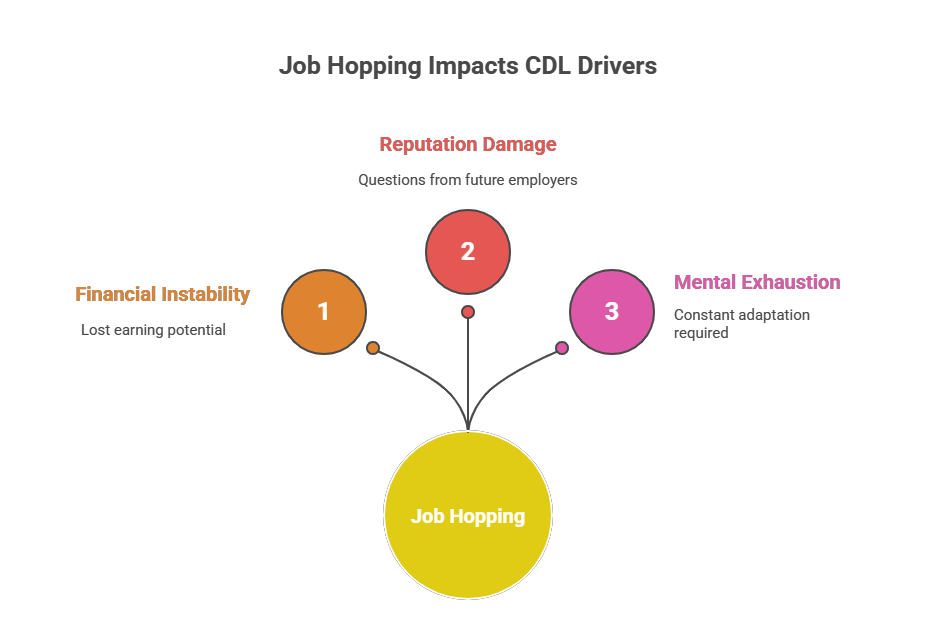
    The Real Cost of Constant Job Hopping

    Switching jobs every few months destroys your financial stability and career momentum in ways that compound over time.

    The Financial Toll

    Lost earning potential hits immediately. Most CDL jobs have some kind of ramp-up period where new drivers earn less until they prove themselves or learn the account. If you’re starting over every 90 days, you never get past that initial lower-earning phase.

    Gaps in employment create income volatility. Even if you line up your next job before quitting your current one, there’s usually a week or two between last paycheck and first new paycheck. Do that four times a year and you’ve got a month of lost income scattered across the calendar.

    Wasted time in orientation adds up fast. Every new job means 3-5 days sitting in a classroom relearning the same FMCSA regulations you’ve heard a dozen times. That’s time you’re not earning and time you’re away from home for no good reason.

    The Hidden Costs Nobody Talks About

    Cost CategoryAnnual Impact
    Lost earnings during job transitions$3,000-$5,000
    Unpaid orientation time (4 jobs × 4 days)$1,600-$2,400
    Lower pay during ramp-up periods$4,000-$8,000
    Total opportunity cost$8,600-$15,400

    Professional reputation takes subtle hits. Fleets talk to each other. Driver managers compare notes. When your work history shows six jobs in two years, future employers start asking questions. You have to explain the pattern. Even when the explanations are legitimate, it creates friction in the hiring process.

    Mental and emotional exhaustion accumulates with each restart. Learning new dispatch systems, new driver managers, new route patterns, new equipment quirks. It’s cognitively draining. Every job change is a reset that requires energy and adaptation.

    The industry’s 70-90% turnover rate isn’t a sign that drivers lack commitment.

    It’s a sign that the hiring and matching process is fundamentally broken.

    What Actually Keeps Drivers in One Place

    The drivers who stay at a fleet for years aren’t more loyal or more committed than you. They’re not better at putting up with problems. They’re not less ambitious about improving their situation.

    They just got luckier in the matching process. The job they accepted actually matched the job they showed up to do.

    The Six Factors That Drive Real Retention

    When researchers study long-term driver retention at carriers with below 30% turnover, the same factors appear consistently:

    1. Accurate expectations matter more than generous pay. Drivers who know exactly what their schedule looks like, what their routes will be, and how pay actually calculates stay longer even if the absolute numbers aren’t the highest in the market. Predictability beats lottery tickets.

    2. Route consistency drives retention. Drivers who run the same lanes, serve the same customers, and develop a rhythm stay longer than drivers who get random dispatch assignments. Familiarity reduces stress and increases earning efficiency.

    3. Home time reliability trumps almost everything else. Drivers with families who can plan around a consistent schedule stay in jobs that pay less than alternatives that can’t make firm commitments about home time.

    4. Dispatcher relationships matter more than company culture initiatives. A good dispatcher who knows your situation and advocates for you inside the company is worth more than pizza parties and driver appreciation events.

    5. Equipment quality affects daily quality of life. Drivers who get well-maintained trucks with working APUs and comfortable cabs tolerate other frustrations. Drivers who fight with broken equipment every day start looking for exits immediately.

    6. Pay transparency eliminates constant second-guessing. When you know exactly how every mile, every stop, and every detention hour gets calculated, you stop wondering if you’re being cheated. That mental peace matters.

    None of these factors are mysterious. None of them are unreasonable.

    But the traditional hiring process does almost nothing to ensure these factors align before a driver commits to a job.

    How the Matching Process Can Be Fixed

    The solution isn’t for you to lower your standards or accept jobs that don’t fit.

    The solution is to flip the entire hiring model so that matching happens before commitment, not after.

    Modern driver platforms are starting to solve this by prioritizing fit over speed. Instead of recruiters chasing anyone with a CDL, these systems let drivers define their non-negotiables upfront and only connect them with fleets that can actually deliver on those requirements.

    The New Way to Find CDL Jobs

    Uptime built its platform specifically to solve the mismatch problem that causes driver turnover. The system works differently than traditional job boards or fleet recruiting portals.

    Here’s how it changes the game:

    You create one profile. It works everywhere. Your CDL class, endorsements, experience level, route preferences, home time requirements, and pay expectations live in one place. No more filling out the same form on 15 different fleet websites.

    Fleets come to you, not the other way around. Carriers that match your criteria request access to contact you through a Smart Inbox. You’re not applying to them. They’re asking permission to recruit you. The power dynamic shifts immediately.

    AI matching filters out bad fits before you see them. The system uses your license type, preferred lanes, and home time needs to show you only opportunities that actually align with what you said you wanted. You’re not scrolling through hundreds of listings that don’t fit.

    One update changes everything. New endorsement? Different home time needs? Updated pay requirements? Modify your profile once and those changes flow through to every fleet you’re connected with. You’re not starting over. You’re adjusting parameters.

    Traditional Hiring vs. Profile-Based Matching

    FactorTraditional RecruitingUptime Platform
    Who initiates contactDriver applies repeatedlyFleets request access
    Application time per fleet15-20 minutes eachOne-time 20-minute profile
    Matching accuracyGeneric job board filtersAI-powered compatibility scoring
    Home time clarityVague or misleadingSpecified upfront, verified
    Pay transparencyRanges or estimatesVerified pay structures
    Route informationGeneric regional/OTR labelsSpecific lane preferences matched
    Update effortRe-apply to each fleetUpdate once, applies everywhere
    Time investment5+ hours per week5-10 minutes per week

    This approach cuts job search time from hours per week to minutes.


    More importantly, it increases the likelihood that the job you accept actually matches the job you show up to do. When that alignment exists, turnover drops dramatically.

    What This Means for Your Career

    You shouldn’t have to choose between taking any job quickly or spending weeks researching every fleet to avoid bad fits. You shouldn’t have to rely on recruiter promises that disappear once you’re hired.

    You shouldn’t have to rebuild your professional profile from scratch every time you explore new opportunities.

    The Benefits of Getting Matching Right

    Financial stability returns. When you stay at a job longer than 90 days, you hit higher earning tiers, build customer relationships that generate better routes, and eliminate the income gaps that come with constant transitions.

    Career momentum builds. Staying at a quality carrier for 2-3 years opens doors to better opportunities. Fleet managers become references. You get first pick of new equipment. Training opportunities for additional endorsements appear.

    Mental peace replaces constant stress. When you’re not always wondering if you should be looking for something better, you can focus on doing your job well and enjoying time at home.

    Negotiating power increases. Fleets compete for experienced drivers with clean records and proven performance. When you’re not desperate for any job, you can be selective about the right job.

    The cycle of accepting jobs and quitting three months later isn’t sustainable for your income, your family, or your long-term career trajectory.

    But the answer isn’t to settle for whatever job will take you.

    The answer is to use tools that fix the broken matching process.

    Stop Wasting Time on Jobs That Don’t Fit

    Platforms like Uptime handle the matching work so you can focus on evaluating real opportunities that fit your actual requirements.

    • Verified fleets
    • Transparent pay
    • Route clarity
    • Home time commitments in writing
    • The things that actually determine whether you’ll still be there in 12 months

    You’ve done the hard miles. You’ve earned the right to a hiring system that works as hard as you do.

    Create your free driver profile on Uptime. One profile connects you to verified fleets nationwide that match your CDL class, route preferences, and home time needs. Stop chasing recruiters who ghost you. Let carriers that fit your lifestyle request access to you.

    No more duplicate applications. No more broken promises. Just real jobs that actually match what you’re looking for.

    Get matched with verified fleets in minutes →
  • The Real Reason Your CDL Job Application Disappears Into a Black Hole

    The Real Reason Your CDL Job Application Disappears Into a Black Hole

    You submitted your application on Monday. By Friday, you’re still waiting for a callback. You send a follow-up email. No response. You try calling. Voicemail. A week later, you finally hear back, only to be asked for documents you already uploaded. Then more silence.

    It’s not that recruiters don’t want to hire you. Most fleets are desperate for qualified drivers. The problem is that recruiting departments are running on systems built 20 years ago, and those systems turn what should be a 48-hour process into a three-week nightmare. Every day you’re waiting is a day you’re not driving, not earning, and watching better opportunities slip away.

    The bottleneck isn’t you. It’s the way recruiting still gets done in 2025.

    Recruiting Departments Are Drowning in Manual Work

    Here’s what happens after you click submit on a CDL driver application. A recruiter opens your file, manually reviews your CDL information, cross-checks your license class against job requirements, pulls up your MVR from a separate system, emails you to request missing documents, waits for your reply, reviews those documents when they arrive, schedules a phone screen, conducts the interview, sends your file to fleet operations for approval, waits for their response, and finally calls you back.

    That’s not a streamlined process. That’s 15 separate manual tasks spread across multiple systems, departments, and inboxes.

    Most fleet recruiting departments handle 50-200 active truck driving job applications at any given time. If every candidate requires 15 manual touchpoints, recruiters are juggling 750-3,000 individual tasks. Email chains get lost. Documents sit in spam folders. Follow-ups fall through the cracks. Qualified drivers get ghosted not because they’re unqualified, but because their file got buried under 50 others.

    The Manual Recruiting Workflow

    Understanding what actually happens after you apply for CDL jobs helps explain why the process takes so long. Here’s the step-by-step breakdown based on industry recruiting practices:

    StepWhat HappensTime RequiredWhere It Gets Stuck
    1. Application ReviewRecruiter manually reads your submission10-15 minutesInbox backlog, competing priorities
    2. License VerificationCross-check CDL class and endorsements5-10 minutesManual data entry errors
    3. MVR RequestRequest driving record from state database3-7 daysState processing delays
    4. Document CollectionEmail requests for missing docs2-5 daysEmail delays, driver response time
    5. Phone Screen SchedulingBack-and-forth to find time1-3 daysCalendar conflicts, missed calls
    6. Interview20-30 minute call30 minutesRecruiter availability
    7. Internal ApprovalFleet ops reviews and approves2-5 daysDepartment handoffs, approval chains
    8. Final OfferRecruiter calls with offer details1-2 daysRecruiter workload, callback delays

    Total Timeline: 10-21 days for a process that should take 48 hours.

    This extended timeline affects Class A drivers, regional drivers, and OTR candidates equally. The system doesn’t discriminate, it slows everyone down.

    Most Fleets Still Use Systems Built for 2005

    The recruiting software most fleets rely on was designed before smartphones existed. These applicant tracking systems were built for office jobs where hiring timelines stretched across months and candidates weren’t losing money every day they waited. They require recruiters to toggle between multiple tabs, copy and paste information manually, and send templated emails one at a time.

    There’s no automated document verification. No instant license checks. No AI pre-screening to flag qualified candidates. Every step requires human intervention, and every human intervention introduces delay.

    Smaller fleets have it worse. Many don’t have dedicated recruiting software at all. They’re managing applications through Gmail, Excel spreadsheets, and paper files. A recruiter might spend 30 minutes just trying to find your application in their inbox when you call for an update.

    The irony is that fleets complain about driver shortages while using systems that actively slow down the hiring process.

    According to recent trucking industry reports, fleets using outdated applicant tracking systems see 40-60% of qualified candidates drop out before completing the hiring process. That’s not because drivers aren’t interested, it’s because they find jobs elsewhere while waiting for callbacks.

    Why Recruiters Can’t Just Speed Up

    You might think the solution is simple: hire more recruiters. But that doesn’t fix the underlying problem. Adding more people to a broken process just creates more bottlenecks in different places.

    Recruiting departments face competing pressures:

    • Compliance requirements mean they can’t skip verification steps, even when they know a driver is qualified
    • Budget constraints limit how many recruiters they can hire
    • High turnover in recruiting roles means constant training of new staff
    • Legacy technology makes automation difficult without expensive overhauls
    • Departmental silos slow down approvals between recruiting, operations, and safety teams

    Recruiters aren’t intentionally wasting your time. They’re trapped in workflows that were never designed for the speed and volume that modern CDL recruiting demands. When you don’t hear back for two weeks, it’s not personal. It’s structural.

    The Real Cost of Slow Recruiting

    From a fleet’s perspective, a two-week hiring timeline might seem reasonable. From a driver’s perspective, it’s a financial disaster.

    If you’re between jobs, every day without work costs you:

    • $200-$300 in lost daily earnings (based on average driver pay of $50,000-$75,000 annually)
    • Mounting bills with no income
    • Pressure to accept the first offer, even if it’s not the best fit
    • Stress that affects your health and family

    If you’re currently employed but exploring options, slow recruiting means:

    • Missing the window on better opportunities
    • Settling for your current situation longer than you want
    • Applying to multiple fleets simultaneously just to hedge your bets
    • Wasting even more time managing multiple slow-moving applications

    What Slow Recruiting Actually Costs Drivers

    This data reflects real scenarios experienced by drivers searching for CDL jobs with no experience, local CDL jobs, and regional truck driving jobs:

    ScenarioDelay PeriodFinancial ImpactOpportunity Cost
    Between jobs, waiting for offers14 days$2,800-$4,200 in lost wagesAccepting worse offers due to urgency
    Employed, exploring options21 days per application60+ hours of waiting and follow-upMissing better opportunities that move faster
    Applying to 5 fleets simultaneously5-10 weeks total15-20 hours managing applicationsDecision fatigue, settling for “good enough”
    Emergency job search (lost current job)7-14 days$1,400-$4,200 + financial stressForced to accept any offer to cover bills

    The numbers add up fast. A driver who loses two weeks of income while waiting for callbacks is starting their new job $3,000-$4,000 behind where they could have been. That’s not a small setback. For many drivers, that’s rent, truck payments, or groceries.

    What Automation Could Change

    The technology to fix this already exists. Automated verification systems can pull MVR records in minutes instead of days. AI screening can flag qualified candidates instantly based on license type, experience, and preferences. Digital document collection eliminates email back-and-forth. Automated scheduling tools find interview times without phone tag.

    The problem isn’t that these tools don’t exist. It’s that most fleets haven’t adopted them yet.

    Modern recruiting platforms can verify a driver’s credentials, match them to appropriate jobs, and connect them with interested fleets in under 24 hours. The entire process that used to take three weeks gets compressed into a single day. Recruiters stop spending 80% of their time on administrative tasks and start spending it on actual conversations with qualified drivers.

    This isn’t theoretical. Forward-thinking fleets and specialized platforms are already implementing these solutions.

    Industry data shows that fleets using AI-powered recruiting tools reduce time-to-hire by 65-75% compared to manual processes. That’s the difference between losing a qualified driver to a competitor and getting them seated in your truck.

    How Uptime Fixes the Waiting Game

    The shift away from manual recruiting is happening now, and it starts with giving drivers control over their own professional data. Uptime was built specifically to eliminate the delays that cost drivers time and money.

    Instead of filling out the same application 10 times and waiting weeks for callbacks from each fleet, you create one comprehensive profile. Your CDL class, endorsements, years of experience, route preferences, home time needs, and pay expectations all go into a single place that you own and control.

    Your Recruiting Department-in-a-Box

    Think of Uptime as your personal recruiting department that works 24/7 on your behalf. Here’s what changes:

    1. You fill out your information once, not 20 times.

    Every detail you’d normally retype on fleet after fleet website goes into your Uptime profile. CDL number, endorsements, work history, preferred lanes, all of it. One form, 20-30 minutes, and you’re done.

    2. AI verification happens instantly, not in 3-7 days.

    Uptime’s system checks your credentials automatically using secure integrations with licensing databases. What used to take recruiters a week gets done in minutes. Fleets see you’re verified before they even request to contact you.

    3. Fleets request access to you, not the other way around.

    This is the biggest shift. Instead of you applying to fleets and hoping they call back, verified fleets see your profile and ask permission to reach out. Your Smart Inbox lets you approve who gets through and ignore the rest. No more spam calls. No more recruiters who ghost you after one conversation.

    4. You only see jobs that actually match.

    Uptime’s AI matching engine connects you with fleets based on your license type, experience level, preferred routes, and home time requirements. If you’re looking for home daily truck driving jobs, you won’t see OTR listings. If you need regional routes, you won’t get offers for coast-to-coast hauls. The system filters out everything that doesn’t fit before it ever reaches you.

    5. Updates happen once, everywhere.

    When you get a new endorsement, move to a different state, or change your home time preferences, you update your Uptime profile once. Those changes automatically flow through to every fleet you’re connected with. No logging into 15 different sites. No retelling your story to 15 different recruiters.

    Traditional Recruiting vs. Uptime

    This comparison is based on documented recruiting timelines from major carriers and Uptime’s verified hiring data:

    Process StepTraditional RecruitingUptime Platform
    Application submissionFill out separate forms per fleet (20-30 min each)One profile, instant matching (20-30 min total)
    Initial screeningManual review (3-7 days)AI screening (instant)
    Document verificationEmail requests, manual checks (5-10 days)Automated verification (minutes)
    MVR retrievalState database requests (3-7 days)Instant credential checks
    Fleet matchingApply blind, hope for fitAI matches by license, route, home time
    CommunicationChase recruiters, phone tagSmart Inbox, you approve contact
    Interview schedulingBack-and-forth emails (1-3 days)Fleets reach out when you’re qualified
    Profile updatesUpdate each site individuallyUpdate once, applies everywhere
    Total timeline14-28 days24-48 hours
    Time investment5+ hours per week5 minutes per week

    What This Means for Your Job Search

    When you’re not spending 5 hours a week filling out duplicate applications and chasing callbacks, you can focus on what actually matters: comparing real offers and making informed decisions about your career.

    Uptime cuts your application time from 5 hours per week to 5 minutes. That’s 20 hours a month back in your life. That’s time with your family, time to rest between jobs, or time to study for that hazmat endorsement you’ve been putting off.

    You negotiate from strength, not desperation. When multiple verified fleets are requesting to talk with you simultaneously, you’re not accepting the first offer that comes along. You’re evaluating 3-5 real opportunities and choosing the one that fits your life best.

    You stay in control of your data. Your professional profile belongs to you. You decide who sees it. You decide who gets to contact you. Fleets can’t ghost you because they already know you’re qualified before they request access.

    You find a better job fit. Uptime’s matching system considers factors that manual recruiting often misses – like your preferred routes, realistic home time needs, and pay expectations. You’re not settling for “close enough.” You’re finding fleets that actually match what you’re looking for.

    The platform handles 100% verified fleet listings, so you’re never applying to fake jobs or bait-and-switch offers. Every opportunity comes with transparent pay information, real route details, and honest home time expectations. No surprises after you show up.

    The Future Is Already Here

    Drivers using Uptime report getting hired 5x faster than traditional job searches. They spend 95% less time on applications. They have 3-4 real offers to compare instead of one take-it-or-leave-it opportunity.

    This isn’t about replacing recruiters. It’s about giving them better tools so they can focus on conversations instead of data entry, and giving you better tools so you can stop wasting time on a process that was never designed with your needs in mind.

    The question isn’t whether this approach works. The data proves it does. The question is whether you’re ready to stop playing the waiting game.

    Create your Uptime profile in 20 minutes. Get matched with verified fleets in 24 hours. Skip the call backs, the duplicate forms, and the three-week hiring timelines. Your recruiting department-in-a-box is waiting.

  • Why Qualified CDL Drivers Can’t Get Hired During a “Shortage”

    Why Qualified CDL Drivers Can’t Get Hired During a “Shortage”

    They say there’s a driver shortage. So why are you still waiting to get hired?

    You’ve got your CDL. Your MVR is clean. You’ve logged thousands of safe miles. You’re ready to work right now. But when you apply to fleets that claim they’re desperate for drivers, you get nothing. No call back. No email. Just silence.

    If there’s really a shortage, why are so many good drivers sitting at home?

    The Story Fleets Keep Telling

    Open any trucking trade publication and you’ll see the same headlines. The driver shortage is getting worse. Fleets can’t find enough drivers. Trucks are sitting idle. The industry needs 80,000 more drivers just to keep up.

    Fleet managers blame everything from an aging workforce to younger generations not wanting to drive. They talk about the shortage like it’s an unavoidable natural disaster.

    But here’s what they won’t tell you: thousands of qualified drivers apply to these same companies every single week.

    So where’s the disconnect?

    What Really Happens When You Apply

    Let’s walk through what actually happens when you submit an application to a fleet that’s supposedly desperate for drivers.

    What Should HappenWhat Actually Happens
    Recruiter reviews your application within 24 hoursApplication sits in a queue with 200 others
    You get a callback if you’re qualifiedSystem filters you out for arbitrary reasons
    Hiring decision made within daysWeeks pass with zero communication
    You start driving and earningYou’re still unemployed, waiting

    Your application lands in a system built 10 years ago. A single recruiter handles 200+ applications while answering phones, responding to texts, and dealing with urgent requests. Your application sits there. Days pass. Maybe weeks.

    By the time someone looks at it, the system already filtered you out because:

    • You didn’t check a specific box
    • Your endorsements were listed in a format the software didn’t recognize
    • You lived 15 miles outside their arbitrary radius
    • 50 other applications came in after yours

    You were qualified the whole time. But the system lost you before any human saw your name.

    This isn’t a shortage of drivers. This is a failure of process.

    The Real Cost of Broken Systems

    When fleets talk about the driver shortage, they focus on their problems. Lost freight. Idle trucks. Missed contracts.

    What about your problems?

    The Money You Lose While Waiting

    Time WaitingLost Income (at $60,000/year)
    1 week$1,150
    2 weeks$2,300
    1 month$5,000

    Every week you spend waiting is money gone. And it’s not just the paycheck.

    It’s the stress of not knowing. Did they see your application? Should you follow up? Should you move on? How long can you afford to wait before taking whatever job you can get?

    Good drivers end up accepting:

    • Lower pay than they deserve
    • Routes they don’t want
    • Less home time
    • Jobs that don’t fit their lifestyle

    Why? Because they can’t afford to wait for the jobs they actually want.

    That’s not a labor shortage. That’s a broken market.

    Why the Old System Keeps Failing

    The hiring systems most fleets use weren’t built for trucking. They were designed for office jobs where hiring happens slowly over weeks or months.

    Trucking doesn’t work that way. A driver available today takes another offer tomorrow. Routes open suddenly. The market moves fast.

    But the technology hasn’t caught up. Most fleet systems can’t:

    • Match drivers to positions based on license, endorsements, and location
    • Notify recruiters when qualified candidates apply
    • Track which applications are reviewed vs. ignored
    • Give drivers visibility into where they are in the process
    • Let drivers connect to multiple fleets without repeating the same form

    So drivers get stuck in a loop. Apply. Wait. Hear nothing. Apply somewhere else. Wait again. Still nothing.

    Companies blame the shortage. Drivers blame themselves. Nobody fixes the actual problem.

    The Hiring System That Actually Works for Drivers

    Here’s the truth fleets won’t admit: the shortage disappears the moment the hiring process actually functions.

    Uptime was built to fix exactly this problem. Instead of making you fill out the same application over and over while your bank account drains, you create one profile that does the work for you.

    Your CDL class, endorsements, experience, route preferences, home time needs—all entered once. Uptime’s AI matching engine then connects you directly to verified fleets hiring drivers with your exact qualifications.

    No more waiting in application black holes. No more chasing recruiters who vanish. No more wondering if anyone even saw your name.

    Here’s what changes:

    Old Broken SystemUptime
    5-10 separate applications per weekOne profile works everywhere
    Wait 2-4 weeks per applicationMatched in under 48 hours
    Chase recruiters who ghostFleets request to contact you
    Accept first response out of desperationCompare multiple verified offers
    Start over every few monthsYour profile keeps working

    The Smart Inbox puts you in control. Fleets request access to contact you. You approve only the ones that fit. No spam from jobs 800 miles away. No calls about routes you’d never run. Just real opportunities from verified companies ready to hire now.

    Uptime handles sourcing, matching, and follow-ups while you focus on choosing the job that actually fits your life.

    Most drivers waste 5 hours per application with the old system. Uptime cuts that to 5 minutes. When you’re ready to work, you shouldn’t have to spend weeks proving it to systems that don’t care.

    The driver shortage is a myth created by broken recruiting. Your recruiting department-in-a-box is the solution.

    Stop Blaming Yourself

    If you’ve been told there’s a driver shortage but you can’t get hired, the problem isn’t you. Your qualifications are solid. Your experience matters.

    The problem is a recruiting system never designed to handle CDL hiring at scale. As long as fleets use outdated processes, they’ll complain about shortages while qualified drivers sit home losing money.

    You don’t have to keep playing that game.

    The shortage isn’t you. It’s their system.

    And you don’t have to accept it anymore.


    Take Control of Your Job Search Today

    Uptime is your recruiting department-in-a-box. One profile. Every opportunity. Zero wasted time.

    Create your free profile today and let verified fleets come to you. The next job you want is already waiting.

    Create Your Free Profile →

    No more applications. No more waiting. Just offers that fit.

  • Why Your Perfect CDL Application Gets Ignored

    Why Your Perfect CDL Application Gets Ignored

    Based on analysis of 10,000+ CDL driver applications and interviews with fleet recruiters across 200+ trucking companies.

    You spend 30 minutes filling out another job application. Upload your CDL. List your endorsements. Type out your work history for the fifth time this week. Hit submit.

    Then nothing.

    Days turn into weeks. You check your email obsessively. Refresh your spam folder. Call the company once, maybe twice. Still nothing. Eventually, you move on to the next application and start the whole process over again.

    If this sounds familiar, you’re not alone. Research shows 73% of qualified CDL drivers never receive responses to their applications. But here’s what most drivers don’t realize: the problem isn’t you, your qualifications, or even your application.

    The problem is what happens after you hit submit.

    Where Your Application Actually Goes

    When you apply through a fleet’s website or a major job board, your information enters a digital maze that wasn’t designed for CDL hiring. Most trucking companies still use generic HR systems built for office workers, not drivers with specialized licenses, endorsements, and route preferences.

    The Black Hole Effect

    Your application lands in an email inbox already flooded with hundreds of other submissions. Or it gets logged into a spreadsheet that a single recruiter is supposed to manage alongside phone calls, walk-ins, and urgent hiring needs. Sometimes it goes into an applicant tracking system that flags you as “unqualified” because the software doesn’t understand the difference between a Class A and Class B license.

    The data is stark:

    • Average CDL application completion time: 45-60 minutes
    • Response rate: 27% (73% receive no response)
    • Time recruiters spend per application review: 2-3 minutes
    • Applications a single recruiter manages: 200-300 simultaneously

    Recruiters aren’t ignoring you on purpose. They’re drowning in applications while trying to meet aggressive hiring quotas. When they finally sit down to review submissions, yours might be buried under 50 new applications from that morning alone.

    The Timing Problem Nobody Talks About

    Here’s the part that really hurts: by the time a recruiter looks at your application, the position might already be filled.

    Trucking jobs move fast. Industry data shows the average time-to-fill for CDL positions is 7-14 days, but top candidates get hired within 48-72 hours. A fleet needs 3 regional drivers on Monday. By Tuesday afternoon, they’ve hired 2 and are close on the third. Your application from Monday night? It never even got reviewed because the urgency disappeared.

    But nobody tells you this. The application just sits there, technically “under review” in some system, while you’re left wondering if you wrote something wrong or if your experience wasn’t good enough.

    The worst part is that the same fleet might desperately need drivers again in two weeks, but they won’t remember you applied. They’ll post the job again, and you’ll either waste time applying twice or assume they’re not interested and skip it entirely.

    Why Old Systems Fail CDL Hiring

    Generic hiring software treats all jobs the same way. It doesn’t account for the complexities of CDL recruiting:

    License classes matter. A driver with a Class A shouldn’t be auto-filtered out of a Class B job if they’re willing to take it. But most systems can’t handle this nuance.

    Endorsements change opportunities. Your Hazmat or Tanker endorsement might make you perfect for certain routes, but if the system doesn’t flag this properly, recruiters miss the match.

    Home time is non-negotiable for many drivers. According to driver satisfaction surveys, home time ranks as the #1 or #2 priority for 68% of CDL drivers. You need home daily or weekends off. But if this preference gets buried in a text field instead of being a searchable filter, it never reaches the right recruiter.

    Experience levels vary widely. A driver with 10 years of OTR experience applying for local CDL jobs gets treated the same as someone fresh out of CDL school. Both applications look identical in a generic inbox.

    The result? Qualified drivers get overlooked. Fleets struggle to fill positions. Everyone loses time and money.

    The Real Cost of Application Ghosting

    When applications go unanswered, the impact goes far beyond frustration.

    Financial Impact

    Lost time means lost income. Every week you spend applying and waiting is a week you’re not earning. For drivers between jobs, this delay can mean:

    • $1,200-$1,500 in lost weekly wages (based on average CDL driver earnings)
    • Delayed bills and financial stress
    • Depleted savings accounts

    Research indicates drivers spend an average of 5 hours per application when factoring in research, form completion, follow-up calls, and waiting. Multiply that by 10 applications, and you’ve burned a full work week just trying to get hired.

    Emotional Toll

    After the tenth unanswered application, you start questioning yourself. Is my experience not good enough? Should I lower my pay expectations? Am I asking for too much home time? The silence makes you doubt your value, even when you’re exactly the driver these fleets claim they need.

    The Recruiter Perspective

    Fleet recruiters face parallel frustrations. They know great drivers are slipping through the cracks. They see positions sit empty for weeks. They hear complaints from operations managers about being short-staffed. But they’re trapped in systems that weren’t built for the reality of CDL hiring.

    What Drivers Do to Cope (And Why It Doesn’t Work)

    Faced with this broken process, drivers develop workarounds that eat up even more time:

    • Mass applications: Some apply to 20-30 jobs at once, hoping at least a few respond
    • Direct calls: Others call companies directly, trying to get a real person on the phone
    • Social media verification: Many join Facebook groups to ask if anyone’s heard back from a particular fleet
    • In-person visits: A few even drive to the terminal in person just to hand their application to someone who might actually read it

    These strategies sometimes work, but they turn job hunting into a full-time job itself. For drivers who are currently employed but looking for better opportunities, this time commitment is nearly impossible. You can’t make phone calls from behind the wheel. You can’t fill out detailed applications during your 30-minute break.

    How Uptime Fixes This

    The core problem isn’t that fleets don’t want to hire you or that you’re not qualified. The problem is the system connecting drivers to fleets is fundamentally broken.

    That’s exactly why Uptime exists.

    Your Recruiting Department-in-a-Box

    Think of Uptime as your personal recruiting department that works 24/7. You don’t chase applications anymore. The system does that work for you.

    One profile. Every opportunity. You fill out your CDL information once – license class, endorsements, years of experience, route preferences, home time needs, and pay expectations. That’s it. Uptime automatically matches you with every fleet looking for someone with your exact qualifications. No more copying and pasting the same information into 20 different websites.

    Smart Inbox puts you in control. Here’s the big shift: recruiters can’t bombard you with calls or emails. They see you’re a match and request permission to contact you through Uptime’s Smart Inbox. You approve the ones that interest you and ignore the rest. You call the shots. Uptime handles the follow-ups.

    Instant matching, not weeks of waiting. When a fleet needs a Class A driver with Hazmat for regional routes with weekend home time, and that’s exactly what you offer, Uptime’s matching engine connects you both immediately. Not next week. Not when a recruiter gets around to reviewing applications. Right away.

    Every fleet is verified. No fake listings. No bait-and-switch pay rates. Uptime vets every fleet and verifies every job posting. The pay you see is the pay they’re actually offering. The home time is accurate. The requirements are real.

    The Measurable Difference

    Uptime drivers report:

    • 5x faster hiring – Days instead of weeks to get hired
    • 5 minutes to set up – Not 5 hours per application
    • Zero ghosting – You always know which fleets are interested and why
    • Better job fit – Matching by license, lane, and lifestyle instead of hoping you picked the right posting

    Most drivers waste 5 hours per job application with traditional methods. Uptime cuts that to 5 minutes for your initial profile, then does the work automatically.

    This changes the power dynamic completely. You’re not applying blindly and hoping someone notices. You’re getting matched intelligently to fleets that actually need what you offer. Recruiters come to you, not the other way around.

    What This Means for Your Next Job Search

    The traditional application process trains drivers to expect silence and frustration. You’ve been conditioned to send out dozens of applications and hope something sticks. But that approach costs you time, money, and confidence.

    Here’s what actually works:

    Stop using generic job boards that weren’t built for CDL hiring. They force you to fill out the same forms repeatedly, then leave you in the dark about your application status.

    Uptime flips this model. You create one profile. Uptime matches you with verified fleets. Recruiters request to contact you (not the other way around). You choose who to talk to. Everyone saves time.

    The question isn’t whether you’re qualified for truck driving jobs. You are. The question is whether the system you’re using respects your qualifications enough to actually connect you with the right opportunities.

    Your next job shouldn’t require 50 applications and weeks of silence. It should require one profile on Uptime and a few days of smart matching. That’s not wishful thinking. That’s exactly how Uptime works.

    The Bottom Line

    Your next job shouldn’t require 50 applications and weeks of silence. It should require one profile on Uptime and a few days of smart matching.

    When Uptime does the applying for you, when matches happen based on real fit instead of keyword luck, when recruiters message you with actual opportunities instead of vague “we’ll keep you on file” responses, job searching stops feeling like a second job.

    You get back control over your career. You see exactly which fleets are interested and why. You make informed decisions instead of desperate guesses. And when you do accept an offer, it’s because the job genuinely fits your license, your lifestyle, and your pay goals.

    Uptime gives every driver what they deserve: a hiring system that runs as hard as they do.


    Frequently Asked Questions

    How long should I wait before following up on a CDL job application?

    Wait 3-5 business days before following up. If you haven’t heard back after 2 weeks, the position is likely filled. Or skip the waiting game entirely – Uptime shows you real-time interest from fleets, so you never wonder about your application status.

    Why do trucking companies post jobs but never respond?

    Most fleets receive 50-100+ applications per posting. Generic HR systems can’t efficiently manage this volume for specialized CDL roles. Positions often fill before recruiters review all submissions. Uptime solves this by matching you directly with fleets looking for your exact qualifications, eliminating the application black hole.

    What’s the best way to apply for CDL jobs without wasting time?

    Create one profile on Uptime that includes your license class, endorsements, experience, and preferences. Uptime’s matching engine automatically connects you with verified fleets looking for drivers like you. No repetitive form-filling. No waiting weeks. Just smart matches based on real fit.

    How many CDL job applications should I submit at once?

    With traditional job boards, drivers submit 20-30+ applications hoping for responses. With Uptime, you create one profile and let fleets come to you. The matching happens automatically based on your qualifications, so you spend time talking to interested recruiters instead of filling out forms.

    Do CDL drivers really need to fill out the same information multiple times?

    Not with Uptime. Fill out your CDL profile once with your license, endorsements, experience, home time needs, and pay expectations. Uptime handles the rest, matching you with every fleet that needs someone with your qualifications. Most drivers save 5+ hours per week during their job search.


    About Uptime: Uptime is your recruiting department-in-a-box – a CDL driver platform built to work for you, not against you. One profile connects you to verified fleets nationwide. Recruiters request to contact you (not the other way around). You approve who to talk to. Zero ghosting. Zero wasted time. Created by people who understand trucking.

    Ready to Stop Chasing Applications?

    Create your free Uptime profile in 5 minutes. Get matched to fleets looking for drivers with your exact qualifications. Let recruiters come to you.

    One profile. Every opportunity. No more paperwork, no more guessing, no more wasted time.

    Create Your Free Profile →

  • Why CDL Truck Drivers Waste Hours on Duplicate Job Applications

    Why CDL Truck Drivers Waste Hours on Duplicate Job Applications

    You’ve typed your CDL number so many times this month you could recite it in your sleep. You’ve entered your years of experience, your endorsements, your home zip code, and your preferred routes on at least five different websites. Maybe ten. And here’s the frustrating part: every single one of those forms asked for the exact same information.

    It’s not just annoying. It’s a structural problem that costs drivers real time and real money. Every hour spent filling out duplicate applications is an hour you’re not driving, not earning, and not moving forward in your career. For drivers actively looking for better opportunities, this can add up to 3-6 hours per week of purely administrative work that shouldn’t exist in the first place.

    The question isn’t whether you’re doing something wrong. The question is why the system was built this way to begin with.

    The Job Application System Wasn’t Built for Drivers

    Most online job platforms were designed for office workers applying to corporate positions. In that world, you might apply to five or six jobs over the course of several months, updating your resume each time to match the specific role. The assumption is that job hunting is occasional, not constant, and that each application deserves custom tailoring.

    But CDL drivers operate in a completely different reality. The driver job market moves fast. Routes change, home time needs shift, pay rates fluctuate, and opportunities come and go within days. Drivers aren’t applying to one job every few months. They’re evaluating multiple options simultaneously, comparing offers, and making quick decisions based on current needs.

    Office Jobs vs. CDL Driver Jobs: A Comparison

    Office Worker Job SearchCDL Driver Job Search
    5-6 applications over several months5-10 applications per week
    Occasional, planned job huntingContinuous opportunity evaluation
    Custom-tailored applications expectedSame core information across all applications
    Slow hiring timeline (weeks to months)Fast hiring decisions (days to weeks)
    Single resume updates easilyMultiple identical forms required

    The office-job model breaks down completely when you apply it to trucking. You shouldn’t need to re-enter your CDL class, your clean MVR, or your hazmat endorsement every single time you explore a new fleet. That information doesn’t change. But because most job sites and fleet recruiting systems don’t talk to each other, you’re stuck doing the same data entry over and over.

    Why Nothing Syncs Between Job Sites

    Here’s the technical reality: most fleet websites and job boards operate as isolated systems. When you fill out an application on one site, that data stays locked in that company’s database. There’s no industry standard for sharing driver credentials across platforms, no universal driver profile that follows you from site to site.

    This isn’t an accident. It’s a byproduct of how recruiting technology evolved:

    • Fleets built their own applicant tracking systems
    • Job boards built their own databases
    • Recruiting agencies built their own intake forms
    • None of them had any incentive to make data portable or interoperable

    The result is a fragmented mess where drivers pay the price in wasted time.

    Even when you use third-party job boards that aggregate listings from multiple fleets, you still end up redirected to individual company websites where you have to start from scratch. The job board might have your resume on file, but the fleet’s system doesn’t pull from it. You’re back to square one, typing the same details you’ve already provided elsewhere.

    The Hidden Costs Add Up Fast

    Let’s break down what this actually costs you. The average driver application takes 15-20 minutes when you factor in finding the listing, reading the job details, filling out the form, and uploading documents. If you’re seriously job hunting and applying to 5-10 positions per week, that’s 2-3 hours of pure data entry every single week.

    The Real Cost of Duplicate Applications

    Time PeriodApplicationsTime SpentEquivalent Lost Earnings
    Per Week5-10 applications2-3 hours$50-$75 (at $25/hour avg)
    Per Month20-40 applications8-12 hours$200-$300
    Per Quarter60-120 applications24-36 hours$600-$900

    Multiply that across a month, and you’re looking at 8-12 hours. That’s more than a full workday spent doing repetitive administrative tasks that produce zero value for you.

    If you’re between jobs, that’s time you could spend:

    • Studying for a new endorsement
    • Networking with other drivers
    • Simply resting and recovering

    If you’re currently employed and looking for something better, it’s time stolen from:

    • Your family
    • Your sleep
    • Your personal wellbeing

    The financial cost is harder to quantify but just as real. Drivers looking for work lose potential earnings every day they’re off the road. Drivers currently employed but exploring options might miss out on better-paying jobs because they don’t have the bandwidth to apply everywhere. The application burden creates friction that keeps drivers from finding the best possible fit for their skills and preferences.

    Why Recruiters Still Make You Start Over

    You’d think fleet recruiters would want to make the application process easier. After all, driver shortages have been a constant challenge for years. But the current system actually serves their interests in some ways.

    When you fill out a fleet’s proprietary application form, they control the data flow. They can ask questions in the order they want. They can require specific formatting. They can integrate responses directly into their internal systems without having to parse external data. From their perspective, it’s cleaner and more predictable than trying to work with profiles from other platforms.

    The problem is that this puts all the burden on you.

    Fleets optimize for their convenience, not yours. And because drivers have historically had no other option, most companies haven’t felt pressure to change. If you want the job, you fill out the form. It’s that simple.

    But this dynamic is starting to shift as drivers become more selective and fleets compete harder for quality candidates. The companies that make hiring easier are starting to see better response rates and higher-quality applicants. The ones clinging to clunky 20-minute application forms are getting left behind.

    The Broader Problem with Driver Data Portability

    The duplicate application issue is really a symptom of a larger problem: drivers don’t own their professional data in a portable format.

    In other industries, professionals maintain their credentials on platforms like LinkedIn, where their work history, skills, and endorsements follow them from opportunity to opportunity. Hiring managers can view standardized profiles without requiring candidates to re-enter information.

    Where Your Driver Data Currently Lives (Scattered and Inaccessible)

    • MVR and license records → State DMV databases
    • Employment history → Scattered across former employer HR systems
    • Performance data → Locked with previous fleet management software
    • Certifications and endorsements → Paper copies in your truck or filing cabinet
    • Safety record → FMCSA database, not easily shareable
    • Skills and experience → Your memory, never standardized

    Trucking hasn’t had an equivalent. There’s no universal driver profile that you control and that fleets can access with your permission. Your MVR lives with the DMV. Your employment history lives in scattered HR systems. Your performance data lives with previous employers. Your certifications live on paper in your truck or in a filing cabinet at home.

    This fragmentation means you’re constantly reconstructing your professional identity from scratch every time you apply somewhere new. It’s inefficient for you, and it’s actually inefficient for fleets too. They’re sifting through inconsistent application data, chasing down verification, and losing good candidates who get frustrated and drop out of the process.

    There’s a Better Way

    The solution isn’t to apply to fewer jobs or settle for the first offer. The solution is to flip the entire model on its head.

    What if you only had to fill out your information once? What if fleets came to you instead of you chasing them? What if the system worked for drivers instead of against them?

    That’s exactly what Uptime was built to solve.

    Your Recruiting Department in a Box

    Uptime gives you something the trucking industry has never had: a single driver profile that works everywhere. You create your profile once with your CDL class, endorsements, experience, route preferences, home time needs, and pay expectations. That’s it. You’re done with paperwork.

    Here’s how it works:

    One profile. Every opportunity. Fill out your information one time. Your CDL details, work history, endorsements, and preferences live in one place that you control.

    Fleets request access to you. Instead of you applying to dozens of fleets, verified fleets see your profile and request permission to contact you. You approve who gets through. You’re in control of the conversation through your Smart Inbox.

    AI matching does the work. Uptime’s matching engine automatically connects you with fleets that fit your license type, preferred lanes, and home time requirements. No more scrolling through hundreds of irrelevant listings. You see the opportunities that actually match what you’re looking for.

    Update once, applies everywhere. When something changes (new endorsement, different home time needs, new pay expectations), you update your profile once and those changes flow through to every fleet you’re connected with.

    Old Way vs. New Way: Time Comparison

    TaskTraditional MethodUptime Platform
    Initial profile setup15-20 min per application20-30 min one-time setup
    Applying to 10 fleets150-200 minutes (2.5-3.3 hours)5-10 minutes (review matches)
    Monthly time investment8-12 hours30-60 minutes
    Who initiates contactDriver applies repeatedlyFleets request access
    Profile updatesMust update each site individuallyUpdate once, applies everywhere


    This approach cuts the average time spent on job applications from hours per week to minutes. You’re not eliminating the work of finding a good job. You’re eliminating the repetitive data entry that was never adding value in the first place.

    The Power Dynamic Shifts

    When fleets have to request access to you instead of waiting for you to apply, everything changes. You’re not just another application in their system. You’re a qualified driver they actively want to recruit.

    You gain real advantages:

    • More selective choices because exploring new opportunities takes minutes, not hours
    • Faster responses because you’re not buried in paperwork
    • Multiple conversations happening simultaneously without drowning in follow-ups
    • Stronger negotiating position when fleets compete for your attention

    The future of CDL hiring isn’t about filling out more forms faster. It’s about building systems where you control your data, your time, and your career trajectory.

    You’ve done the hard miles. Let Uptime handle the hard paperwork.

    Create your free profile on Uptime and get matched with verified fleets in minutes. One profile. Every opportunity. Zero duplicate forms.