You’ve quit more jobs in the past two years than you care to admit.
Not because you can’t commit. Not because you’re difficult to work with. Not because you lack work ethic.
You quit because the job you showed up for wasn’t the job you were promised.
The recruiter said home every weekend. Reality was home every other weekend, maybe. The listing advertised $75,000 annual. Your first paycheck revealed that number assumed you’d run illegal hours and never take time off. The routes were supposed to be regional Southeast. You spent three weeks bouncing between Arizona and Montana.
The trucking industry has a turnover problem that everyone blames on drivers. Turnover rates hover between 70-90% at many carriers. Industry publications run endless articles about driver loyalty and commitment. Fleet executives complain about the challenges of retention.
But here’s what gets glossed over: most drivers don’t leave because they’re flaky. They leave because fleets set them up to fail from day one.
The Mismatch Problem Nobody Wants to Admit
Driver retention isn’t a driver problem. It’s a matching problem disguised as a behavior problem.
When you accept a CDL job, you’re making decisions based on limited, often misleading information. The job posting lists a pay range so wide it’s meaningless. The recruiter focuses on sign-on bonuses and skips over the details that actually determine whether you’ll last 90 days.
You take the job because you need work. You show up ready to perform.
Then reality hits.
What Actually Goes Wrong
The routes don’t match what you were told. You wanted consistent regional lanes. You get random spot freight that bounces you all over the country with no predictable pattern.
The schedule doesn’t align with your needs. You made it clear you need to be home for your kid’s weekend games. The dispatcher treats your home time like a suggestion, not a commitment.
The pay structure punishes you for things outside your control. Detention time isn’t compensated. Breakdown time comes out of your pocket. The accessorial pay you were promised requires fighting with back-office staff every single week.
The equipment isn’t what you expected. You were told you’d get a 2022 or newer truck. You’re assigned a 2018 with 600,000 miles and a check engine light that won’t go away.
You didn’t change. The job description did.
The only rational response is to start looking again.
Why Fleets Keep Making the Same Mistakes
Fleet recruiters operate under brutal pressure. They have seat quotas to fill. Empty trucks cost money every single day. When a driver quits, the clock starts ticking immediately to find a replacement.
That urgency creates a system where getting someone hired becomes more important than getting the right person hired.
The Recruiter’s Playbook
| What They Emphasize | What They Minimize |
| Sign-on bonuses | Actual weekly take-home |
| “Competitive pay” | Specific CPM or hourly rates |
| “Regional routes” | Actual lane assignments |
| “Home weekends” | Forced dispatch exceptions |
| Shiny new equipment | Maintenance record of your actual truck |
| Driver appreciation events | Pay for detention and breakdown time |
So recruiters oversell. They emphasize the positives and minimize the negatives. They frame things in the best possible light. They focus on getting you to say yes, knowing full well that once you’re in orientation, the sunk cost fallacy makes you more likely to stick around even when red flags appear.
This isn’t a conspiracy. It’s a rational response to misaligned incentives.
Recruiters get measured on hires, not on 12-month retention. By the time you quit three months in, that recruiter has already moved on to filling the next 20 seats. Your departure becomes a data point in a spreadsheet, not a failure that demands process changes.
The fleet loses money on the deal. You lose time, income stability, and peace of mind.
But the system perpetuates because there’s no forcing function that makes better matching more profitable than fast hiring.
The Real Cost of Constant Job Hopping
Switching jobs every few months destroys your financial stability and career momentum in ways that compound over time.
The Financial Toll
Lost earning potential hits immediately. Most CDL jobs have some kind of ramp-up period where new drivers earn less until they prove themselves or learn the account. If you’re starting over every 90 days, you never get past that initial lower-earning phase.
Gaps in employment create income volatility. Even if you line up your next job before quitting your current one, there’s usually a week or two between last paycheck and first new paycheck. Do that four times a year and you’ve got a month of lost income scattered across the calendar.
Wasted time in orientation adds up fast. Every new job means 3-5 days sitting in a classroom relearning the same FMCSA regulations you’ve heard a dozen times. That’s time you’re not earning and time you’re away from home for no good reason.
The Hidden Costs Nobody Talks About
| Cost Category | Annual Impact |
| Lost earnings during job transitions | $3,000-$5,000 |
| Unpaid orientation time (4 jobs × 4 days) | $1,600-$2,400 |
| Lower pay during ramp-up periods | $4,000-$8,000 |
| Total opportunity cost | $8,600-$15,400 |
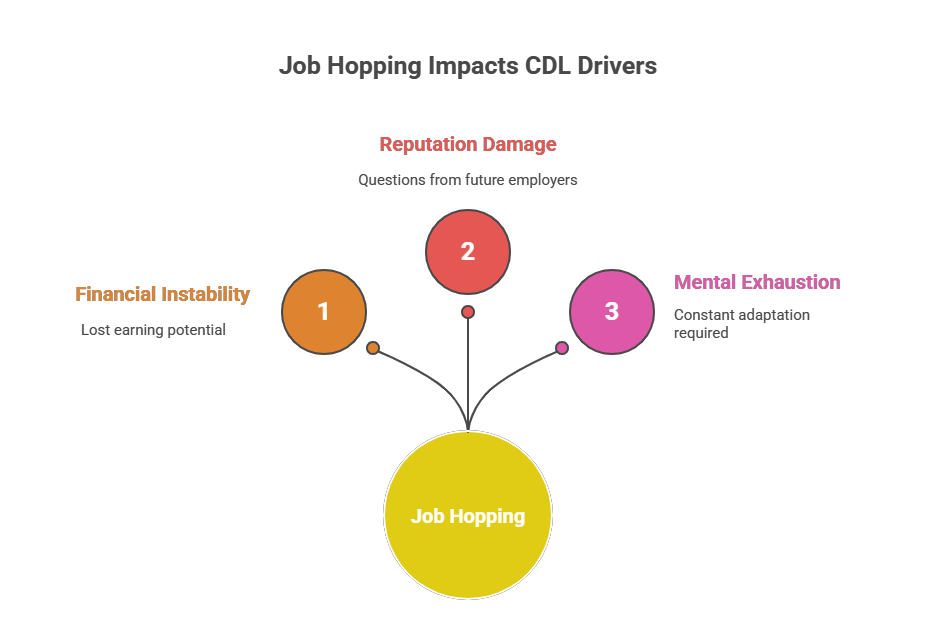
Professional reputation takes subtle hits. Fleets talk to each other. Driver managers compare notes. When your work history shows six jobs in two years, future employers start asking questions. You have to explain the pattern. Even when the explanations are legitimate, it creates friction in the hiring process.
Mental and emotional exhaustion accumulates with each restart. Learning new dispatch systems, new driver managers, new route patterns, new equipment quirks. It’s cognitively draining. Every job change is a reset that requires energy and adaptation.
The industry’s 70-90% turnover rate isn’t a sign that drivers lack commitment.
It’s a sign that the hiring and matching process is fundamentally broken.
What Actually Keeps Drivers in One Place
The drivers who stay at a fleet for years aren’t more loyal or more committed than you. They’re not better at putting up with problems. They’re not less ambitious about improving their situation.
They just got luckier in the matching process. The job they accepted actually matched the job they showed up to do.
The Six Factors That Drive Real Retention
When researchers study long-term driver retention at carriers with below 30% turnover, the same factors appear consistently:
1. Accurate expectations matter more than generous pay. Drivers who know exactly what their schedule looks like, what their routes will be, and how pay actually calculates stay longer even if the absolute numbers aren’t the highest in the market. Predictability beats lottery tickets.
2. Route consistency drives retention. Drivers who run the same lanes, serve the same customers, and develop a rhythm stay longer than drivers who get random dispatch assignments. Familiarity reduces stress and increases earning efficiency.
3. Home time reliability trumps almost everything else. Drivers with families who can plan around a consistent schedule stay in jobs that pay less than alternatives that can’t make firm commitments about home time.
4. Dispatcher relationships matter more than company culture initiatives. A good dispatcher who knows your situation and advocates for you inside the company is worth more than pizza parties and driver appreciation events.
5. Equipment quality affects daily quality of life. Drivers who get well-maintained trucks with working APUs and comfortable cabs tolerate other frustrations. Drivers who fight with broken equipment every day start looking for exits immediately.
6. Pay transparency eliminates constant second-guessing. When you know exactly how every mile, every stop, and every detention hour gets calculated, you stop wondering if you’re being cheated. That mental peace matters.
None of these factors are mysterious. None of them are unreasonable.
But the traditional hiring process does almost nothing to ensure these factors align before a driver commits to a job.
How the Matching Process Can Be Fixed
The solution isn’t for you to lower your standards or accept jobs that don’t fit.
The solution is to flip the entire hiring model so that matching happens before commitment, not after.
Modern driver platforms are starting to solve this by prioritizing fit over speed. Instead of recruiters chasing anyone with a CDL, these systems let drivers define their non-negotiables upfront and only connect them with fleets that can actually deliver on those requirements.
The New Way to Find CDL Jobs
Uptime built its platform specifically to solve the mismatch problem that causes driver turnover. The system works differently than traditional job boards or fleet recruiting portals.
Here’s how it changes the game:
You create one profile. It works everywhere. Your CDL class, endorsements, experience level, route preferences, home time requirements, and pay expectations live in one place. No more filling out the same form on 15 different fleet websites.
Fleets come to you, not the other way around. Carriers that match your criteria request access to contact you through a Smart Inbox. You’re not applying to them. They’re asking permission to recruit you. The power dynamic shifts immediately.
AI matching filters out bad fits before you see them. The system uses your license type, preferred lanes, and home time needs to show you only opportunities that actually align with what you said you wanted. You’re not scrolling through hundreds of listings that don’t fit.
One update changes everything. New endorsement? Different home time needs? Updated pay requirements? Modify your profile once and those changes flow through to every fleet you’re connected with. You’re not starting over. You’re adjusting parameters.
Traditional Hiring vs. Profile-Based Matching
| Factor | Traditional Recruiting | Uptime Platform |
| Who initiates contact | Driver applies repeatedly | Fleets request access |
| Application time per fleet | 15-20 minutes each | One-time 20-minute profile |
| Matching accuracy | Generic job board filters | AI-powered compatibility scoring |
| Home time clarity | Vague or misleading | Specified upfront, verified |
| Pay transparency | Ranges or estimates | Verified pay structures |
| Route information | Generic regional/OTR labels | Specific lane preferences matched |
| Update effort | Re-apply to each fleet | Update once, applies everywhere |
| Time investment | 5+ hours per week | 5-10 minutes per week |
This approach cuts job search time from hours per week to minutes.
More importantly, it increases the likelihood that the job you accept actually matches the job you show up to do. When that alignment exists, turnover drops dramatically.
What This Means for Your Career
You shouldn’t have to choose between taking any job quickly or spending weeks researching every fleet to avoid bad fits. You shouldn’t have to rely on recruiter promises that disappear once you’re hired.
You shouldn’t have to rebuild your professional profile from scratch every time you explore new opportunities.
The Benefits of Getting Matching Right
Financial stability returns. When you stay at a job longer than 90 days, you hit higher earning tiers, build customer relationships that generate better routes, and eliminate the income gaps that come with constant transitions.
Career momentum builds. Staying at a quality carrier for 2-3 years opens doors to better opportunities. Fleet managers become references. You get first pick of new equipment. Training opportunities for additional endorsements appear.
Mental peace replaces constant stress. When you’re not always wondering if you should be looking for something better, you can focus on doing your job well and enjoying time at home.
Negotiating power increases. Fleets compete for experienced drivers with clean records and proven performance. When you’re not desperate for any job, you can be selective about the right job.
The cycle of accepting jobs and quitting three months later isn’t sustainable for your income, your family, or your long-term career trajectory.
But the answer isn’t to settle for whatever job will take you.
The answer is to use tools that fix the broken matching process.
Stop Wasting Time on Jobs That Don’t Fit
Platforms like Uptime handle the matching work so you can focus on evaluating real opportunities that fit your actual requirements.
- Verified fleets
- Transparent pay
- Route clarity
- Home time commitments in writing
- The things that actually determine whether you’ll still be there in 12 months
You’ve done the hard miles. You’ve earned the right to a hiring system that works as hard as you do.
Create your free driver profile on Uptime. One profile connects you to verified fleets nationwide that match your CDL class, route preferences, and home time needs. Stop chasing recruiters who ghost you. Let carriers that fit your lifestyle request access to you.
No more duplicate applications. No more broken promises. Just real jobs that actually match what you’re looking for.
Get matched with verified fleets in minutes →
Leave a Reply