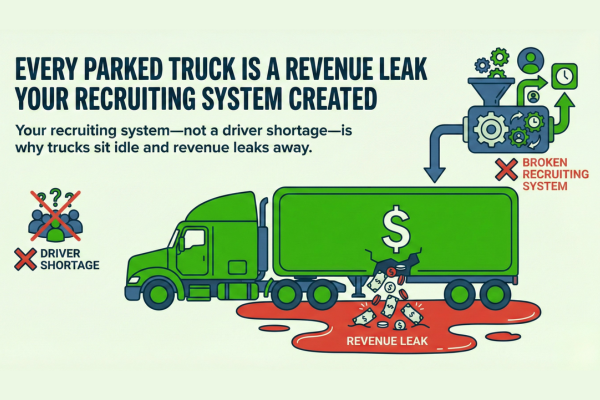
A truck sitting in the yard doesn’t look expensive. No fuel burning. No maintenance happening. Just metal and rubber taking up space.
But that truck costs between $1,200 and $3,000 every single day it sits empty.
Not because the driver shortage is real. Not because qualified CDL holders don’t exist. But because the recruiting system most fleets use was never built to move at trucking speed.
The Math Fleet Owners Don’t Want to See
Ten idle trucks for one week equals $30,000 in lost revenue. That’s assuming $1,200 per truck per day on the conservative end. Scale that to a month and fleets are bleeding six figures while their recruiting team is still screening applications from three weeks ago.
The American Trucking Associations reported driver turnover rates at large truckload carriers hit 87% in recent quarters. But here’s what that stat doesn’t capture: most of those drivers didn’t leave the industry. They moved to another fleet that hired them faster.
The numbers get worse when factoring in deadhead miles and empty capacity. A truck that’s parked can’t generate revenue. A truck that’s running but underutilized because routes are being adjusted to cover driver gaps is only marginally better.
| Idle Scenario | Daily Cost | Weekly Cost | Monthly Cost |
| 5 trucks idle | $6,000-$15,000 | $42,000-$105,000 | $180,000-$450,000 |
| 10 trucks idle | $12,000-$30,000 | $84,000-$210,000 | $360,000-$900,000 |
| 20 trucks idle | $24,000-$60,000 | $168,000-$420,000 | $720,000-$1,800,000 |
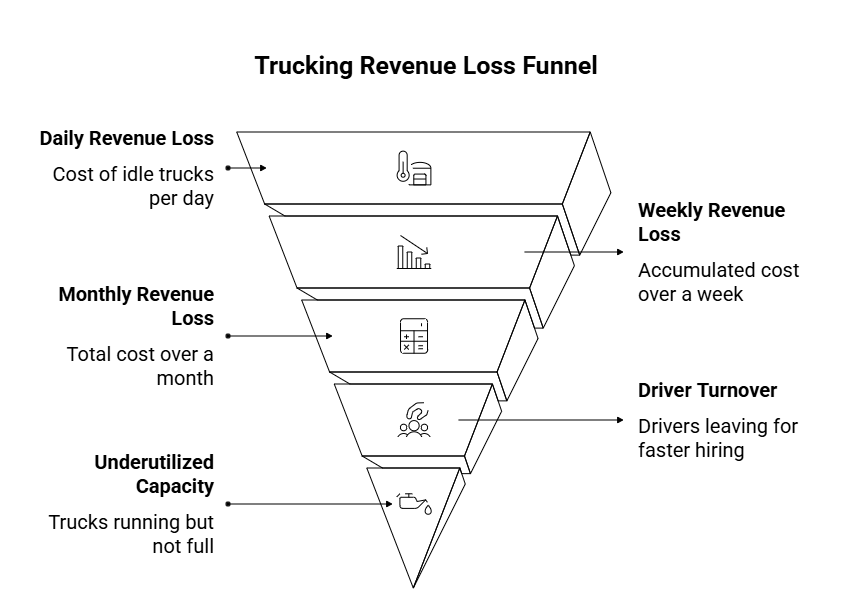
Fleets treat idle time as an HR problem when it’s actually an operations breakdown.
The issue isn’t that drivers aren’t applying. Most recruiting systems have leads sitting in spreadsheets, email threads, and half-filled application forms. The bottleneck is what happens between “driver applies” and “driver gets hired.”
Where Traditional Recruiting Systems Break Down
Most fleets are using tools built for corporate hiring. Applicant tracking systems designed for office jobs where time to hire is measured in weeks, not days. Where compliance means checking a background report, not verifying CDL endorsements, PSP reports, MVR checks, and drug test clearances through the FMCSA clearinghouse.
Industry data shows the average time to hire for CDL drivers ranges from 21 to 45 days. But driver candidates are actively applying to multiple fleets simultaneously. Research on speed to lead in high-velocity hiring shows that companies responding within 5 minutes are 9 times more likely to convert a candidate than those responding after 30 minutes.
The typical flow looks like this:
- Job gets posted on multiple trucking job boards manually
- Applications trickle in through different channels
- Recruiter manually screens each one for CDL class, endorsements, and experience
- Follow-ups happen when someone remembers
- Compliance documents get requested via email (driver qualification file, DOT physical, clearinghouse query)
- Half the candidates ghost before the process finishes
- The cycle restarts next month
Speed to lead matters more in trucking than almost any other industry. A driver applying for a CDL position is often applying to five other fleets at the same time. The first company to respond, screen, and make an offer wins. The fleet that takes three days to follow up loses that driver to a competitor who moved in three hours.
This isn’t a talent problem. It’s a systems problem.
Why Recruiting Feels Like Starting Over Every Month
Fleets spend thousands on job boards, recruiting agencies, and internal HR staff, yet truck utilization stays flat. The hiring funnel resets every 30 days because nothing compounds.
What happens to drivers who applied last month but weren’t ready? Most systems have no re-engagement workflow. Those leads disappear. Job posts expire and get rewritten from scratch. Compliance tracking lives in a folder somewhere. Nobody owns follow-up. There’s no analytics showing which sources actually produce drivers who stay past the critical 90-day turnover window.
The result is operational leakage. Revenue walks out the door not because drivers don’t exist, but because the system can’t retain, screen, and onboard them fast enough to match trucking capacity needs.
And every day that system stays broken, another truck sits idle.
The Real Cost Isn’t the Truck
Fleet owners look at parked trucks and see asset underutilization. Accountants see depreciation and opportunity cost. But the operational impact runs deeper.
When trucks sit empty:
- Routes get reassigned and schedules compress
- Remaining drivers take on more miles and burn out faster (accelerating driver turnover)
- Customer relationships strain when loads get delayed
- Competitors capture market share that’s hard to win back
A fleet running at 85% capacity because of driver turnover and slow hiring isn’t just losing revenue on the empty seats. It’s losing competitive positioning. Clients don’t care that the issue is recruiting bottlenecks. They care that their freight isn’t moving.
One operations director at a 76-truck fleet put it plainly: “We weren’t losing money because drivers didn’t exist. We were losing money because our system took 3 weeks to do what should take 3 days.”
How Recruiting Pipelines Create Compounding Gains
The difference between a reactive hiring process and a structured recruiting pipeline is the same as the difference between scrambling for loads and having predictable freight.
A pipeline doesn’t reset. It builds. Drivers who weren’t ready last month stay warm through automated re-engagement. Compliance documents get tracked automatically with expiry alerts for CDL renewals, DOT physicals, and MVR updates. Follow-ups happen whether someone remembers or not. Analytics show which channels bring in drivers with the best retention rates and lowest cost per hire.
Most fleets measure cost per hire. The better metric is time to seat.
Cutting time to hire from 21 days to 7 days doesn’t just fill trucks faster. It captures drivers before competitors do. It reduces the number of candidates who ghost mid-process. It lets fleets run predictable hiring cycles instead of constantly chasing new leads.
Fleets optimizing for hiring speed report 40-60% reductions in idle truck days and 30-50% improvements in driver application to hire ratios.
How It Can Be Changed
The shift isn’t about hiring more recruiters or posting on more job boards. It’s about replacing disconnected tools with a system built specifically for CDL recruiting at trucking speed.
Uptime isn’t a job board. It’s not another applicant tracking system built for corporate HR. It’s a complete CDL Recruiting Department-in-a-Box that combines an operating system with an embedded recruiting team.
The platform handles the grunt work. AI-powered job creation and distribution across trucking networks. Predictive driver matching that ranks candidates by route fit, experience, and retention likelihood. Automated compliance tracking with OCR for license expiries and driver qualification file management tied directly to FMCSA and PSP data.
But the system doesn’t just track applicants. A dedicated Uptime recruiter operates inside the OS, managing sourcing, screening, and follow-ups with measurable SLAs. Fleets get weekly ROI reports showing time to hire, cost per hire, and recruiter velocity. Everything lives in one dashboard instead of scattered across emails and spreadsheets.
| Traditional ATS | Uptime Recruiting OS |
| Manual job posting | AI job creation + auto-distribution |
| Generic candidate screening | Predictive CDL matching by route/experience |
| Spreadsheet compliance tracking | OCR + automated DQ file management |
| Recruiter works in email | Recruiter works inside your OS with SLAs |
| No re-engagement workflow | Automated driver pipeline nurturing |
| Generic time-to-hire metrics | Trucking-specific analytics (idle days, cost per seat) |
The result is hiring speed that matches trucking operations. Fleets using Uptime cut time to hire by 60% and reduce idle truck days by filling seats in under a week instead of three.
It’s not about finding more drivers. It’s about keeping the ones already in the system and moving them to hire fast enough to matter.
Idle Time Is a Choice
Every parked truck represents a decision. Not a conscious one. But a decision made by default when recruiting systems can’t keep pace with driver turnover and capacity needs.
The driver shortage narrative lets fleets off the hook. It frames the problem as external and unsolvable. But most fleets already have enough inbound interest. They just don’t have the infrastructure to convert it into hires before those drivers accept offers elsewhere.
Recruiting at trucking speed means treating driver pipeline like freight pipeline. Predictable, measurable, and optimized for throughput. When the system works, trucks don’t sit. Revenue doesn’t leak. And fleets stop paying twice for the same driver seat.
Calculate What Idle Time Is Actually Costing You
Most fleet owners underestimate the revenue impact of empty trucks because the cost is spread across missed loads, route adjustments, and capacity constraints.
Uptime’s ROI calculator shows the real number. Enter your truck count and average idle days, and see exactly how much revenue faster hiring could recover each month.
Calculate My Idle Truck Cost →
Or book a 15-minute demo to see how Uptime’s recruiting department fills seats in days instead of weeks.
Book a Demo →
Leave a Reply