Here’s a question most fleet owners don’t ask themselves: How many times have you paid to find the same driver?
Not the same type of driver. The actual same person. Same phone number. Same CDL. Same route preference. You paid Indeed or a recruiting agency to surface their profile six months ago. They said “not right now.” You moved on. They moved on. And last week, you paid another $400 to rediscover them through a different job board.
This happens every single day in trucking. Fleets treat driver recruiting like it resets every month. Post a job. Wait for applications. Sort through responses. Lose track of anyone who doesn’t convert immediately. Start over.
The problem isn’t a driver shortage. The problem is that most fleets have no institutional memory.
Why Past Leads Disappear Into Thin Air
Walk into most fleet operations and ask to see their driver database. You’ll get one of three things: a messy spreadsheet, a filing cabinet full of old applications, or a confused look.
The recruiting process looks something like this: A driver applies. The recruiter reaches out once, maybe twice. If the driver doesn’t respond or isn’t ready to start immediately, they fall off the radar. No follow-up system. No structured re-engagement. No record that can be easily searched or activated later.
When that same driver is ready to make a move three months later, your fleet isn’t even on their list anymore. They’ve forgotten you just as thoroughly as you’ve forgotten them.
Meanwhile, you’re spending money to re-attract them all over again.
According to data from trucking job boards and recruitment analytics platforms, the average cost to generate a driver lead ranges from $50 to $150, depending on the source. Agencies can charge $1,000 to $3,000 per hire. If your fleet makes 20 hires per year and 70% of those drivers were leads you’d already paid for once before, you’re bleeding $20,000 to $40,000 annually just from memory loss.
That’s not driver turnover. That’s operational leakage.
The Hidden Leak Nobody Talks About
Fleets focus obsessively on driver retention after hire, which makes sense. Losing a driver after 90 days is expensive. But there’s an earlier leak that costs just as much and gets almost no attention: losing driver leads before they ever convert.
Think about what happens in your recruiting funnel:
- Driver sees your job post and applies
- Recruiter calls, driver says “I’m finishing up with my current company, call me in a month”
- Recruiter writes it down (maybe) and moves to the next lead
- One month passes. No follow-up. Driver finds another job.
- Two months later, your fleet posts the same role again and pays to reach that driver through a different channel
You just bought the same lead twice and got zero return on the first purchase.
This isn’t rare. It’s the default. Most recruiting systems are built to track active applicants, not to retain and reactivate past leads. The entire model assumes a continuous stream of new people, which works fine when driver supply is high. But when every qualified lead counts, forgetting 70% of your past applicants is a death sentence.
Industry research on speed to lead shows that contact rates drop by 80% after the first 24 hours. When fleets lose track of leads and try to re-engage weeks or months later without a system, they’re starting from zero contact history. No context. No relationship. Just another cold call.
Here’s what the real cost looks like for a typical 50-truck fleet:
| Recruiting Activity | Traditional Approach | Annual Cost |
| Job board spend | Constant re-posting, no database | $12,000 |
| Agency fees | 8 hires at $1,500 each | $12,000 |
| Lost leads (re-acquisition) | 70% of leads forgotten and re-bought | $18,000 |
| Recruiter time (manual follow-up) | 15 hours/week at $25/hour | $19,500 |
| Total Annual Recruiting Cost | $61,500 |
Now compare that to fleets with a database-first approach:
| Recruiting Activity | Database-First Approach | Annual Cost |
| Job board spend | Reduced by 60% (re-engaging existing leads) | $4,800 |
| Agency fees | 2 hires at $1,500 each | $3,000 |
| Lost leads (re-acquisition) | Automated re-engagement, 90% retained | $1,800 |
| Recruiter time (automated follow-up) | 6 hours/week at $25/hour | $7,800 |
| Total Annual Recruiting Cost | $17,400 |
That’s a savings of $44,100 per year just from remembering the drivers you already paid to find.
Recruiting Should Compound, Not Reset
Here’s the shift fleets need to make: Recruiting is not a monthly campaign. It’s a database that grows in value over time.
Every driver who applies, interviews, or even just clicks on your job post is an asset. Not just today, but for the next 12 to 24 months. Drivers change jobs. They finish contracts. They get frustrated with their current fleet. They move cities. Their circumstances shift constantly.
The fleets that win are the ones who stay in front of these drivers when they’re ready to move.
A strong recruiting system doesn’t just capture leads. It remembers them. It knows when to re-engage. It automates follow-ups based on driver behavior and timeline. It tracks which leads are warm, which are cold, and which just need a nudge at the right moment.
This is how recruiting becomes a compounding system instead of a treadmill. Every month, your database gets smarter. Your cost per hire drops because you’re reactivating existing leads instead of starting from scratch. Your time to hire shrinks because you’re not waiting for strangers to discover you. You’re working a pipeline that’s already warm.
Real-world data from fleets using modern driver CRM systems shows that re-engaged leads convert at 2x to 3x the rate of brand-new cold leads. The time to hire drops from an industry average of 45-60 days down to 15-20 days when working warm pipelines.
What a Smarter System Looks Like
Let’s talk about what changes when fleets stop treating recruiting like a monthly reset.
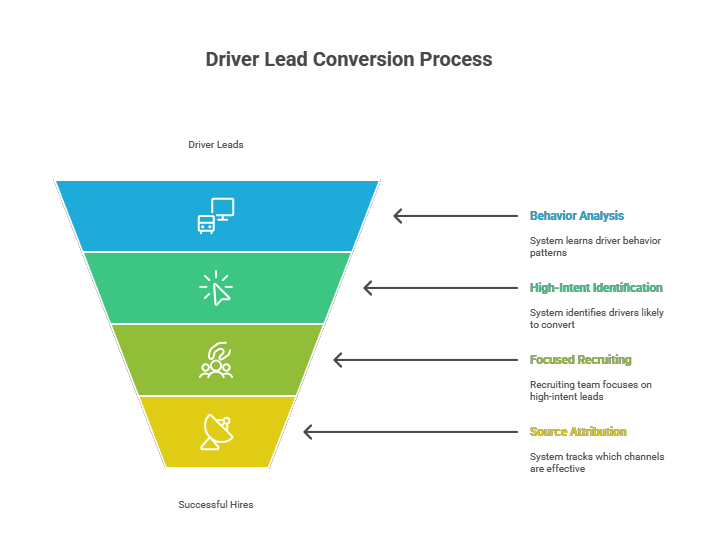
First, centralization. Every lead, every conversation, every “not right now” response lives in one place. No scattered spreadsheets. No recruiter notebooks. One smart driver database that tracks every interaction and keeps leads warm automatically.
Second, automation. Drivers who said “call me in three months” get automatically re-engaged in three months. Drivers who opened your email but didn’t apply get a follow-up. Drivers who applied but didn’t respond to your first message get a second and third touchpoint without your recruiter lifting a finger.
Third, intelligence. The system learns which drivers are most likely to convert based on their behavior. It surfaces high-intent leads to your recruiting team so they focus their energy where it matters. It tracks source attribution so you know which channels are worth the spend and which are just noise.
This isn’t theory. Fleets running systems like this are seeing 30% to 50% of their hires come from re-engaged past leads instead of new acquisitions. They’re cutting their cost per hire in half. They’re filling seats faster because they’re not starting from zero every time.
The best recruiting operations treat their driver database like a revenue-generating asset. They track database health metrics: total contacts, engagement rates, conversion rates by source, and time-to-reactivation. They measure ROI not just on new lead acquisition but on lead retention and reactivation.
How It Can Be Changed
Uptime was built to solve exactly this problem.
At its core, Uptime is your CDL Recruiting Department-in-a-Box, combining a smart driver database with an embedded recruiting team that runs the entire operation for you. Every driver who interacts with your fleet gets stored, tagged, and tracked. When someone says “not now,” the system doesn’t forget. It schedules automated follow-ups based on their timeline and keeps them warm until they’re ready.
Here’s what that looks like in practice:
Automatic lead capture. Every application, phone call, and email gets logged in the Uptime OS. No more lost contacts. No more “I think we talked to that driver six months ago but I can’t find the notes.” Your entire driver history lives in one searchable, filterable database.
AI-powered re-engagement workflows. Uptime automatically reaches out to past leads at the right time. Drivers who ghosted your recruiter three months ago get a fresh message when they’re statistically more likely to be job-hunting again. The AI Job Engine creates personalized outreach based on driver preferences and timing. You’re not chasing cold leads. You’re activating warm ones.
Predictive matching intelligence. The system learns which drivers are the best fit for your fleet based on route type, experience, and past behavior. The Matching Intelligence Service ranks top 10% fits by license, route, and predicted retention. Your recruiters spend less time sorting through unqualified leads and more time talking to drivers who are actually likely to sign.
Full visibility with your dedicated recruiter. Your assigned Uptime recruiter operates inside your OS with complete transparency. Your recruiting team can see exactly who’s in the pipeline, where they came from, and when they’re due for follow-up. Fleet leadership gets dashboards showing cost per hire, time to hire, and how many past leads are converting into hires each month. Weekly ROI reports show you exactly how many recruiter hours you’ve saved and how much your database is worth.
One fleet using Uptime re-hired 30% of their past applicants within 45 days just by turning on automated re-engagement. Another cut their job board spend by 60% because they stopped needing to buy the same leads over and over. A third fleet reduced their average time to hire from 52 days to 18 days by working their existing database instead of constantly sourcing new leads.
Recruiting doesn’t have to be a monthly reset. It can be a compounding system that gets better and cheaper over time.
Stop Repaying for the Same Driver
The math is simple. If your fleet makes 20 hires per year and you’re spending $1,500 per hire on recruiting (job boards, agencies, internal recruiter time), that’s $30,000 annually. If even half of those hires could come from re-engaged past leads instead of new acquisitions, you’re saving $15,000 per year while filling seats faster.
That’s not even counting the time saved. Recruiters stop spending hours re-posting the same jobs. They stop chasing leads that were already in their system six months ago. They focus on moving qualified drivers through the pipeline instead of constantly starting over.
The fleets that figure this out first are going to dominate hiring in their regions. The ones that don’t will keep bleeding money while wondering why they can’t fill seats.
Your fleet doesn’t need more leads. You need a system that remembers the ones you already paid for.
Ready to Turn Your Driver Database Into Your Biggest Asset?
Stop treating recruiting like a monthly reset. Uptime gives you the CDL Recruiting OS that captures every lead, automates re-engagement, and turns “not now” into “now ready.”
Your subscription includes:
- Smart Driver Database with automatic lead capture and tracking
- AI-Powered Re-Engagement Engine that follows up at the perfect time
- Dedicated Uptime Recruiter who manages your pipeline inside the OS
- Predictive Matching Intelligence that surfaces your best-fit drivers
- Full Analytics Dashboard showing cost per hire, time to hire, and ROI
Start your 14-day free trial and see how many past leads you’ve been leaving on the table. No credit card required.
[Book 15-Min Demo]
Plans start at $499/month for fleets with 25-50 trucks. See how much you could save with our ROI calculator.
Leave a Reply