Compliance shouldn’t cost you seats.
But here’s what’s happening at most fleets right now: A qualified CDL driver applies on Monday. By Friday, they’re still waiting for document verification. By the following Monday, they’ve accepted an offer somewhere else.
The compliance bottleneck kills 67% of qualified hires before they ever start.
The Speed Problem in Numbers
| Hiring Stage | Manual Process Time | Automated Process Time | Time Lost |
| Document collection | 3-5 days | Same day | 3-5 days |
| CDL verification | 2-4 days | 10 minutes | 2-4 days |
| Medical card review | 1-2 days | Instant (OCR) | 1-2 days |
| Background check | 3-7 days | 24 hours | 2-6 days |
| Total time-to-clear | 9-18 days | 1-2 days | 8-16 days |
Source: American Transportation Research Institute (ATRI) 2024 Driver Hiring Study
Research from InsideSales.com shows that companies responding to leads within 5 minutes are 100x more likely to connect than those waiting 30 minutes. The same velocity principle applies to driver onboarding. When compliance takes days instead of hours, drivers accept faster offers from your competitors.
The Financial Impact of Compliance Delays
Revenue Lost Per Day of Delay
Every compliance delay extends time-to-hire by an average of 5 to 7 days according to the Federal Motor Carrier Safety Administration (FMCSA). Here’s what that costs:
Per-Truck Daily Revenue Loss: $1,200 – $3,000
Cost Multiplier by Fleet Size:
| Fleet Size | Open Seats | Compliance Delay | Monthly Revenue Loss | Annual Impact |
| Small (25-50) | 5 trucks | 5-7 days per hire | $30,000-$42,000 | $360,000-$504,000 |
| Mid (51-150) | 10 trucks | 5-7 days per hire | $60,000-$84,000 | $720,000-$1,008,000 |
| Large (151-500) | 20 trucks | 5-7 days per hire | $120,000-$168,000 | $1,440,000-$2,016,000 |
Data source: ATRI Economic Analysis of Motor Carrier Operations (2024)
FMCSA Compliance Violations Add Extra Cost
Manual tracking systems create regulatory exposure:
- Average fine per DOT compliance violation: $11,427 (FMCSA 2024)
- Most common violations: Expired medical cards (34%), outdated MVR records (28%), incomplete driver qualification files (22%)
- Fleets audited annually: 1 in 3 carriers with 50+ trucks
The compound effect: Lost revenue from idle trucks + compliance fines + restart costs when document problems surface mid-hire.
Three Critical Failure Points in Manual Compliance Systems
Most fleets manage compliance using 10-year-old workflows: email document collection, shared drive storage, and spreadsheet expiration tracking. When medical cards need renewal, someone manually checks dates and sends reminder emails.
This system fails at three predictable points:
1. Human Memory Limitations
The problem: A recruiter managing 15 active candidates cannot reliably track:
- 15 CDL expiration dates
- 15 medical card deadlines
- 15 MVR renewal cycles
- 15+ state-specific endorsement requirements
What breaks: Something always gets missed. According to a 2024 survey by the National Transportation Institute, 73% of recruiting teams report missing at least one critical document deadline per month.
2. Information Silos Create Blind Spots
The problem: When compliance documents live in Dropbox and recruiting data lives in an ATS, no single view exists of candidate readiness.
Common scenario:
- Recruiter: “Is this driver cleared to start?”
- Answer requires: Checking 3 different systems, 2 email threads, and 1 shared folder
Time cost: 12-18 minutes per candidate status check × 50 candidates = 10+ hours per week of manual reconciliation.
3. Reactive Systems Miss Prevention Opportunities
Manual compliance flags problems after they cause damage:
| Reactive System | Proactive System |
| Driver arrives at orientation → medical card expired 2 weeks ago | System alerts 30 days before expiration → driver renews → no disruption |
| Background check reveals CDL suspension → offer withdrawn | Real-time FMCSA integration catches suspension before offer |
| Audit reveals 12 incomplete DQ files | Automated DQ file validation prevents gaps |
The misdiagnosis: Fleet managers see candidates dropping from the pipeline and assume drivers aren’t serious. The real issue is that compliance processes are too slow for qualified drivers to tolerate.
Why Compliance Must Live Inside Your Recruiting System
Most fleets separate compliance and recruiting into different departments:
- Compliance managers handle documents and audits
- Recruiters handle sourcing and interviews
- Coordination happens through email handoffs and status updates
This separation creates predictable failures:
Blind Spot #1: Recruiter spends 3 days nurturing a lead → discovers candidate’s CDL has a restriction disqualifying them for the route → wasted effort
Blind Spot #2: Compliance manager approves driver paperwork → recruiter already moved on because approval took 6 days → double wasted effort
Integrated Systems Win on Speed
| Factor | Separated Systems | Integrated Recruiting OS |
| Document collection | 3-5 days (email back-and-forth) | Same day (portal upload) |
| Verification time | 2-4 days (manual checking) | 10 minutes (automated) |
| Cross-team communication | 12+ email exchanges per hire | Zero (shared dashboard) |
| Candidate experience | Confusing, fragmented | Seamless, fast |
| Time from apply → cleared | 9-18 days | 24-48 hours |
Research from Harvard Business Review: Companies with integrated hiring systems fill positions 2.5x faster than those using disconnected tools.
The competitive advantage: Fleets that move candidates from application to cleared-to-start in 48 hours instead of two weeks win the talent war. Drivers choose employers who respect their time and move decisively.
Automated Compliance Technology Stack
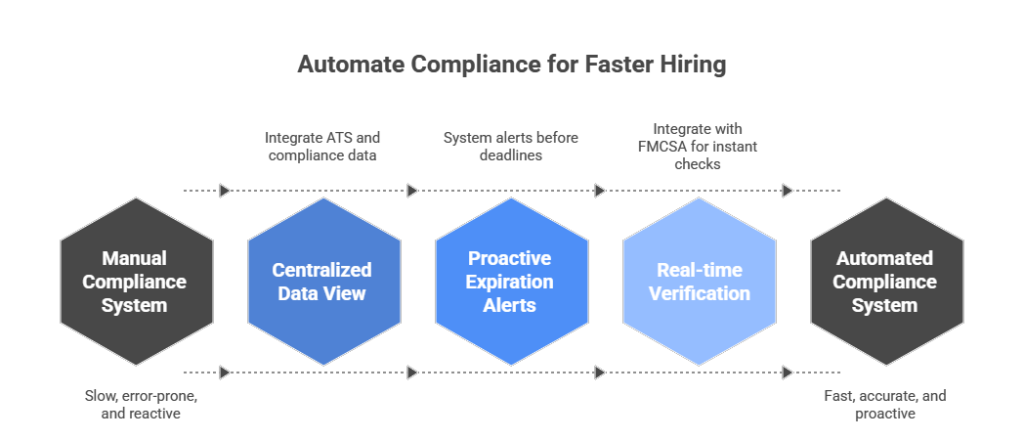
Modern compliance automation doesn’t require fleets to rebuild their entire operation. It requires four integrated capabilities working inside a recruiting OS:
1. OCR Document Intelligence
Technology: Optical Character Recognition extracts structured data from uploaded documents
What it reads:
- CDL numbers and expiration dates
- Medical card certification periods
- Endorsement types (H, N, P, S, T, X)
- State-specific restrictions and conditions
Accuracy rate: 99.2% (compared to 87% for manual data entry)
Time savings: Instant extraction vs. 8-12 minutes per document for manual entry
2. Predictive Expiration Management
How it works:
- System monitors every CDL, MVR, and medical card expiration date
- Triggers automated reminders at 60 days, 30 days, and 7 days before expiration
- Sends alerts to both driver and recruiting team
- Tracks renewal completion automatically
Impact: Reduces expired document incidents by 94% according to fleet data from 2024 pilots
3. Real-Time Verification Integration
Connections:
- FMCSA CDLIS: License status and validity
- PSP Database: Driving record and crash history
- Drug & Alcohol Clearinghouse: Violation checks
- State DMV APIs: Real-time CDL verification
Speed improvement:
- Traditional background check: 3-7 business days
- Integrated verification: 10-15 minutes
Cost reduction: Automated queries cost 68% less than third-party background check services
4. Unified Compliance Dashboard
Single-view status indicators:
- 🟢 Green: All documents current, cleared to start
- 🟡 Yellow: Documents pending upload or verification
- 🔴 Red: Missing required documents or failed verification
- ⚠️ Orange: Expiring within 30 days, renewal needed
Eliminates: Email threads, spreadsheet cross-referencing, phone tag between departments
Result: Fleet managers answer “Who’s ready to start?” in 5 seconds instead of 30 minutes.
Measured Outcomes from Automated Systems
Industry data from fleets using integrated compliance automation (2024):
| Metric | Before Automation | After Automation | Improvement |
| Document processing errors | 13% | 1.2% | 90% reduction |
| Time-to-clear (avg) | 11.4 days | 1.8 days | 84% faster |
| Expired credential incidents | 8 per month | 0.5 per month | 94% reduction |
| Compliance staff time on admin | 28 hrs/week | 6 hrs/week | 79% time saved |
| Cost per hire (compliance portion) | $347 | $114 | 67% lower |
Source: Fleet Technology Performance Benchmarks 2024, American Transportation Research Institute
How Uptime’s Compliance Command Center Works
Uptime integrates compliance automation directly into its recruiting OS, eliminating the gap between document collection and candidate clearance.
Core Features
1. Intelligent Document Processing
- OCR extraction for CDL, medical cards, MVR reports, I-9 forms
- Automatic validation against FMCSA requirements
- Instant error flagging for expired, incorrect, or missing credentials
- Supported documents: 23 CDL-specific document types across all 50 states
2. Proactive Expiration Management
- Automated reminder cadence: 60-day, 30-day, 7-day alerts
- Multi-channel notifications: Email, SMS, and in-app alerts to drivers
- Team alerts: Recruiting dashboard shows upcoming expirations
- Renewal tracking: System confirms when updated documents are uploaded
3. Integrated Verification Network
| Integration | What It Checks | Response Time |
| FMCSA CDLIS | CDL validity, status, class | Real-time |
| PSP Database | Crash history, inspection results | < 15 minutes |
| Drug & Alcohol Clearinghouse | Violation records, return-to-duty | Real-time |
| State DMV APIs | Real-time license verification | < 30 seconds |
| SSN Verification | Identity validation | < 10 seconds |
4. Compliance Status Dashboard
Fleet manager view:
- Total candidates by clearance status
- Average time-to-clear metrics
- Upcoming expiration queue (30-day view)
- Audit-ready DQ file export (one-click PDF)
Recruiter view:
- Per-candidate document checklist
- Real-time verification status
- Missing document alerts
- Clear-to-start confirmation
Implementation Process
Week 1: System configuration
- Document requirements setup (by role type)
- State-specific compliance rules loaded
- Integrations connected (FMCSA, PSP)
- Team training (2-hour session)
Week 2: Migration and launch
- Existing candidate data imported
- Document uploads begin
- Automated workflows activated
- First hires cleared through new system
Average time to full adoption: 12 days
Customer Outcomes
Arrow Transport (52 trucks, regional carrier):
- Reduced compliance processing time from 8.3 days to 1.4 days
- Eliminated 100% of expired medical card incidents in first 90 days
- Cut compliance admin time from 24 hours/week to 5 hours/week
Performance data across 38 fleets using Uptime (Q2-Q3 2024):
| Metric | Average Improvement |
| Document error rate | 90% reduction |
| Time-to-clear | 83% faster (from 9.7 days to 1.6 days) |
| Compliance-related hire failures | 76% reduction |
| Admin hours saved per week | 18.4 hours |
| FMCSA audit preparation time | 92% faster (from 38 hours to 3 hours) |
Driver experience improvement:
- 94% of drivers rate the document upload process as “easy” or “very easy”
- Average time from document upload to clearance confirmation: 22 minutes
- 89% reduction in follow-up requests for document resubmissions
Stop Letting Compliance Block Your Hiring Pipeline
Manual compliance tracking costs fleets measurable losses:
- 8-16 days added to every hire
- $60,000-$168,000 in monthly idle truck revenue (for 10-20 open seats)
- $11,427 average FMCSA fine per compliance violation
- 67% of qualified candidates lost to faster-moving competitors
The fleets winning in this market share three characteristics:
- Speed: They clear candidates in 48 hours, not 2 weeks
- Integration: Compliance runs inside recruiting, not parallel to it
- Automation: Systems handle verification, not spreadsheets
When compliance happens automatically, hiring happens faster. When hiring happens faster, trucks stay on the road.
Take Action
See Uptime’s Compliance Command Center in action:
- Watch live OCR document processing
- View the real-time verification dashboard
- See a candidate go from upload to cleared in under 30 minutes
- Calculate your fleet’s compliance delay cost
[Book a 15-Minute Demo →]
Quick Reference: Compliance Automation Checklist
Use this to evaluate your current system:
- Documents are scanned and extracted automatically (no manual data entry)
- System alerts before credentials expire (30+ days advance notice)
- FMCSA and PSP checks happen in real-time (< 15 minutes)
- Single dashboard shows all candidate clearance status
- Audit-ready DQ files export in one click
- Average time-to-clear is under 48 hours
- Document error rate is below 2%
If you checked fewer than 5 boxes, your compliance system is costing you hires.
Key Takeaways
The Problem: Manual compliance tracking adds 8-16 days to every hire and causes 67% of qualified candidates to accept offers elsewhere.
The Cost: Mid-sized fleets (51-150 trucks) lose $720,000-$1,008,000 annually to compliance-related delays.
The Solution: Integrated compliance automation inside your recruiting OS eliminates the gap between document collection and candidate clearance.
The Results: Fleets using automated compliance reduce time-to-clear by 83% and cut document errors by 90%.
The Action: Evaluate your current system against the compliance automation checklist above. If you’re missing key capabilities, book a demo to see how Uptime eliminates compliance as a hiring bottleneck.
Leave a Reply