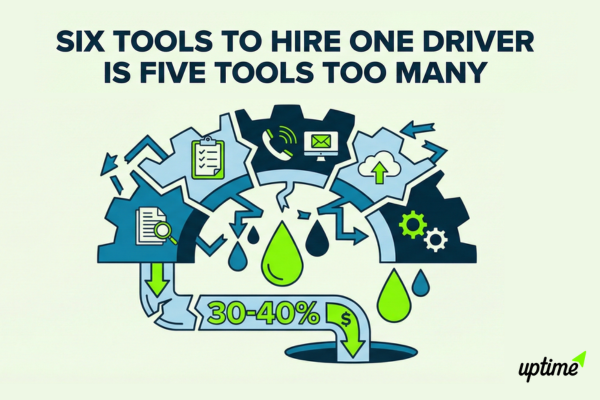
Fleets using 5-6 disconnected recruiting tools lose 30-40% of qualified driver leads between application and hire. The problem isn’t driver shortage—it’s operational leakage caused by fragmented workflows.
If you’re juggling six tools to hire one driver, you’ve already lost.
Not to the driver shortage. Not to competitor fleets offering better pay. You’ve lost to the chaos that happens when recruiting workflows get stitched together from job boards, spreadsheets, email threads, Dropbox folders, and whatever CRM the sales team bought three years ago.
The cost? For a 100-truck fleet, losing 40% of qualified leads translates to 12-15 additional weeks of idle capacity per year—roughly $180,000 in lost revenue.
The Anatomy of Tool Sprawl in Fleet Recruiting
Most fleets didn’t intentionally build a six-tool recruiting operation. It evolved gradually, one problem at a time.
The Typical Fleet Recruiting Stack
| Tool Type | Common Solutions | What It Handles | Where It Breaks |
| Job Boards | Indeed, Gary’s Job Board, CDL-specific boards | Lead generation | Applications scatter across platforms |
| CRM/ATS | Generic HR software, spreadsheets | Candidate tracking | Can’t handle CDL-specific fields |
| Communication | Email, personal phones, text threads | Driver follow-up | Messages get lost across channels |
| Compliance | Dropbox, filing cabinets, Google Drive | DQ files, MVR, PSP reports | Documents requested multiple times |
| Screening | Manual calls, email questionnaires | Initial qualification | No automation, high recruiter time |
| Analytics | Excel, manual reports | Hiring metrics | No real-time visibility |
Each tool solved one problem. Together, they created a bigger one.
The 3 Ways Disconnected Systems Lose Drivers:
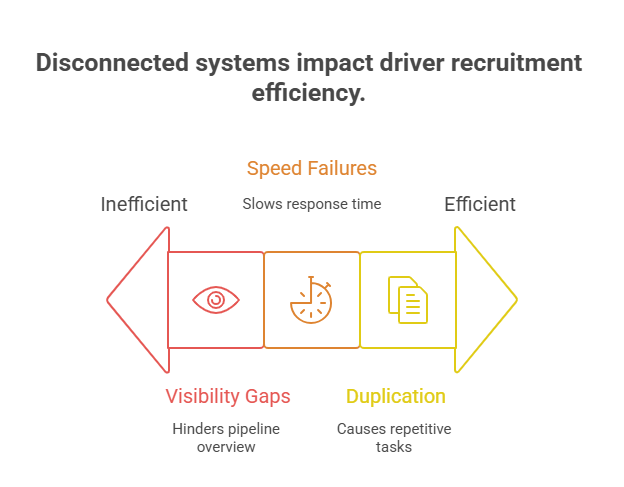
1. Visibility Gaps: Nobody Sees the Full Pipeline
The Problem: When driver data lives across multiple platforms, recruiting managers can’t answer basic questions without opening 3-4 systems.
Real Impact:
- Average time to locate candidate status: 8-12 minutes per driver
- For 50 active candidates: 7-10 hours per week lost to data hunting
- Result: Delayed responses and ghosted applicants
A recruiting manager at a 75-truck fleet described it this way: “I can see applications in our ATS but can’t tell which drivers completed their MVR check without opening another system. By the time I piece it together, they’ve accepted offers elsewhere.”
2. Speed Failures: Tool-Switching Kills Response Time
Speed to lead matters more in CDL recruiting than almost anywhere else. Drivers apply to 5-7 fleets simultaneously. The first company to respond and move them through screening wins.
The Tool-Switching Tax:
- Post a job: 15-20 minutes across multiple boards
- Check candidate status: 5-8 minutes per driver
- Follow up: 3-5 tool switches per interaction
- Verify compliance: 10-15 minutes per document set
Industry Benchmark: Fleets responding within 4 hours convert 3x more applicants than those taking 24+ hours.
Reality Check: With disconnected tools, even urgent follow-ups take 12-24 hours because information isn’t centralized.
3. Duplication: Doing the Same Work Multiple Times
When workflows aren’t connected, recruiters repeat tasks unnecessarily:
- Driver uploads CDL to job board → recruiter requests it again via email → ATS requires another upload
- Compliance documents requested 2-3 times because systems don’t sync
- Multiple recruiters contact the same driver (one emails, one texts, one calls)
- Result: Frustrated candidates who ghost mid-process
Measured Impact: Fleets with disconnected systems spend 35-40% of recruiter time on duplicate data entry and document requests.
The Hidden Cost: Zero Useful Analytics
When driver data lives in six places, fleets can’t measure what matters.
Questions Most Fleets Can’t Answer:
- Which job boards produce drivers who stay past 90 days?
- What’s our real time to hire from application to seat?
- How many candidates drop off during document submission?
- What’s the actual cost per hire including recruiter hours?
- Which communication method has the highest response rate?
Without these answers, fleets optimize nothing. Recruiting budgets grow. Turnover stays high. And nobody knows which spend actually works.
Why Adding Another Tool Makes It Worse
The instinct when recruiting slows down is to add another solution:
- Pipeline too slow? Buy automation software.
- Communication gaps? Add a texting platform.
- Compliance taking forever? Subscribe to verification services.
The Result: Seven tools instead of six. More logins. More data silos. More places where candidates get lost.
Core Principle: Efficiency isn’t about more tools. It’s about fewer logins and more hires.
What High-Performance Recruiting Systems Look Like
The best recruiting operations for 50-300 truck fleets share three characteristics:
1. Unified Data Model
Every candidate interaction, document, and status update lives in one system. Recruiters see the complete driver profile without switching tools.
2. Workflow Automation
Routine tasks happen automatically:
- Job posts distribute across networks simultaneously
- Follow-ups trigger based on candidate behavior
- Compliance documents route for verification automatically
- Stage movements update based on completed actions
3. Real-Time Visibility
Managers see pipeline health at a glance:
- Candidates in each stage
- Average time per stage
- Conversion rates by source
- Recruiter productivity metrics
How It Can Be Changed
Uptime replaces the 6-tool stack with one complete CDL recruiting operating system.
Job Distribution: From Manual to Automated
Old Way: Log into Indeed, Gary’s Job Board, and 3-4 other platforms. Manually create posts for each. Total time: 45-60 minutes per job.
Uptime Way: AI generates CDL-optimized job posts and distributes them across networks automatically. Total time: 3-5 minutes.
Candidate Tracking: From Scattered to Centralized
Old Way: Applications in multiple inboxes. Status tracking in spreadsheets. Documents in Dropbox. Total visibility: 30-40%.
Uptime Way: Unified pipeline shows every candidate, every document, and every interaction in one dashboard. Visibility: 100%.
Compliance: From Manual Chasing to Automated Verification
Old Way: Email drivers requesting CDL, MVR, and medical cards. Chase missing documents. Manually check expiry dates. Average time per driver: 45-60 minutes.
Uptime Way: OCR-powered document verification with automatic expiry tracking. Drivers upload once. System alerts before documents expire. Average time per driver: 5-8 minutes.
Communication: From Channel Chaos to Unified Inbox
Old Way: Texts on personal phones. Emails in multiple inboxes. No tracking of who contacted whom.
Uptime Way: SMS and email in one hub. Templates for routine follow-ups. Read receipts show engagement. Auto-nudges trigger based on candidate inactivity.
Analytics: From Guesswork to Metrics
Old Way: Manual reports cobbled together from multiple sources. Data often 2-3 weeks old.
Uptime Way: Real-time dashboard showing time to hire, cost per hire, source attribution, and retention by channel.
Dedicated Recruiting Team: Not Just Software
Here’s what separates Uptime from traditional ATS systems: the platform includes a dedicated recruiter operating inside your OS.
Not an agency charging per-hire commissions. Not software that still requires full internal headcount. A recruiting department that delivers measurable outcomes with SLAs.
Measurable Results from 50-300 Truck Fleets:
- 60% reduction in time to hire (from 21 days to 8 days average)
- 4-5 redundant tools eliminated in first 90 days
- 35% decrease in cost per hire
- 85%+ visibility into pipeline health (up from 30-40%)
Common Questions About Centralizing Recruiting Systems
“Won’t switching systems disrupt our current pipeline?”
Uptime imports existing candidate data during onboarding. Most fleets are live within 2 weeks without losing active candidates.
“Can our current recruiters still use the system?”
Yes. Your internal team operates the OS while Uptime recruiters augment capacity as needed. Full transparency into who’s managing what.
“What about our existing job board subscriptions?”
Uptime integrates with major boards or distributes directly. Most fleets consolidate to 1-2 high-performing boards after seeing source attribution data.
“How do you handle CDL-specific compliance?”
The platform structures driver qualification files to match FMCSA requirements. PSP reports, MVR checks, and clearinghouse verification route automatically.
The Bottom Line
Tool sprawl happens gradually. One login becomes two. Two becomes five. Five becomes a recruiting operation where nobody can see the full picture and 40% of qualified drivers vanish between application and hire.
The fix isn’t adding tool number seven. It’s replacing six with one.
For fleets running 50-300 trucks, centralizing recruiting workflows into one operating system delivers:
- Complete pipeline visibility
- Response speed that matches trucking operations
- Elimination of duplicate work
- Analytics showing what actually drives hires
Fleets don’t need more software. They need fewer obstacles between “driver applies” and “driver gets hired.”
Calculate Your Tool Sprawl Cost
Most recruiting managers don’t realize how much time their team loses to tool-switching until they see it measured.
Free Tool Sprawl Calculator: Enter your fleet size and active candidates to see how many recruiter hours you’re losing weekly.
Calculate My Cost →
Platform Audit: See exactly where drivers get lost in your current workflow and how much time centralization could save.
Book 15-Minute Audit →
Or start with a free trial and see the difference one unified system makes in your first week.
Start 14-Day Free Trial →
Leave a Reply