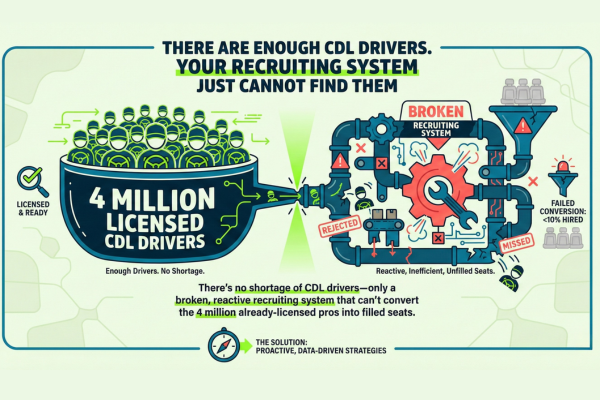
Every fleet manager has heard it. Every recruiting director repeats it. The truck driver shortage is getting worse, drivers don’t want to work anymore, and there’s nothing anyone can do about it.
Except that’s not what the data shows.
According to FMCSA records, there are over 4 million active CDL holders in the United States right now. That’s four times more licensed drivers than there are active trucking seats. The American Trucking Associations estimates the industry needs around 1 million drivers at any given time, yet fleets across the country report 80-90% truck driver turnover and empty seats they can’t fill.
So if millions of qualified, licensed drivers exist, why are your trucks sitting idle?
The answer isn’t a driver shortage. It’s a conversion problem. Fleets are losing qualified candidates faster than they can move them through broken, reactive recruiting funnels that were never designed to scale.
What the Numbers Really Tell Us
When you dig into the truck driver shortage narrative, the math stops making sense pretty quickly.
| Metric | Reality | What It Means |
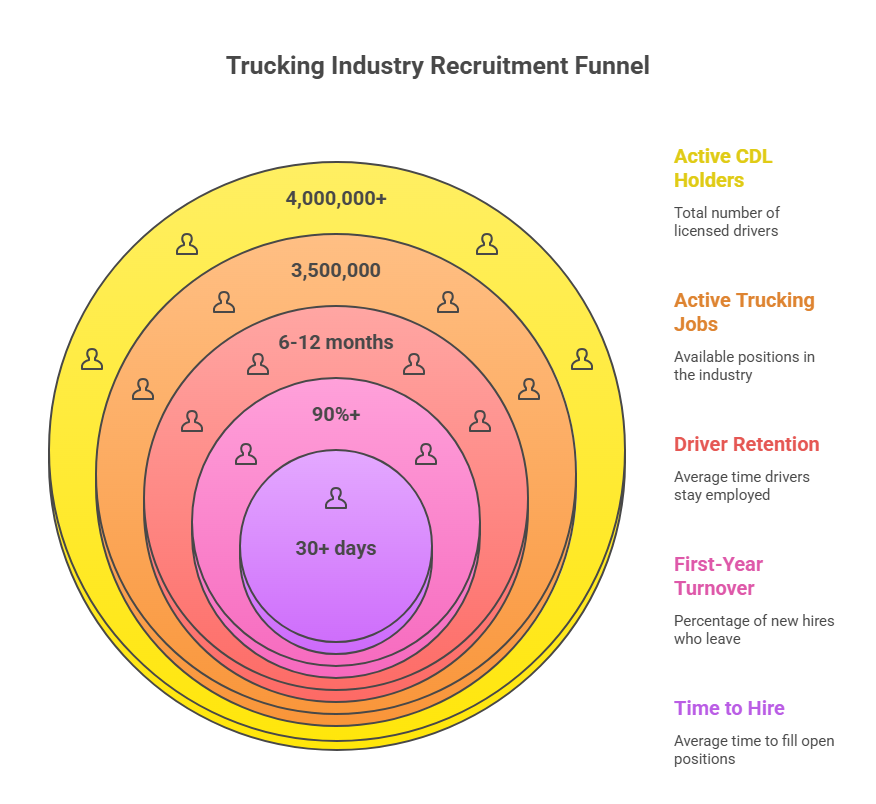
| Active CDL holders | 4 million+ | Far exceeds available trucking jobs |
| Active trucking jobs | ~3.5 million | Supply isn’t the bottleneck |
| Average driver retention | 6-12 months | Fleets lose drivers faster than they hire them |
| First-year turnover rate | 90%+ | New hires don’t stay |
| Average time to hire | 30+ days | Too slow to compete for talent |
| Ideal response time | Under 5 minutes | Most fleets take hours or days |
The real issue shows up in different numbers. Driver retention averages just 6-12 months at most fleets. First-year driver turnover regularly hits 90% or higher. And the average time to hire in trucking stretches past 30 days, even though speed to lead research from Harvard Business Review shows that candidates who aren’t contacted within 5 minutes are 10x less likely to convert.
Those aren’t supply problems. Those are system problems.
Fleets aren’t running out of drivers. They’re running out of time, structure, and continuous engagement.
Why Reactive Recruiting Keeps Failing
Most fleet recruiting funnels work the same way. A truck sits empty. A recruiter scrambles to post on trucking job boards like Indeed or Gary’s Job Board. Applications trickle in. The recruiter manually filters, calls, texts, chases documents, and maybe gets someone onboarded weeks later.
Then the cycle repeats.
This is reactive hiring. And it breaks down at every stage.
Leads Vanish in Inboxes
When a driver applies, they’re hot. They’re ready. But if your recruiter is juggling 50 open positions and can’t respond within an hour, that driver has already moved on to the next fleet. Research on speed to lead confirms this. The difference between a 5-minute response and a 30-minute response isn’t small—it’s the difference between a hire and a ghost.
According to a study by InsideSales.com, the odds of qualifying a lead drop by 21x if you wait 30 minutes instead of 5 minutes to respond.
Job Ads Reset Every Month
Fleets treat driver applications like perishable goods. When a role gets filled, the job post comes down. When another truck sits empty, the same recruiter re-posts the same job. The candidates who applied last month? Gone. The drivers who almost qualified? Forgotten.
There’s no memory, no re-engagement, no continuous pipeline.
Manual Follow-Ups Don’t Scale
Recruiters spend hours texting, calling, and emailing drivers. If someone doesn’t answer the first time, they might try once or twice more before moving on. But driver matching isn’t a one-time event. A driver who wasn’t ready in March might be ready in May. A candidate who declined an OTR role might accept a regional one.
Without automation and CRM-level tracking, those opportunities evaporate.
Compliance Lives in Spreadsheets
Even when a driver says yes, the onboarding process grinds to a halt. CDL verification, mvr checks, medical cards, and dot compliance paperwork pile up across email threads, text messages, and file folders. If one document expires or gets lost, the whole process stalls.
And the driver who was excited two weeks ago? They’ve already started somewhere else.
The Real Cost of a Broken System
Parked trucks don’t just sit there. They bleed money.
A single idle truck costs a fleet between $1,000 and $1,500 per day in lost revenue, according to fleet management data from the American Transportation Research Institute (ATRI). Multiply that by 5 trucks, 10 trucks, 20 trucks, and the losses add up fast. Over a month, 10 empty trucks can cost a fleet over $400,000 in unrealized revenue.
But the financial damage goes deeper:
- Recruiting costs compound: Every turnover event costs fleets between $8,000 and $12,000 in recruiting, onboarding, and training expenses
- Lost productivity: New drivers take 3-6 months to reach full productivity, meaning every hire that leaves within a year represents wasted investment
- Contract losses: Fleets with insufficient capacity turn down loads, damaging relationships with shippers and brokers
- Utilization drops: Empty seats drag down truck utilization metrics, making the entire operation less efficient
Driver retention problems compound into recruiting problems. And recruiting problems compound into capacity problems. Before long, fleets are turning down loads, losing contracts, and watching their utilization metrics drop—all because their hiring system can’t keep pace.
The Shift in Thinking Fleets Need to Make
The industry keeps talking about the truck driver shortage as if it’s a supply crisis that requires more CDL schools or better wages. Those things help, but they don’t fix the bottleneck.
The bottleneck is conversion.
Fleets need to stop thinking about hiring as a reactive emergency and start thinking about it as a continuous pipeline. The goal isn’t to find new drivers every time a truck sits empty. The goal is to build a system that constantly identifies, engages, qualifies, and re-engages CDL talent so that when a seat opens, there’s already a shortlist of ready-to-hire candidates.
What a Modern Recruiting System Requires
That requires three things most fleets don’t have:
- A centralized driver database that tracks every lead, application, and conversation, so recruiters aren’t starting from scratch every month
- Automated re-engagement workflows that keep drivers warm even when there’s no immediate opening
- Compliance automation that moves candidates from application to seat without manual document chasing
When those pieces work together, hiring stops feeling like an emergency and starts looking like a system.
And systems scale.
How It Can Be Changed
Fleets don’t need more job boards. They need a recruiting OS that treats driver hiring like an ongoing operation, not a one-time transaction.
That’s where platforms like Uptime come in. Instead of stitching together job boards, spreadsheets, and manual follow-ups, Uptime combines AI-powered driver matching, automated workflows, and recruiter accountability into one system.
How Uptime Works Differently
| Old Way | Uptime Way | Result |
| Manual job posting on multiple cdl job boards | AI job creation and instant distribution | Jobs go live in minutes, not hours |
| Reviewing every application manually | Predictive matching engine ranks top 10% by fit | Recruiters focus on quality, not quantity |
| Drivers fall off after one conversation | Continuous re-engagement automation | 5x higher conversion from past applicants |
| Compliance docs tracked in spreadsheets | Automated CDL verification and mvr checks | Zero onboarding delays from missing paperwork |
| No visibility into recruiter performance | Real-time SLA tracking and cost per hire metrics | Measurable, accountable recruiting operations |
AI job creation and distribution means no more rewriting the same ad every month. Uptime generates optimized job descriptions and pushes them across networks instantly.
Predictive matching and scoring ranks drivers by fit based on route type, experience, and predicted retention. Recruiters focus on the top 10%, not every applicant.
Continuous re-engagement keeps drivers who applied six months ago in the system. If they weren’t ready then, Uptime’s automation keeps them engaged so they’re top-of-mind when they are ready. Fleets that implement this kind of re-engagement see 5x higher conversion rates from past applicants.
Compliance automation handles CDL verification, mvr checks, and document tracking inside the platform. Expiry alerts, reminders, and dot compliance workflows eliminate the spreadsheet chaos that stalls onboarding.
Recruiter accountability with SLA tracking gives fleets visibility into performance in real time. Response times, interview rates, and cost per hire all live in one dashboard. That level of visibility turns recruiting from a black box into a measurable operation.
The Outcome
The result? Faster hires, lower costs, and a pipeline that doesn’t reset every time a truck sits empty.
Stop Chasing Drivers You’ve Already Paid to Find
The truck driver shortage isn’t the problem. The problem is a hiring system that treats every open seat like a brand-new emergency and burns through qualified candidates because it can’t move fast enough.
There are 4 million licensed CDL holders in this country. Your fleet just needs a system that can convert them before your competitors do.
Book a demo to see how to fill seats with the drivers you already have.
Leave a Reply