Your fleet posted 12 job openings last month. Applications came in. Some drivers got interviewed. A few made it to the offer stage. Three trucks are still empty.
Who’s responsible?
The recruiter says the applications weren’t qualified. The hiring manager says the recruiter took too long to respond. Operations says HR lost the paperwork. HR says the driver never uploaded their documents. Everyone has a reason. Nobody has an answer.
This isn’t a people problem. It’s a systems problem. According to American Trucking Associations data, fleets with disconnected recruiting systems lose 30 to 40% of qualified driver applicants between initial contact and hire. Not because the drivers weren’t interested, but because someone, somewhere in the workflow, lost track.
When recruiting workflows get scattered across job boards, email threads, spreadsheets, CRM tools, and compliance folders, accountability evaporates. Not because anyone is dropping the ball intentionally, but because there’s no single place where the ball actually lives.
Fleets running disconnected recruiting systems can’t answer basic questions like “which recruiter owns this candidate?” or “why did this driver application stall?” The data exists somewhere across five different logins, but piecing it together takes longer than just moving on to the next applicant.
And that’s exactly what happens. Drivers fall through the cracks while everyone blames the tools.
The Illusion of Ownership
Most fleet recruiting operations look organized on paper. Someone owns job postings. Someone else manages the pipeline. A third person handles compliance checks. Interviews get scheduled by whoever has time. Documents get requested via email and tracked in a shared drive.
It feels like a system. It’s actually just task distribution without outcome ownership.
Here’s what the typical fleet recruiting tech stack looks like:
| Tool Type | Common Platform | What It Tracks | What Falls Through |
| Job Board | Indeed, Gary’s Job Board | Applications received | Driver follow-up timing |
| CRM/ATS | Generic business CRM | Contact information | CDL-specific requirements |
| Spreadsheet | Excel, Google Sheets | Pipeline stages | Real-time status updates |
| Email/SMS | Individual accounts | Direct communication | Unified conversation history |
| Compliance | Dropbox, Google Drive | Document storage | Expiry tracking, alerts |
| Analytics | Manual reports | Weekly summaries | Live performance data |
Each tool does one thing. None of them talk to each other. The gaps between them are where drivers disappear.
The problem shows up when drivers disappear between stages. A candidate applies on Monday. By Friday, nobody followed up because the application landed in a shared inbox and everyone assumed someone else would handle it. The driver accepts an offer from a competitor who responded in 24 hours.
Industry research on speed-to-lead shows that contact within 5 minutes increases conversion by 900% compared to waiting 30 minutes. When tool sprawl adds even one day of delay, fleets lose the majority of their best candidates before the first conversation happens.
Tool sprawl makes it impossible to assign accountability because the workflow itself is invisible. Recruiters can’t see what happened before a candidate landed in their queue. Hiring managers can’t track why an interview took eight days to schedule. Operations can’t tell whether a compliance delay is a document issue or a follow-up issue.
When the process lives in six different places, failure has six different owners. Which means it has none.
Where Accountability Actually Breaks
The breakdown happens in three predictable places, each responsible for a measurable percentage of lost candidates.
| Breakdown Point | % of Drivers Lost | Average Delay | Primary Cause |
| System Handoffs | 35-40% | 3-7 days | Manual data transfer between tools |
| Document Collection | 25-30% | 5-12 days | Email-based requests, no tracking |
| Status Updates | 15-20% | 2-4 days | No single source of truth |
| Interview Scheduling | 10-15% | 3-5 days | Calendar conflicts, multiple contacts |
Handoffs between systems are where most drivers vanish. A candidate moves from the job board into the CRM. The CRM flags them for document collection. Documents get requested via email. The driver uploads files to a Dropbox link. Someone has to manually check the folder, verify the documents, and update the CRM. Each transition is a chance for something to stall without anyone noticing.
No single source of truth means recruiters and hiring managers are working from different data. The spreadsheet says 14 active candidates. The CRM shows 9. The shared inbox has 23 unread driver emails. Nobody knows which number is real, so nobody can be held accountable for pipeline velocity.
Metrics that measure activity instead of outcomes make everything look fine until trucks sit empty. Job postings went out on time. Applications came in. Interviews happened. Documents were requested. Every task got checked off. The fleet still missed its hiring target by 40%. When systems track tasks but not results, accountability becomes performative.
One fleet director described it this way after reviewing three months of hiring data: “We had activity everywhere and progress nowhere. I could see people working. I couldn’t see anyone driving outcomes.”
The Accountability Tax
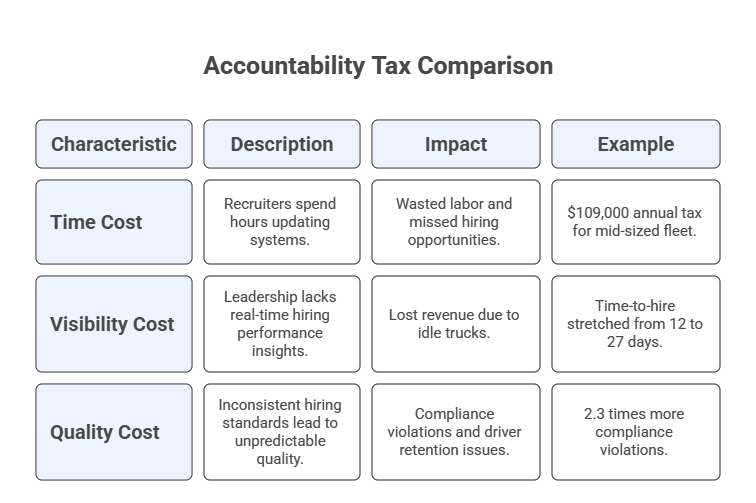
Disconnected systems don’t just hide responsibility. They create an accountability tax that fleets pay in three measurable ways.
Time cost: Recruiters spend 6 to 8 hours weekly just updating systems, chasing status updates, and reconciling conflicting data across tools. That’s 312 to 416 hours annually per recruiter. At an average recruiter salary of $55,000, that’s $8,580 to $11,440 in wasted labor per recruiter per year.
Here’s what the math looks like for different fleet sizes:
| Fleet Size | Recruiters | Annual Time Waste | Labor Cost Lost | Opportunity Cost (Hires Missed) |
| 25-50 trucks | 1 | 312-416 hours | $8,580-$11,440 | 4-6 drivers |
| 51-150 trucks | 2-3 | 624-1,248 hours | $17,160-$34,320 | 10-15 drivers |
| 150-500 trucks | 4-6 | 1,248-2,496 hours | $34,320-$68,640 | 20-30 drivers |
Visibility cost: Leadership can’t see hiring performance in real time. By the time someone pulls a report showing that time-to-hire stretched from 12 days to 27 days, the quarter is over and the damage is done. Each day a truck sits idle costs fleets $800 to $1,200 in lost revenue. When time-to-hire doubles, the revenue impact compounds fast.
Quality cost: When accountability is blurry, hiring standards get inconsistent. One recruiter shortcuts compliance checks to hit speed targets. Another overscreens candidates and creates bottlenecks. A third focuses entirely on volume metrics. The fleet ends up with unpredictable hiring quality because nobody is measuring the outcome that actually matters—drivers who stay.
According to FMCSA compliance data, fleets using manual document tracking systems have 2.3 times more compliance violations during audits compared to fleets with automated tracking. Each DOT violation can cost $1,000 to $16,000 in fines, plus the operational impact of pulling drivers off the road while issues get resolved.
Driver retention drops 40 to 50% when compliance documentation delays onboarding by more than two weeks. The driver finds another fleet that can get them working faster.
A 120-truck fleet calculated they spent $47,000 annually just on the labor cost of recruiter time lost to tool-switching and status updates. That’s before counting:
- $18,000 in duplicate job board subscriptions
- $32,000 in lost revenue from trucks idle an extra 8 days per hire
- $12,000 in compliance software that doesn’t integrate with their recruiting tools
Total accountability tax: $109,000 per year for a mid-sized fleet.
The Single Dashboard Problem
Most fleets try to solve accountability by adding another layer: a weekly hiring report. Someone manually pulls data from all the systems, drops it into a spreadsheet, and emails it to leadership.
This creates two new problems.
First, it’s backward-looking. By the time the report shows that five drivers stalled in document collection, those drivers have already moved on to other jobs. Accountability based on weekly reports is accountability without the ability to act.
Second, it still doesn’t answer the most basic question: who owns this specific outcome?
The report shows metrics. It doesn’t show responsibility. When hiring misses the target, leadership sees that applications dropped or time-to-hire increased. They don’t see which specific handoff failed, which recruiter owns the stalled candidates, or where process changes would actually move the number.
Accountability needs visibility in real time, not in retrospect.
How It Can Be Changed
Accountability only works when ownership is built into the system, not layered on top of it.
Uptime’s CDL Recruiting Department-in-a-Box solves this by making responsibility visible at every stage. The platform operates as a single system where every candidate interaction, document, and status change lives in one place. Recruiters, hiring managers, and leadership all see the same live data. There’s no reconciliation because there’s nothing to reconcile.
Ownership is assigned, not assumed. Each driver in the pipeline has a clear owner. Each stage has SLA tracking that shows exactly how long candidates spend in screening, compliance, or interview scheduling. When something stalls, the system surfaces it immediately with the name of the person responsible for moving it forward.
The analytics dashboard doesn’t just show hiring speed. It shows recruiter velocity, handoff delays, and outcome attribution. Leadership can see which recruiter closed which hire, how long each stage took, and where bottlenecks are forming before they compound.
Measurable Results from Fleets Using Uptime:
| Metric | Before Uptime | After 90 Days | Improvement |
| Time-to-Hire | 18-27 days | 7-12 days | 60% faster |
| Handoff Delays | 4-7 days avg | 1-2 days avg | 40% reduction |
| Tool-Switching Time | 8 hrs/week per recruiter | <1 hr/week | 87% reduction |
| Candidate Drop-Off | 35-40% | 15-20% | 50% improvement |
| Cost per Hire | $2,200-$2,800 | $1,400-$1,800 | 35% decrease |
| Compliance Violations | 3-5 per audit | 0-1 per audit | 80% reduction |
Fleets using Uptime reduced handoff delays by 40% within the first month. Not because recruiters started working harder, but because they could finally see where drivers were getting stuck and who needed to act.
The platform includes a dedicated Uptime recruiter operating inside the OS with measurable SLAs. Fleets don’t just get software. They get a recruiting department with clear accountability baked in—response time guarantees, weekly performance reports, and ROI tracking that shows exactly what the subscription delivers.
Real Fleet Example: 80-Truck Regional Carrier
Before Uptime:
- 5 different tools (Indeed, generic CRM, Excel, Gmail, Dropbox)
- 23-day average time-to-hire
- 38% candidate drop-off between application and offer
- 2 recruiters spending 15 hours/week on administrative tasks
- 7 compliance violations in last DOT audit
After 90 Days with Uptime:
- 1 unified platform
- 9-day average time-to-hire (61% improvement)
- 18% candidate drop-off (53% improvement)
- 2 hours/week on administrative tasks (87% reduction)
- 0 compliance violations in subsequent audit
- ROI: $67,000 saved in first year
The fleet’s director of operations described the shift this way: “We went from ‘I think someone followed up’ to ‘I can see exactly who followed up, when, and what happened next.’ That clarity alone cut our time-to-hire in half. More importantly, we stopped losing drivers to our own chaos.”
Accountability as a Feature
When recruiting runs on disconnected tools, accountability becomes an exercise in blame assignment after the fact. When it runs on a unified system, accountability becomes automatic.
What Accountability Actually Looks Like:
| What Most Fleets Track | What Actually Drives Accountability |
| Jobs posted | Time from post to first qualified applicant |
| Applications received | Conversion rate by source and recruiter |
| Interviews scheduled | Days from application to interview |
| Offers sent | Offer acceptance rate by recruiter |
| Documents requested | Document completion time and alerts |
| Weekly hiring totals | Daily pipeline velocity by stage |
The difference between “who dropped this?” and “the system shows exactly what happened” is the difference between reactive firefighting and proactive hiring management.
Fleets that figure this out stop losing drivers to tool sprawl. They start losing competitors to speed and consistency.
Calculate Your Accountability Tax
Most recruiting managers don’t realize how much they’re paying for disconnected systems until they see the numbers.
Here’s how to calculate your annual accountability tax:
- Recruiter Time Waste: Hours per week spent updating multiple systems × 52 weeks × hourly rate
- Example: 8 hrs/week × 52 weeks × $26.44/hr = $10,982 per recruiter
- Tool Redundancy: Total spent on job boards + CRM + compliance software + communication tools
- Typical range: $15,000-$35,000 annually for mid-sized fleets
- Idle Truck Cost: Average days to hire × number of hires × daily truck revenue loss
- Example: 20 days × 30 hires × $900/day = $540,000 in delayed revenue
- Compliance Risk: Previous audit violations × average fine amount
- Example: 4 violations × $3,500 avg = $14,000
Total Accountability Tax = Time Waste + Tool Costs + Idle Revenue + Compliance Risk
For a 100-truck fleet making 30 hires per year: $180,000 to $240,000 annually
That’s 2 to 3 times what a unified recruiting system costs.
See Where Your Accountability Is Breaking
Most recruiting managers don’t realize how much visibility they’ve lost until they see their workflow mapped in real time.
Common Questions About Recruiting Accountability:
How do you measure recruiter accountability in fleet hiring? Track specific metrics by recruiter: response time to applications (should be under 24 hours), candidate progression rate through each pipeline stage, time from first contact to interview (target: 3-5 days), offer acceptance rate, and ultimately hires per month. Unified systems make these metrics visible in real time instead of through weekly reports.
What causes most driver candidates to drop out of the hiring process? System handoffs account for 35 to 40% of candidate loss, followed by document collection delays (25-30%), unclear status updates (15-20%), and interview scheduling conflicts (10-15%). The common thread: lack of visibility into where candidates are stuck and who owns the next action.
How long should CDL driver hiring take from application to start date? Industry benchmark is 12 to 18 days for compliant hiring, including MVR checks, drug screening, and document verification. Fleets using unified systems average 7 to 12 days. Anything over 20 days indicates process breakdowns that are costing you qualified candidates.
What’s the ROI of switching from multiple recruiting tools to one platform? Fleets typically see 35 to 60% reduction in time-to-hire, 40 to 50% decrease in candidate drop-off, and 30 to 40% lower cost per hire. The average mid-sized fleet saves $67,000 to $109,000 annually through reduced tool costs, faster hiring, and fewer compliance violations.
Uptime’s free platform audit shows exactly where drivers are stalling in your current system, which handoffs are causing delays, and how much recruiter time you’re losing to tool-switching.
[Book Your Free Audit →]
Or start a 14-day free trial and see what hiring looks like when accountability is built into the platform instead of bolted on afterward.
[Start 14-Day Free Trial →]
Plans start at $499/month for fleets with 25-50 trucks. Every plan includes the OS, a dedicated recruiter, SLA tracking, and weekly performance reports. No commissions. No surprises.
Leave a Reply